

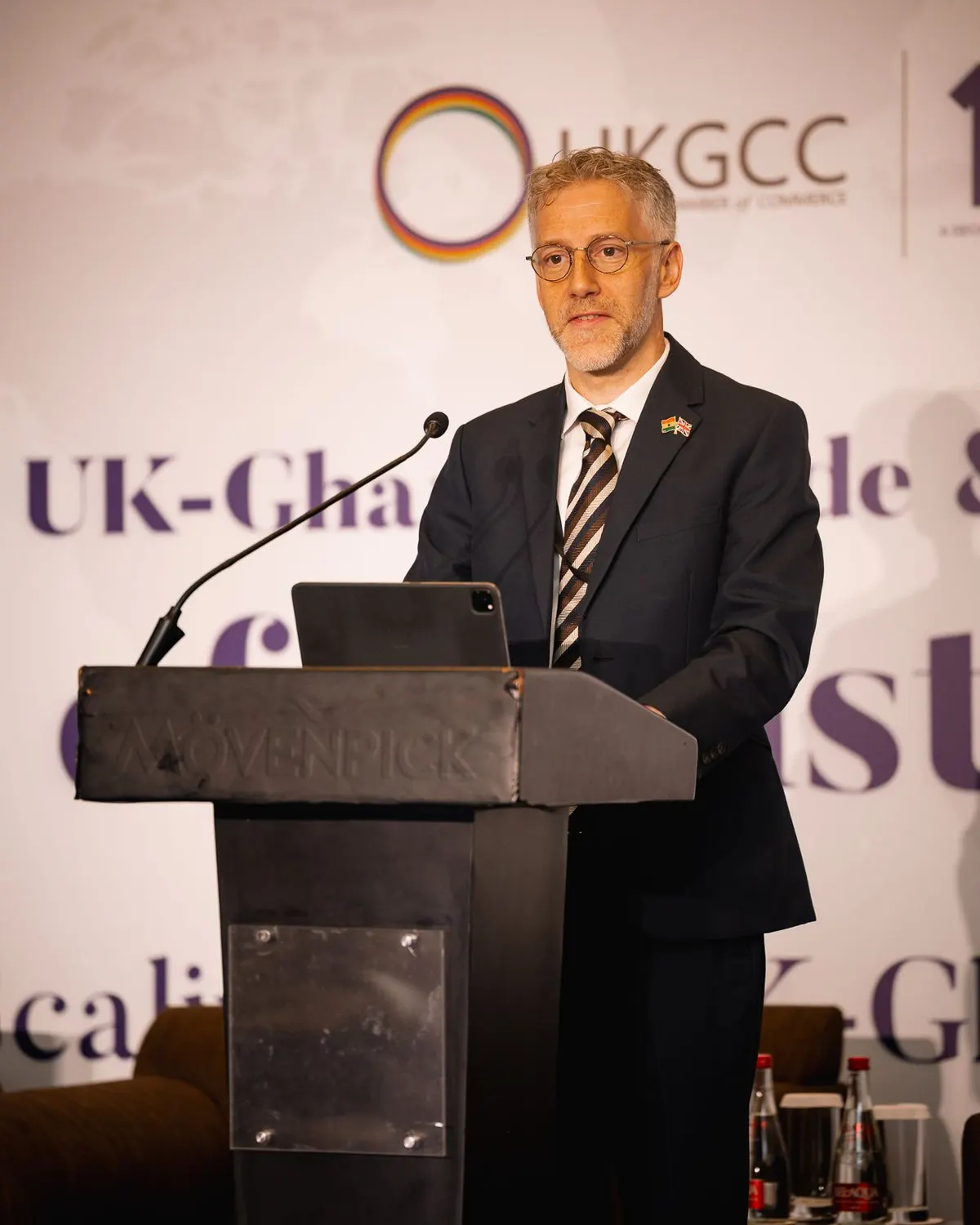
Trade between Ghana and the United Kingdom has surpassed £1.6 billion, with officials from both countries calling for stronger investment, expanded business partnerships and greater economic cooperation to ensure that the relationship delivers more jobs and sustainable growth. Corrections Policy
The development was highlighted at the UK–Ghana Trade and Investment Summit 2026, organised by the UK–Ghana Chamber of Commerce (UKGCC) under the theme “A Decade of Trust, A Future Always On: Scaling the UK–Ghana Growth Partnership.”
The event brought together government officials, business leaders, investors and development partners to explore opportunities for deepening commercial ties between the two countries.
His Majesty’s Trade Commissioner for Africa, Alastair Long, said the existing trade relationship provided a strong foundation for further growth but stressed that both countries needed to focus on turning commercial activity into tangible economic benefits.

Speaking during an interview at the summit, Long identified agriculture, technology, services and investment as areas with considerable potential for expansion.
He also pointed to Ghanaian agricultural products, including mangoes and bananas, which are increasingly reaching consumers in the British market.
According to a report, the trade commissioner emphasised that the success of the partnership should not be measured solely by the value of goods and services exchanged.
The jobs created, businesses supported and livelihoods improved through increased trade and investment would be equally important indicators of progress.
The call comes as Ghana seeks to strengthen its economic recovery, attract foreign capital and expand opportunities for locally owned businesses.
For the United Kingdom, deeper commercial engagement with Ghana offers opportunities to develop new markets, support investment and strengthen economic relationships across West Africa.
Growth partnership seeks practical economic results
A central feature of the renewed relationship is the UK–Ghana Growth Partnership covering 2026 to 2028.
The framework is intended to support private-sector-led growth, improve trade opportunities, encourage investment and strengthen cooperation in infrastructure, industry, skills and education.
The UK government announced the partnership in June 2026, building on existing trade arrangements and previous investment commitments.
It is designed to help businesses in both countries access opportunities while encouraging investment that can produce lasting economic benefits.
Deputy Minister for Trade, Agribusiness and Industry Sampson Ahi, who delivered a keynote address on behalf of Vice President Professor Jane Naana Opoku-Agyemang, described the summit as an opportunity to translate years of cooperation into practical investment outcomes.

Ahi cited Ghana’s economic performance, noting that the country recorded growth of 6 per cent in 2025 and expanded by 6.4 per cent in the first quarter of 2026. Editorial Ethics & Independence
He said these indicators demonstrated the opportunities available to investors seeking to participate in Ghana’s developing economy.
He also highlighted the scale of British investment in Ghana, stating that UK foreign direct investment had reached £1.8 billion, supporting more than 670 projects and creating over 44,000 jobs, according to figures presented at the summit.
The deputy minister encouraged investors to explore opportunities in manufacturing, logistics, agro-processing, healthcare and the digital economy.
These sectors could help Ghana increase domestic production, develop new industries and create employment beyond traditional commodity exports.
Agriculture and value addition offer opportunities
Agriculture remains an important part of Ghana–UK trade, particularly as Ghanaian producers seek to expand exports and reach more international consumers.
Products such as mangoes and bananas demonstrate the potential for local agricultural businesses to increase their presence in overseas markets.
However, expanding agricultural exports requires investment in processing facilities, storage, packaging, transport and compliance with international quality standards.
Improvements in these areas could help Ghanaian businesses reduce post-harvest losses, improve competitiveness and retain more value from their products.
Ghana’s High Commissioner to the United Kingdom and the Republic of Ireland, Sabah Zita Benson, called for a stronger partnership focused on industrialisation, value addition, technology transfer, skills development and job creation.

She also highlighted Ghana’s strategic position in West Africa and its role as host of the African Continental Free Trade Area Secretariat.
These advantages could provide UK businesses with opportunities to establish operations in Ghana and explore wider African markets.
Benson encouraged stronger business-to-business relationships and greater support for small and medium-sized enterprises. Editorial Standards
She also called on members of the Ghanaian diaspora in the UK to use their expertise, professional networks and investment capacity to support economic development in Ghana.
Chamber seeks stronger links between businesses
The UK–Ghana Chamber of Commerce, which is celebrating its tenth anniversary, has positioned the summit as a platform for building stronger commercial relationships and helping businesses identify practical investment opportunities.
Its Executive Director, Adjoba Kyiamah, said Ghanaian companies should also benefit from the relationship by using the UK to access financing, expertise, international markets and global business networks.

The three-day summit brought together stakeholders through policy discussions, business networking and investment-focused engagements intended to connect potential partners and support commercially viable projects.
For Ghanaian businesses, stronger links with UK companies could provide access to new technologies, improved production methods, technical expertise and international distribution channels.
Such partnerships could also help local companies strengthen their capacity to compete beyond the domestic market.
Nevertheless, converting these opportunities into measurable gains will require effective implementation of agreements, predictable business regulations, access to finance and sustained cooperation between public institutions and private companies.
Jobs and sustainable growth remain the key measures
Although bilateral trade exceeding £1.6 billion represents a significant economic relationship, the challenge for both countries is ensuring that future growth produces benefits that extend beyond headline figures.
For Ghana, this means encouraging investment that creates decent jobs, strengthens local supply chains, expands exports and develops the skills of the workforce.
For British businesses, it means building commercially sustainable partnerships that offer long-term value. Privacy Policy & Terms
The summit has reinforced the importance of moving from diplomatic commitments towards practical projects that generate measurable outcomes.
As the 2026–2028 Growth Partnership progresses, attention will turn to the investments secured, businesses supported and employment opportunities created.
Ultimately, the future of UK–Ghana trade will depend not only on how much the two countries exchange but also on how effectively their economic relationship supports industrial development, innovation and shared prosperity.