

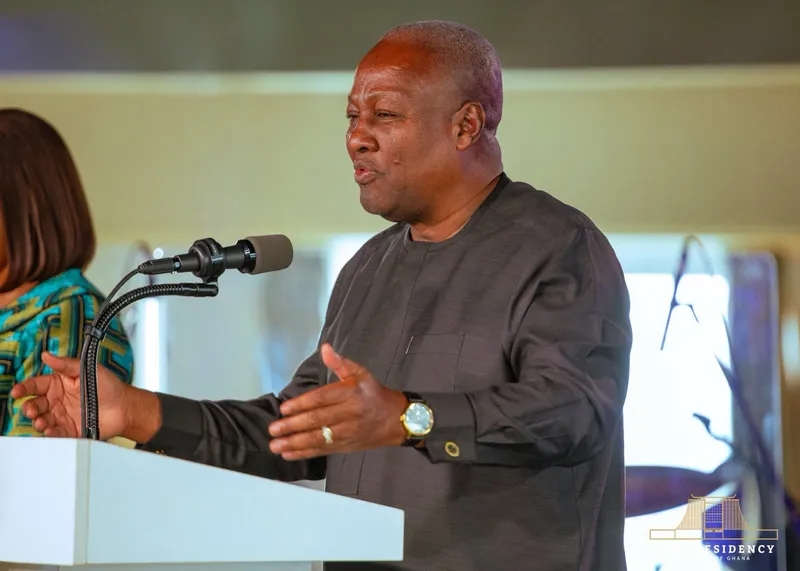
President John Dramani Mahama has cut the sod for the construction of the Afienya Industrial Park in the Greater Accra Region, marking a significant step in the government’s efforts to expand manufacturing, attract investment and create employment opportunities for Ghanaians.
The 1,238-acre industrial development is expected to accommodate more than 120 enterprises and provide the infrastructure businesses need to establish factories, increase production and access domestic and international markets. Newscard
The project is also intended to strengthen Ghana’s position as a manufacturing and logistics hub in West Africa.
According to reports, President Mahama performed the sod-cutting ceremony on Thursday, October 15, 2026. The initiative responds to growing investor interest in Ghana, particularly following the exhaustion of available space at the Tema Export Processing Zone.
The President said the country must ensure that increasing investor interest translates into actual factories, employment and higher export volumes.
The new industrial park is expected to provide businesses with serviced land and essential facilities, helping reduce some of the difficulties associated with setting up manufacturing operations.
The proposed infrastructure includes electricity, water, road networks, drainage and waste treatment facilities. These services are intended to make it easier for companies to establish operations and begin production without having to independently develop all the essential utilities required for their businesses.
The availability of reliable infrastructure is particularly important for manufacturers, whose operations often depend on consistent power, efficient transportation and appropriate waste-management systems.
By developing these facilities within a dedicated industrial zone, the government hopes to improve the investment environment and encourage more businesses to establish operations in Ghana.
A major component of the project’s financing is expected to come through the government’s proposed $10 billion New Economy Programme, which is intended to support productive sectors and infrastructure development.
According to report, the programme is expected to invest $2 billion annually over four years, with half of the planned investment directed towards agriculture and agro-processing, while the remainder would support industry and infrastructure connecting producers to markets.

The government has indicated that the full framework of the programme will be presented to Parliament in the 2027 Budget. Its proposed support for Afienya is expected to help provide the facilities needed to attract and sustain industrial investment.
The park’s location also offers potential logistical advantages. It is situated near the Tema Harbour and has access to the Tema-Mpakadan standard-gauge railway corridor, which could support the movement of raw materials and finished goods.
These connections may help businesses transport products to local markets and export destinations more efficiently. Editorial Ethics & Independence
The Ghana Free Zones Authority has identified the Afienya development as a new addition to Ghana’s industrial zones. Its location, approximately 20 kilometres from Tema Harbour and 35 kilometres from Accra International Airport, could make it attractive to companies involved in manufacturing, distribution and international trade.
Potential investment areas include agro-processing, textiles and garments, pharmaceuticals, medical consumables, automotive components, assembly and light engineering.
Opportunities may also emerge in logistics, data services, business process outsourcing, renewable energy and other forms of green manufacturing.
Beyond attracting large companies, the project is expected to create opportunities for small businesses and communities around Afienya.
Local farmers could supply agricultural produce to processing companies, while transport operators, service providers and other suppliers could benefit from increased commercial activity.
President Mahama has stressed the importance of ensuring that people living near the industrial park are prepared to benefit from the jobs it generates.

This makes skills development, technical training and local recruitment important considerations as the project progresses.
However, the park’s long-term impact will depend on implementation. The provision of infrastructure must be followed by actual business investment, factory construction, production and sustained employment. Editorial Standards
Transparent land administration, efficient utilities and a reliable business environment will also be important in maintaining investor confidence.
For Ghana, the Afienya Industrial Park represents an opportunity to move beyond exporting raw materials towards producing more finished goods locally. If successfully developed, it could strengthen domestic supply chains, increase export earnings and create employment for young people.
The ultimate measure of success will be the number of businesses that become operational, the quality of jobs created and the extent to which Ghanaian products reach markets across Africa and beyond.