

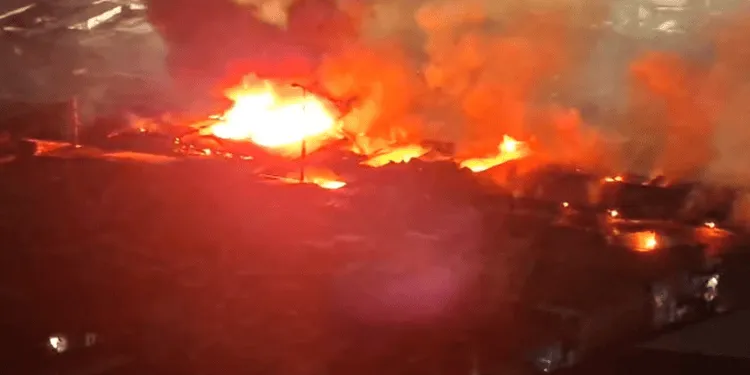
Parts of the Kumasi Central Market in the Ashanti Region have been hit by a fire outbreak, triggering an emergency response from the Ghana National Fire Service (GNFS) and raising fresh concerns about fire safety in one of Ghana’s busiest commercial centres. Editorial Standards
The fire broke out on the night of Friday, October 9, 2026, near Aboabo Station, where firefighters rushed to the scene to battle the flames and prevent the blaze from spreading to other sections of the market.
The full extent of the damage remained unclear at the time of reporting.
The incident has renewed concerns about the vulnerability of traders whose livelihoods depend on daily commercial activities in the market.
For many shop owners and retailers, merchandise represents years of investment, borrowed capital and income needed to support their families.
Although details about the number of shops affected and the value of goods destroyed were not immediately available, the outbreak has once again drawn attention to the financial consequences that market fires can have on traders and the wider local economy.
The cause of the fire had not been established at the time of publication. Authorities were expected to provide further details as emergency operations and investigations progressed.
There was also no confirmed information on casualties or injuries linked to the incident.

The latest outbreak was the second fire incident recorded in the Kumasi metropolis within approximately three hours.
It followed a separate blaze at a mattress factory in Sokoban-Ampayoo, also in the Ashanti Region. However, no immediate evidence indicated that the two incidents were connected. Newscard
The proximity of the two incidents has heightened attention on fire prevention and emergency preparedness across commercial and industrial areas in Kumasi.
Fires in locations where goods, equipment and other combustible materials are stored can spread rapidly, potentially putting nearby businesses and people at risk.
The Ghana National Fire Service responded to the market incident, with personnel working to bring the blaze under control.
The speed and effectiveness of such responses are particularly important in densely populated commercial areas, where closely arranged shops can allow flames to move from one structure to another.
The Kumasi Central Market has experienced several fire outbreaks over the years, making fire prevention a recurring concern for traders, city authorities and emergency responders.
In December 2023, the Ghana News Agency reported that limited access routes and congestion within parts of the market made firefighting difficult during an earlier blaze at the French-Line section.
Deputy Ashanti Regional Fire Commander Rashid Nisawu said the arrangement of shops and trading structures contributed to the challenges faced by firefighters.
Such challenges highlight the importance of maintaining accessible emergency routes, ensuring that fire service vehicles can reach affected areas and preventing trading activities from obstructing access points.

Electrical safety is another important consideration in busy markets. Faulty wiring, overloaded electrical connections and poorly maintained equipment can increase fire risks where preventive inspections are inadequate. Editorial Ethics & Independence
Cooking equipment and the storage of flammable materials can also create hazards if handled without appropriate precautions.
These are general risks associated with crowded commercial environments; the cause of the October 9 outbreak at Kumasi Central Market has not yet been confirmed.
To reduce future incidents, traders can help by ensuring that electrical installations are checked by qualified professionals, avoiding overloaded sockets, switching off unnecessary electrical equipment and keeping combustible materials away from potential ignition sources.
Fire extinguishers should also be accessible, maintained and used only by people who know how to operate them safely.
Market authorities and local government officials have a complementary responsibility to support regular safety inspections, improve access routes and ensure that emergency procedures are understood by traders.
Equally important is the need for coordinated emergency planning. Clearly marked exits, accessible firefighting equipment and effective communication between market leaders and the GNFS can help reduce confusion when an outbreak occurs.
The economic consequences of market fires often extend beyond the immediate destruction of goods.
Traders may lose their working capital, struggle to repay suppliers and face difficulties reopening their businesses. Workers who depend on those shops for their income can also be affected.
Where substantial losses are confirmed, a transparent assessment of the damage would help authorities determine the scale of the impact and identify whether affected traders require assistance.
Any support programme should be guided by verified information about the victims and the losses they suffered.
The latest incident also comes as attention remains on the redevelopment of Kumasi’s central market. Corrections Policy

The Ghana News Agency reported on October 5 that the government expected contractors to resume work on the second phase of the Kumasi Market Project, which had stalled for about two years. The project is intended to improve facilities and commercial activity in the area.
Modern market infrastructure can create opportunities to improve safety, but construction alone will not eliminate fire risks.
Effective maintenance, responsible use of facilities, regular inspections and cooperation between traders and authorities will remain essential.
For now, the immediate priority is to establish the cause of the latest outbreak, determine the extent of the damage and confirm whether any people were injured.
Until authorities release verified findings, claims about the origin of the fire or the scale of losses should be treated cautiously.
The fire at Kumasi Central Market serves as another reminder that protecting commercial centres requires sustained attention to prevention as well as emergency response.
For traders whose livelihoods depend on the market, stronger safety measures could help protect their goods, businesses and the economic activity that supports thousands of people in Kumasi.