

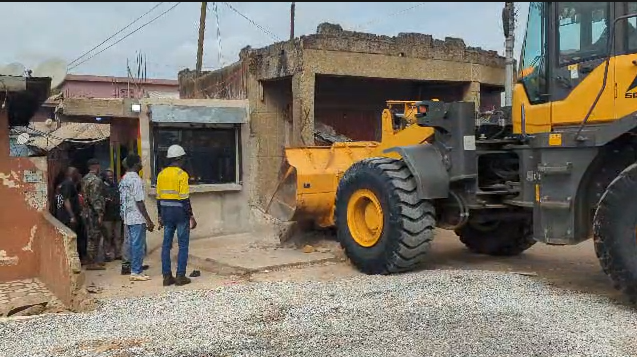
Demolition and enforcement operations have begun at Abrepo Junction in Kumasi, Ashanti Region, as authorities clear structures and businesses located within the designated corridor for Phase One of the Suame Interchange Project.
The exercise, which began on Thursday, October 8, 2026, is being undertaken by the Kumasi Metropolitan Assembly (KMA) to make way for road expansion and other construction activities associated with the major transport infrastructure project. Editorial Standards
The development marks a significant step toward the commencement of intensive works on the Abrepo section of the project, which is expected to transform one of Kumasi’s busiest traffic corridors and improve movement between several parts of the metropolis.
The demolition follows a final notice issued by the KMA to traders, garage operators, businesses and other occupants within the affected areas.

The Assembly had directed those occupying the designated project corridor to voluntarily relocate and remove their belongings before the enforcement deadline.
According to the KMA, occupants were given until October 4, 2026, to vacate the area. The Assembly subsequently indicated that a designated demolition and enforcement team would begin removing unauthorised structures, goods, equipment, building materials and other items left behind from October 8.
The authorities said the notice was part of preparations for Phase One of the Suame Interchange Project and followed earlier engagements with affected stakeholders.
However, the commencement of the demolition has not been without tension.
Reports from the scene indicate that some affected traders resisted the exercise and clashed with security personnel deployed to maintain order.

The disagreement reportedly centred partly on a GH¢200 payment that some traders said they had made in connection with their relocation.
The affected traders are demanding the return of the money, alleging that it was collected to facilitate their movement but that they have not received an explanation about how the funds were handled.
Attempts to obtain an immediate response from the local authority regarding the traders’ allegation were reportedly unsuccessful. The claim should therefore be treated as an allegation pending a response or clarification from the KMA or any other responsible authority.
The dispute highlights one of the challenges that can accompany large-scale urban infrastructure projects, particularly when construction requires businesses and informal economic activities to move from established locations. Editorial Ethics & Independence
Abrepo Junction has long served as an important commercial and transportation point in Kumasi, meaning that relocation can have direct implications for traders, mechanics, businesses, motorists and other people whose livelihoods or daily activities depend on the area.
Despite these concerns, the authorities have maintained that clearing the project corridor is necessary for construction to proceed.
The KMA previously advised affected traders seeking alternative trading locations to consider the Racecourse Market.
Garage operators were also directed to contact the Works Engineer at the market for assistance in identifying suitable relocation spaces.
The demolition is linked to the first phase of the Suame Interchange Project, which has been designed to address persistent congestion and improve the road network in the Kumasi metropolitan area.

Phase One is expected to include a major three-tier interchange at Suame, overpasses at Abrepo and Krofrom junctions and the widening of sections of the Eastern and Western Bypass Roads.
At Abrepo Junction specifically, the project includes grade separation intended to reduce conflicts between different traffic movements.
Earlier project information indicated that an underpass would be developed to allow some traffic movements to pass below the junction while other vehicles use the upper road level.
The proposed arrangement is expected to improve traffic flow at a location that regularly experiences congestion, particularly during busy periods.
The Department of Urban Roads has previously explained that the road between Suame Roundabout and Abrepo Junction would be widened to increase vehicle capacity.
The Abrepo component is intended to provide a more efficient movement pattern by separating traffic flows.
The project is being implemented in phases partly to provide alternative routes for motorists during the major construction activities.
Phase Two, which covers approximately 15 kilometres of local roads within the project’s area of influence, includes overpasses at Anomangye, New Road and Ebusuakruwa. Corrections Policy
Authorities have indicated that completing these supporting roads will provide alternative routes when construction on the main interchange intensifies.
As of late September, however, Phase One itself was still at an early stage.
Roads and Highways Minister Governs Kwame Agbodza, during an inspection on September 30, said the main interchange component was approximately five percent complete and urged the contractor and stakeholders to accelerate construction.

He expressed concern that the existing 2028 completion target was too far away and called for a crash programme to speed up the work.
The current demolition exercise is therefore an important enabling step because construction cannot proceed effectively where structures and commercial activities remain within the project’s right of way.
Utility relocation is also expected to form part of the preparatory works. The KMA has identified Ghana Water Company Limited pipelines and Electricity Company of Ghana infrastructure among the utilities that will need to be relocated or addressed before construction progresses.
Traffic management preparations will also be necessary as the project begins to affect existing routes and movement patterns.
For motorists, the construction period could bring temporary inconvenience, including diversions, congestion and changes in access to businesses around the affected corridor.
However, authorities expect the completed project to deliver longer-term improvements in traffic circulation and transportation within Kumasi.
The challenge for authorities will be to balance the urgency of infrastructure development with the concerns of people whose businesses and livelihoods are affected by the construction.
Clear communication, transparent relocation arrangements and proper engagement with affected occupants will therefore remain important throughout the project.
Where compensation or reinstatement is applicable, earlier project consultations have indicated that assessments would be undertaken for eligible property owners.
Persons who have encroached on government land, however, may not qualify for compensation under the stated arrangements.
The Abrepo demolition also demonstrates the transition from planning and preparatory activities to visible construction on the ground.

After several rounds of stakeholder engagement and relocation notices, authorities are now physically clearing the corridor required for the project.
For Kumasi, the stakes are significant. The metropolis is one of Ghana’s busiest commercial centres, and traffic congestion has long affected commuting, freight movement and business activity.
A successful Suame Interchange Project could therefore have implications beyond the immediate junctions. Better traffic flow could reduce travel delays, improve connectivity and make movement across key sections of the city more efficient.
At the same time, the concerns raised by affected traders show that infrastructure development carries immediate social and economic costs that authorities must manage responsibly.
As demolition continues, attention will remain on how the KMA and project managers handle relocation issues, maintain order and minimise disruption while ensuring that construction progresses.
The Suame Interchange is ultimately intended to provide a long-term solution to congestion in one of Kumasi’s most heavily used corridors.
The demolition at Abrepo Junction signals that the project has entered another critical stage, but its success will depend not only on the physical construction but also on effective coordination among government agencies, contractors, businesses, residents and other affected stakeholders. Newscard

With the project corridor now being cleared, the next priority will be to complete the necessary utility relocations, traffic arrangements and other enabling works so that construction can advance without unnecessary delays.