

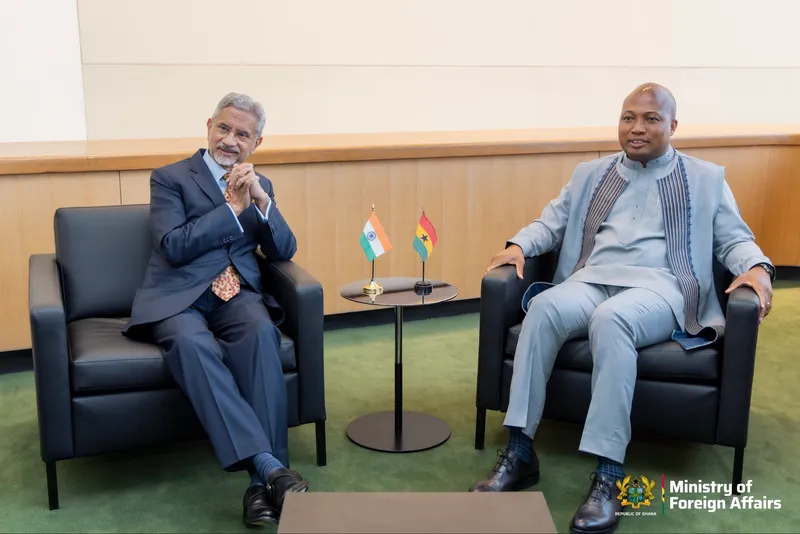
Ghana and India are poised to strengthen their longstanding bilateral relationship, with pharmaceutical development emerging as one of the key areas of cooperation, Foreign Affairs Minister Samuel Okudzeto Ablakwa has announced. Corrections Policy
Mr Ablakwa said the two countries have an opportunity to deepen collaboration in pharmaceuticals as part of the government’s broader effort to promote industrialisation, strengthen healthcare systems and create economic opportunities.
The announcement follows the minister’s engagement with India’s External Affairs Minister, Dr Subrahmanyam Jaishankar, on the sidelines of the United Nations General Assembly.
Mr Ablakwa said Dr Jaishankar is expected to visit Ghana during the week of October 5, 2026, describing the visit as historic.
According to a source, Mr Ablakwa said the upcoming engagement would provide an opportunity for Ghana and India to advance their relationship in pharmaceutical development within the framework of President John Dramani Mahama’s “Accra Reset” philosophy.
He also identified agriculture, information and communication technology, scholarships and industrial development as other areas in which the two countries could expand cooperation.
“Ghana and India value our inseparable bond of solidarity and shared values,” Mr Ablakwa said in a post following his engagement with Dr Jaishankar.
The pharmaceutical sector is particularly significant for Ghana as the country seeks to strengthen domestic production and improve access to medicines. Newscard
Greater cooperation with India could create opportunities for investment, technical knowledge, skills development and technology transfer, although the precise projects to emerge from the proposed engagement will depend on discussions between the two governments and relevant private-sector institutions.
Ghana and India have already identified pharmaceuticals as a strategic area for closer collaboration.
In July, Mr Ablakwa reaffirmed Ghana’s commitment to strengthening cooperation with India when he received the Open Letters of India’s High Commissioner-designate to Ghana, Surinder Bhagat, at the Ministry of Foreign Affairs in Accra.
At that engagement, the minister highlighted agriculture, pharmaceuticals and ICT, particularly robotics and artificial intelligence, as priority areas for bilateral cooperation.
The Ministry of Foreign Affairs said stronger collaboration in these sectors could promote innovation, technological advancement, skills development and sustainable economic growth.

The pharmaceutical focus also fits into Ghana’s wider ambitions to expand domestic manufacturing and reduce vulnerabilities associated with dependence on imported products.
A stronger local pharmaceutical industry could potentially support employment, strengthen supply chains and create opportunities for Ghanaian companies to participate in regional markets.
India, meanwhile, has extensive experience across pharmaceutical manufacturing and healthcare-related industries. Editorial Ethics & Independence
Cooperation could therefore involve knowledge exchange and partnerships, but any expansion of pharmaceutical production in Ghana would also require strong regulatory oversight, quality assurance, investment and compliance with established health and manufacturing standards.
The relationship between the two countries extends beyond conventional trade and diplomacy. In February 2026, the Indian High Commissioner to Ghana inaugurated the country’s first modern Ayurvedic clinic at AIMS Hospital in Tesano, Accra.
The development was described as another step in Ghana-India cooperation in traditional and integrative medicine.
Agriculture is another major component of the renewed partnership.
Mr Ablakwa said Ghana and India were looking to deepen cooperation in agricultural mechanisation and value addition.
Such collaboration could support efforts to improve productivity while encouraging processing and manufacturing activities that retain more value within Ghana.
The minister also pointed to scholarships and IT partnerships as areas for expansion.
Greater educational and technological cooperation could help Ghanaian students and professionals gain access to specialised training while creating opportunities for knowledge transfer between institutions in both countries.
The proposed visit by Dr Jaishankar therefore comes at a time when Ghana is seeking to broaden international partnerships around sectors considered important to its economic transformation agenda.
For Ghana, the potential benefits of deeper cooperation will ultimately depend on the ability to convert diplomatic commitments into practical investments, training programmes, manufacturing partnerships and measurable economic outcomes.
The pharmaceutical sector could be one of the most important areas to watch.
If Ghana and India are able to establish sustainable partnerships involving manufacturing, research, technology and skills development, the cooperation could contribute to strengthening Ghana’s healthcare supply chain while supporting local industrial growth. Editorial Standards
Mr Ablakwa’s comments indicate that the government sees the Ghana-India relationship as extending beyond traditional diplomatic ties.

Instead, the partnership is being positioned around sectors that could contribute directly to healthcare, agriculture, technology, industrialisation and employment.
With Dr Jaishankar’s expected to visit Ghana, attention will now turn to the specific agreements and initiatives that may emerge from the engagement and whether the renewed diplomatic momentum can translate into long-term economic and development benefits for both countries.