

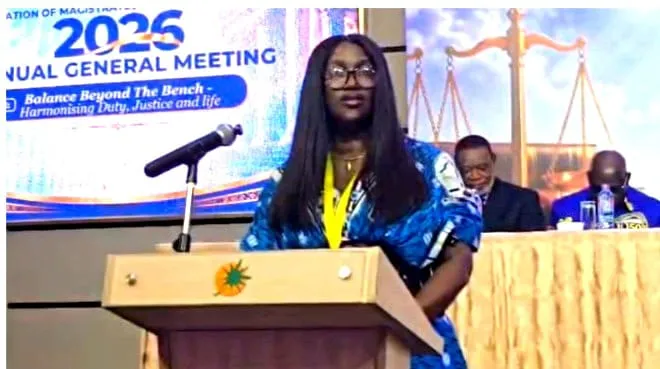
The President of the Association of Magistrates and Judges of Ghana (AMJG), Justice Olivia Obeng Owusu, has called for improved working conditions, adequate resources and stronger security measures for judicial officers to enable them to discharge their responsibilities effectively.
She said addressing the welfare and safety concerns of judges and magistrates was essential to maintaining an effective justice delivery system, particularly as judicial officers continue to manage heavy caseloads under challenging working conditions. Editorial Ethics & Independence
Justice Obeng Owusu made the call on Wednesday, September 30, 2026, at the AMJG conference in Accra, held under the theme, “Balance Beyond the Bench: Harmonising Duty, Justice and Life.”
According to a report by Insightghana, the AMJG President said the demands of judicial work made it difficult for members of the Bench to maintain a healthy balance between their professional responsibilities and personal lives without improvements in their working environment.
She observed that although the public often focuses on the final judgments delivered by courts, less attention is paid to the pressures, resource limitations and personal sacrifices involved in reaching those decisions.
“Magistrates and judges discharge their duties with distinction under difficult circumstances, driven by a deep commitment to justice and service to the nation,” she said.
Judges Face Resource and Welfare Challenges
Justice Obeng Owusu identified several challenges affecting judicial officers, including inadequate official vehicles, deteriorating accommodation facilities and delays in the payment of allowances.
She also raised concerns about the absence of financial clearance to enable some magistrates and judges to engage supporting staff, despite such assistance being provided for under their conditions of service.
These difficulties, she explained, add to the burden on judicial officers who must manage demanding caseloads while ensuring that cases are handled fairly and efficiently. Corrections Policy
The shortage of essential resources can have practical consequences for court operations. Inadequate transportation, for example, may complicate official travel and the performance of duties outside a judge’s regular station.
Delays in allowances and the lack of supporting personnel can also place additional pressure on judicial officers.
The AMJG President consequently appealed for an expedited review of the salaries and conditions of service of judges on the lower bench.
The call highlights the importance of addressing the needs of circuit and district court judges and magistrates, who play a significant role in resolving disputes and handling criminal and civil cases at the local level.
Improving their working conditions could help strengthen the efficiency of court operations, although the overall impact would also depend on staffing, infrastructure, case management and the availability of other essential resources.
Concerns Over Attacks on Judges
Beyond welfare issues, Justice Obeng Owusu expressed concern about attacks on judicial officers, particularly those directed at them through social media.

She noted that court decisions are frequently circulated online, sometimes followed by attacks on the integrity of judges and, in certain instances, their families.
The AMJG President acknowledged that criticism of judicial decisions is legitimate in a democratic society. However, she distinguished constructive criticism from personal attacks, intimidation and physical threats against judicial officers.
Such conduct, she warned, could undermine public confidence in the justice system and threaten judicial independence. Editorial Standards
The distinction is important because courts must be able to make decisions based on the law and evidence presented before them.
While members of the public can question judgments through lawful and appropriate channels, threats and intimidation raise separate concerns about the safety of judicial officers and the administration of justice.
Justice Obeng Owusu also commended the Chief Justice for his prompt intervention following an attack on the Kwame Danso District Court.
She said the response demonstrated a commitment to protecting judicial officers and court staff.
The Association is calling for stronger security arrangements to protect magistrates and judges from threats and attacks, both within court premises and in the course of their duties.
Call for Judicial Wellness Support
The AMJG President further called for the establishment of structures to promote the physical and general wellbeing of judicial officers.
Her remarks placed judicial wellness alongside security, remuneration and access to resources as important considerations in improving the working lives of judges and magistrates.
Judicial responsibilities often involve sustained concentration, complex legal analysis and decisions that can significantly affect the lives, rights and property of individuals. Privacy Policy & Terms
Providing appropriate support could help judicial officers manage these demands while maintaining professional standards.
The Association’s conference theme also reflected the need to consider the relationship between professional obligations and personal wellbeing.
Retiring Judicial Officers Recognised
During the conference, Justice Obeng Owusu recognised judicial officers who had retired or were due to retire after years of service to the Judicial Service and Ghana.
Those mentioned included Supreme Court Justice Philip Bright Mensah, High Court Justice Amos Wuntah Wuni, and several Circuit and District Court judges.
She expressed gratitude for their contributions to the judiciary and wished them good health, peace and fulfilment in retirement.
The conference also provided an opportunity to acknowledge the contributions of the AMJG’s National Executive Committee, National Board, Judicial Secretary Musah Ahmed, his deputy and various committees. Newscard
The Association’s demands ultimately centre on ensuring that judicial officers have the working conditions, resources and security required to perform their duties without undue pressure or intimidation.
As the AMJG continues to raise these concerns, attention will turn to how the relevant authorities respond to calls for improved conditions of service, stronger court security and practical support for judicial wellness.
Addressing these issues will remain important to the effective administration of justice and the protection of judicial independence in Ghana.