

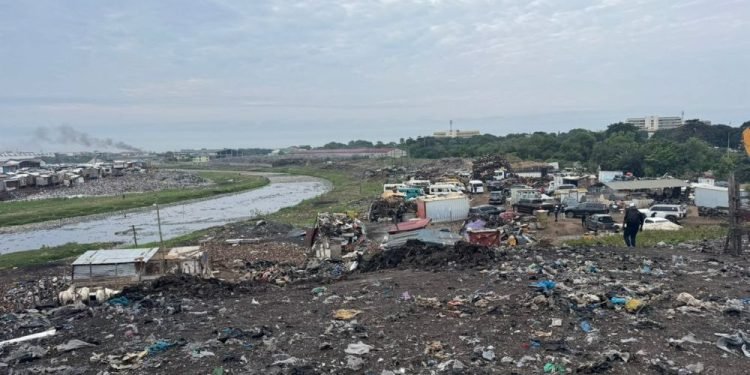
The Minister for Local Government, Chieftaincy and Religious Affairs, Mahama Ayariga, has proposed the development of the Korle Lagoon slum in Accra into container housing, which will consist of high-rise apartments. Editorial Standards
The proposed redevelopment is part of government’s measures to address the environmental and sanitation problems associated with the Korle Lagoon area, one of the heavily impacted neighborhoods in Accra.
As the minister explained, once the pile-up of rubbish has been cleared by a military-led evacuation and clearance operation, the change will take place.It is anticipated that the wastes arising from the exercise will be transported to the Adepa Waste Management Centre situated at Nsawam, for proper disposition.
According to the authorities, the plan for the redevelopment encompasses also dredging of the Korle Lagoon-a move regarded by them as a positive step in the process of solving the area’s environmental issues.
Ayariga told a journalist while inspecting the site that the government is committed to cleaning the lagoon even though the task might not be easy due to the opposition from certain residents.
He was confident that the general public would be in favour of the clearing exercise because the reason for it was to restore sanitation and safeguard public health.” Those of us that are in Accra in a position to clear it, there are so many of us than those who are want to oppose clearing the mess,” he added.
The announcement by the minister is taking place amidst the increasing discussions of sanitation, waste management and congestion problems in the city of Accra.
The Korle Lagoon has been susceptible to environmental stresses such as sediments, the effects of human activities, as well as poor sanitation systems. Corrections Policy

The condition of its surroundings has been linked with flood problems, water pollution and health disturbances.Proposed development-replacement of the existing settlement by a more formalised housing system based on high rise structures built of converted shipping containers.
This idea is designed to accommodate travelers in a different way than the traditional hotel and to make better use of scarce land in a city.
In a high-rise container housing situation it would also be possible for authorities to pack in more people in a smaller space than is currently possible with the low rise and informal housing.
Nevertheless, the impact of the redevelopment will not only hinge on the new housing built but on how the government can manage the transition of the current residents working and living in the area.
The evacuation might have some impacts on livelihood-economy-based people who work on the settlement, like informal workers and small enterprises.
Therefore, communication and engaging directly with affected communities is crucial to the redevelopment process.
Authorities will have to make sure that the proposed housing is well equipped with all the necessary services like water, sanitation, electricity, drainage, waste collection and access roads.
Building on new structures alone cannot address the entire sanitation and environmental problems if there is not an appropriate supporting infrastructure. Newscard
Based on the proposed dredging of the Korle Lagoon as outlined above it, therefore, expected to be a significant part of the general intervention.
Dredging to remove sediment build-up and waste discharge may remove some of the pressures on the lagoon and waster flowing into the reef system.
This waste removal task will also be very important as whether the environmental intervention is a success or not will depend on whether the waste is re-located into the site or not.Government’s proposal to move the waste to the Adepa Waste Management Centre at Nsawam suggests that government will by all means combine the clearing exercise with a more refined waste disposal system.

The initiative is part of the wider movement to improve sanitation in Ghana’s larger cities where rapid growth and expanding slum areas have overwhelmed servicesThe Korle Lagoon has great environmental and drainage functions for Accra.
Its condition has effects not only on the adjacent lands, but also on even farther lands in times of heavy rain, as clogged or sluggish streams can contribute to an increased risk of flooding.
Such a successfull redevelopment could also have wider benefits for residents and the city. If these improvements are implemented together through environmental management, housing and drainage, then the wider benefits are likely to be of greater significance.
At the same time, the government is expected to come under criticism regarding the cost,configuration,ownership structure, and the future maintenance of the high-rise container housing facility.
Questions relating to who will be eligible for housing, how much residents will contribute and how displaced families will be assisted are also likely to be significant issues as the project develops.
It will be imperative for the authorities to clearly communicate on these matters to instil confidence among the residents affected, as well as the general public.
For the time being, Ayariga’s declaration brings an end to the government’s settlement reintegration initiative in the Korle Lagoon. It opens a new chapter of working toward redevelopment of the settlement rather than short-term sanitation interventions.
The utmost concern is still to clear the dumpsite, evacuate the surrounding areas and clear the deposited waste.Once those activities are carried out, the said housing redevelopment and dredging could start to transform the surrounding landscape of the lagoon.
With good management the project could result in the provision of better quality housing, better sanitation as well as rehabilitating the environment of the Korle Lagoon.In the end, it will be its continued maintenance, waste disposal, and real community participation in the redevelopment that will determine its long-term effectiveness.
This intervention in the subject’s image thus represents both a unique chance at major urban regeneration in the subject and a thorny social dilemma that will need careful implementation, reporting and cooperation of the concerned bodies.