


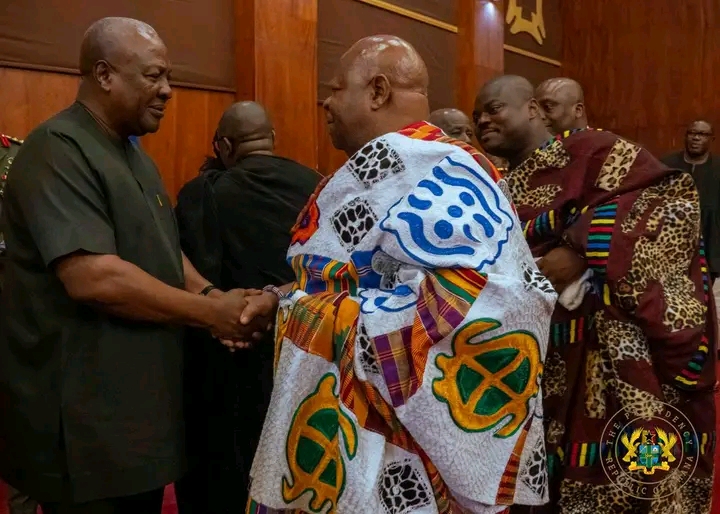
President John Dramani Mahama has reaffirmed his administration’s commitment to equitable national development following a high level engagement with the Eastern Regional House of Chiefs, as government seeks to balance economic recovery with infrastructure expansion across the country.
The meeting, held at the Jubilee House and led by Nene Sakite II, brought together traditional authorities from the Eastern Region to discuss development priorities, economic conditions and ongoing government interventions. The engagement forms part of broader efforts by the presidency to strengthen collaboration with traditional leadership in shaping local and national development strategies.
Addressing the chiefs, President Mahama pointed to what he described as improving macroeconomic conditions, stating that Ghana’s economy is gradually stabilising despite external shocks. “We are meeting all our debt obligations. Inflation is down. The currency has appreciated in value and we have a relatively stable macroeconomic environment,” he said.

He added that the economy has become more resilient in the face of global pressures, particularly those arising from geopolitical tensions in the Middle East, which have affected fuel prices and broader economic activity worldwide. According to him, Ghana is “reaching important milestones” and remains focused on consolidating these gains.
The President also underscored the importance of maintaining fiscal discipline following the completion of Ghana’s programme with the International Monetary Fund. He indicated that government will continue to adhere to strict financial management policies to sustain economic stability and prevent a return to fiscal imbalances.
Beyond macroeconomic indicators, the discussion centred on development at the regional level, with President Mahama assuring the chiefs that government projects would be distributed fairly across the country. He highlighted ongoing and planned infrastructure initiatives, including efforts to revive stalled projects within the Eastern Region.
One such project is the Eastern Regional Hospital, which had faced delays in recent years. The President confirmed that work on the facility would resume, noting that he had directed contractors to return to site and assured that payments would be made to ensure its completion.

The President further outlined government’s broader development agenda, which includes investments in healthcare, education and decentralised governance. He pointed to policies such as the uncapping of the District Assemblies Common Fund, aimed at empowering local authorities to take a more active role in driving development within their jurisdictions.
However, he acknowledged that significant challenges remain, particularly in the area of unemployment. President Mahama stressed that government alone cannot absorb the growing number of job seekers, calling for increased investment in the private sector. “Government alone cannot absorb the numbers, so we need to invest in the private sector to industrialize, and agriculture must also play a key role,” he said.
This emphasis on industrialisation and agriculture reflects a broader policy direction aimed at creating sustainable jobs while reducing reliance on imports and strengthening local production capacity.
In response, the leadership of the Eastern Regional House of Chiefs welcomed the President’s assurances and commended ongoing development efforts in the region. Nene Sakite II expressed appreciation for projects already underway and urged government to sustain the momentum.

The engagement also highlighted the continuing importance of traditional authorities in Ghana’s governance framework. Chiefs remain key stakeholders in land administration, community mobilisation and cultural leadership, making their involvement critical to the successful implementation of development policies.
Political analysts view the meeting as part of a broader strategy by the Mahama administration to deepen grassroots engagement and reinforce trust between government and local institutions. With Ghana navigating economic recovery and preparing for long term growth, such collaborations are expected to play a significant role in shaping inclusive development outcomes.
As the administration pushes forward with its agenda, the focus will remain on translating policy commitments into tangible improvements in infrastructure, employment and living standards across all regions.
Mahama plans five maize factories to end farmers’ post-harvest losses