

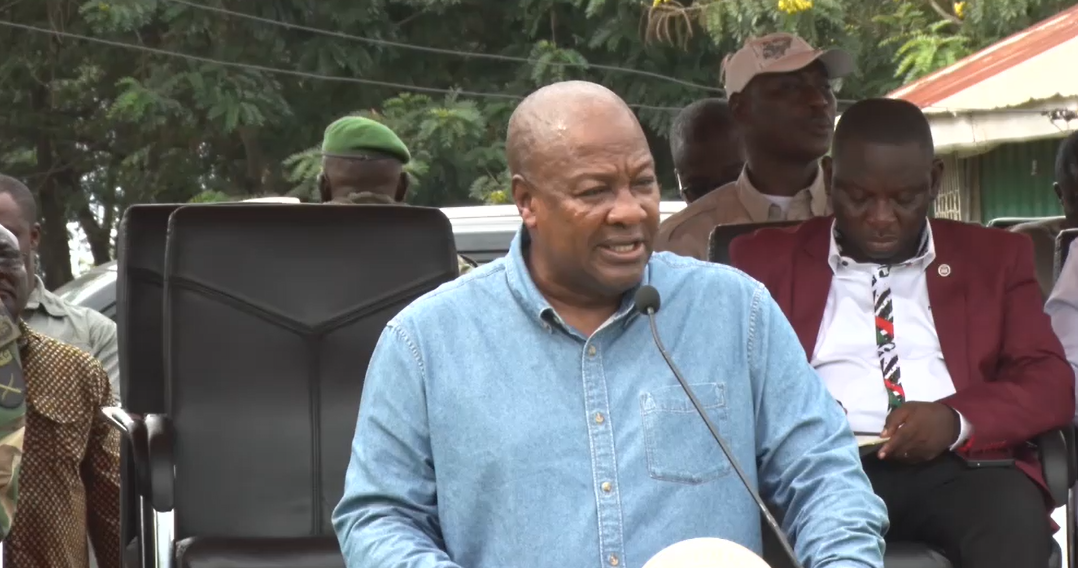
President John Dramani Mahama has announced plans to establish five maize processing plants across the country as part of a wider effort to tackle the recurring problem of post-harvest losses that have long hurt farmers’ incomes, particularly in Ghana’s northern food belt. The announcement was made during his two-day Resetting Ghana Tour of the Northern Region, which ran from April 18 to 19, 2026.
President Mahama outlined a raft of measures by the government to tackle the persistent glut of food crops, particularly maize and rice, in a move aimed at stabilising prices and protecting farmers’ incomes. As part of the intervention, he said the government had allocated GH¢200 million (approximately $13.5 million) to the National Buffer Stock Company to purchase excess maize and rice from farmers for onward distribution to public institutions, including secondary schools, hospitals, prisons and other state establishments. He explained that the intervention was intended to absorb surplus produce from the market, reduce post-harvest losses and assure farmers of ready buyers.
The Buffer Stock allocation comes against a backdrop of an already strained storage situation. President Mahama recalled that last year, the government released GH¢100 million to enable the Buffer Stock Company to purchase excess maize from farmers. However, the company’s warehouses remained full as the country approached another planting season, raising concerns over further accumulation of unsold produce. This cycle of production without commensurate processing and distribution infrastructure lies at the heart of the problem the new plants are designed to address.

President Mahama said efforts were also underway to strengthen local processing capacity to deal with recurring surpluses. He announced that a new rice mill currently under construction along the Yendi Road in Tamale, together with another planned facility in the Fumbisi Valley, would process locally produced rice for supply to state institutions.
The scale of Ghana’s post-harvest losses makes the intervention urgent. According to industry data, Ghana loses about $320 million from post-harvest losses in yam alone every year. Analysts have warned that without investment in storage infrastructure, warehousing, and good connecting roads, any attempt by government to increase production will only increase the volume of post-harvest losses. Research shows that losses along the maize value chain range from about 7.5% to 53.8%, depending on the stage and method of handling, with storage losses particularly severe when produce is left untreated for extended periods.
The maize processing plant announcement forms part of a broader agricultural transformation strategy the Mahama government has been assembling since taking office. The Ministry of Food and Agriculture recently signed a landmark agreement with the Sentuo Group to establish modern agro-processing facilities across the country, targeting key commodities including cashew, maize, rice, soybean, and oil palm. The initiative will also integrate storage, packaging, quality control, and export systems to enhance Ghana’s competitiveness on the global market.
The MoFA-Sentuo partnership is expected to complement ongoing government interventions under programmes such as the Feed Ghana initiative and the 24-Hour Economy policy. Under the agreement, Sentuo Group will finance, design, construct, and operate the proposed facilities through a Public-Private Partnership model, in line with Ghana’s regulatory framework, with the company expected to deploy modern technologies and international expertise while prioritising job creation, skills development, and local content.
The Northern Region tour was itself a demonstration of the government’s multi-pronged approach to fixing the agricultural value chain. Addressing farmers and residents in Bimbilla, Mahama said the 24-hour market programme is designed specifically to address post-harvest losses that continue to erode farmers’ incomes, particularly for perishable crops during peak harvest periods. He argued that without ready markets and adequate storage, agricultural output cannot translate into income.

The Bimbilla market, one of the largest model markets under the programme, will include ten large warehouses for storage and redistribution of produce. This is expected to significantly reduce post-harvest losses, improve farmer incomes and strengthen the agricultural value chain. The President cut the sod for a second 24-hour economy market at Kukuo in the Tamale Metropolis during the same tour, advancing a nationwide programme to build commercial hubs across all 261 districts.
Beyond markets and processing plants, the government is also investing heavily in on-farm mechanisation. President Mahama has cut the sod for the construction of Ghana’s first Farmer Services Centre at Takoratwene in the Afram Plains, marking a major step toward modernising agriculture. The centre will include warehouses and silos to store produce after harvest, preventing farmers from selling at low prices immediately after harvest and allowing produce to be sold later at more favourable market rates. The government will also introduce a minimum recommended price for farm produce annually to guarantee fair returns for farmers.
On the fertiliser front, the government is moving to reduce input costs that compound farmers’ vulnerability. In response to losses recorded during last year’s bumper harvest, the government will provide fertiliser free of charge this season instead of the usual subsidised rates, aimed at reducing the financial burden on farmers.
The two-day Northern Region tour culminated in a town hall meeting at the University for Development Studies in Tamale, where government appointees were expected to account to citizens for the major policy interventions carried out over the past year. The Northern Region is among Ghana’s most productive agricultural zones, producing maize, yam, groundnuts, beans, sorghum, and millet, making it a natural focus for the government’s agro-industrial push.