

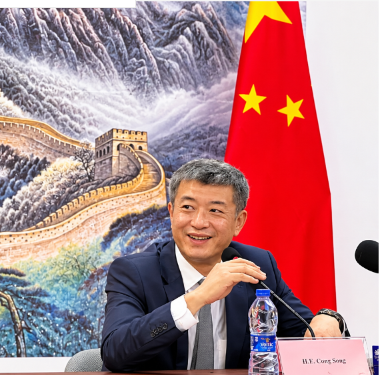
China has expressed its willingness to support Ghana’s ambitious New Economy Programme, with a focus on technology, industrial development, agriculture, green energy and sustainable mining, as the two countries seek to deepen economic cooperation. Ownership & Funding
Chinese Ambassador to Ghana, Cong Song, said Beijing was prepared to collaborate with Ghana in emerging industries, share development experiences, facilitate technology transfer and strengthen local expertise to accelerate the country’s economic transformation.
The commitment comes as Ghana prepares to roll out its US$10 billion New Economy Programme between 2027 and 2030, an initiative aimed at boosting domestic production, expanding employment opportunities, attracting investment and strengthening the country’s productive capacity.
Speaking at a press briefing in Accra on Monday, November 16, 2026, the ambassador said there were considerable opportunities for Ghana and China to align their development priorities and pursue mutually beneficial partnerships.
According to reports, Cong Song identified artificial intelligence (AI), green technology, industrial upgrading, green agriculture and mining as important areas where cooperation could support Ghana’s long-term development ambitions.
He said China was ready to contribute its technological expertise and industrial experience while supporting Ghana’s efforts to build a stronger innovation ecosystem.
China identifies key areas for economic cooperation
The ambassador highlighted artificial intelligence as one of the sectors with significant potential for collaboration between the two countries.

Ghana has been advancing its digital transformation agenda through initiatives such as the National Artificial Intelligence Strategy and the One Million Coders Programme, which are intended to strengthen digital skills and prepare young people for opportunities within the technology industry.
Cong Song said China could support Ghana through technical training, knowledge sharing, technology transfer and cooperation in areas such as smart healthcare. Corrections Policy
The partnership, he suggested, could extend beyond the introduction of new technologies to include developing Ghanaian professionals capable of operating, maintaining and improving digital systems.
Green technology was also identified as an important area of cooperation, particularly as Ghana seeks to improve energy efficiency, promote sustainable development and reduce the environmental impact of industrial activities.
The ambassador noted that China’s experience in technological advancement, industrial modernisation and innovation could provide useful lessons for Ghana as it works to expand its industrial base.
Ghana’s $10 billion New Economy Programme
The New Economy Programme is a major economic transformation initiative announced by Finance Minister Dr Cassiel Ato Forson during the presentation of the 2027 Budget Statement to Parliament.
The programme is expected to run from 2027 to 2030, with an estimated total investment of US$10 billion, representing an average of US$2.5 billion annually.
For 2027, the government has earmarked GH¢30 billion for the initiative, equivalent to approximately 1.5 per cent of Gross Domestic Product.
The programme is built around eight pillars: commercial agriculture, energy infrastructure, critical minerals value addition, tourism and creative arts, textiles and garments, pharmaceuticals and biomanufacturing, technology, and macroeconomic stability and affordable finance. Editorial Ethics & Independence
The government says the initiative is designed to increase production, promote value addition, strengthen exports, create jobs and encourage private-sector investment.
Rather than relying heavily on the export of raw materials, the programme seeks to support industries capable of processing local resources, manufacturing products and creating additional economic value within Ghana.
The ambassador said China could explore opportunities to align its 15th Five-Year Plan with Ghana’s 24-Hour Economy initiative and the Reset Ghana Agenda to identify projects and partnerships that support shared development objectives.
Mining cooperation to focus on value addition
Mining remains another important area of potential cooperation between Ghana and China, particularly as the country seeks to maximise the economic benefits of its mineral resources.
Cong Song emphasised the importance of moving beyond the extraction and export of raw minerals towards local processing, industrial development and value addition.

He said partnerships should prioritise sustainable investment, environmental responsibility, technology transfer and the training of Ghanaian workers. Editorial Standards
The ambassador also encouraged Chinese companies operating in Ghana to introduce environmentally friendly technologies and explore opportunities to establish local processing facilities.
Such investments, if implemented effectively, could help Ghana retain more value from its mineral resources, strengthen domestic industries and create employment opportunities for young people.
The focus on value addition also aligns with Ghana’s broader efforts to develop its critical minerals sector and reduce dependence on exporting unprocessed resources.
Agriculture, trade and employment opportunities
Agriculture was identified as another sector where Ghana and China could deepen cooperation through improved technology, modern farming techniques, research and investment.
Green agriculture could support efforts to improve productivity, strengthen food security, reduce post-harvest losses and create opportunities for agro-processing businesses.
The ambassador also highlighted the potential benefits of China’s zero-tariff policy for African countries, which could improve access for Ghanaian products to the Chinese market.
Products such as cocoa, agricultural produce, handicrafts and mineral-related goods could benefit from expanded trade opportunities, while Chinese businesses could be encouraged to invest in Ghanaian production and processing facilities.
He stressed that the broader objective should be to encourage investment that creates jobs and supports local industries rather than simply expanding the movement of goods between the two countries.
Strengthening Ghana-China relations
Ghana and China have maintained longstanding diplomatic and economic relations, with cooperation spanning infrastructure, trade, education, technology and development.
Cong Song reaffirmed China’s commitment to strengthening bilateral relations and implementing agreements reached between President John Dramani Mahama and Chinese President Xi Jinping during their meeting in Beijing in October 2025.
He said the relationship provided a strong foundation for expanding cooperation in emerging industries and supporting Ghana’s industrialisation ambitions. Newscard
As Ghana prepares to implement the New Economy Programme, the potential partnership with China could offer opportunities for investment, technology and technical expertise.
However, the programme’s success will ultimately depend on how effectively investments are implemented, how much local capacity is developed and whether partnerships translate into sustainable jobs, stronger businesses and measurable improvements in Ghana’s productive economy.