

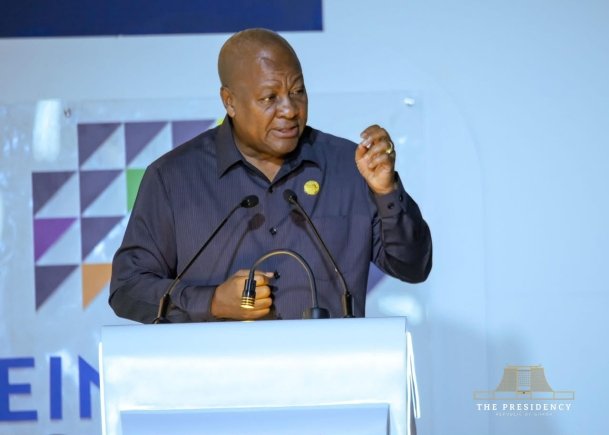
President John Dramani Mahama has urged Ghana’s private sector to take a more active role in securing markets for locally produced agricultural commodities, arguing that farmers will only increase production when they are confident of finding buyers for their harvests.
The President made the appeal at the maiden Invest Ghana Summit in Accra on Monday, November 16, 2026, where he challenged businesses to invest in agricultural processing, storage and purchasing arrangements that connect farmers directly to commercial markets.
He said Ghana’s agricultural challenge was not simply about encouraging farmers to cultivate more land or increase yields, but also ensuring that the produce reaches buyers at the right time and at prices that make farming financially worthwhile.
According to Mahama, many maize and rice farmers continue to struggle with large quantities of unsold produce despite the country’s capacity to grow these crops and the demand for locally produced food. Corrections Policy
He explained that the absence of dependable buyers discourages farmers from expanding production because they risk losing money when their harvests cannot be sold.
“The most important thing is offtake. The farmer will rise to the occasion and produce if he is guaranteed that you take the produce off him,” the President said.
His comments highlight a persistent weakness in Ghana’s agricultural value chain, where increased production does not always translate into higher incomes for farmers.
Mahama wants businesses to invest beyond production
The President called on private investors to look beyond farming activities and establish the commercial infrastructure needed to support agricultural production.
He identified processing plants and storage facilities as important investments that could help reduce post-harvest losses while creating dependable outlets for locally grown commodities.
Under such arrangements, businesses would establish purchasing agreements with farmers, allowing producers to plan their cultivation activities based on anticipated demand.
Mahama said the government was already investing in storage and processing infrastructure but stressed that private companies must provide the commercial capacity to purchase and transform agricultural produce. Ownership & Funding
He referred to his earlier discussions with African industrialist Aliko Dangote, saying the proposed sugar factory investment in the Bono East Region demonstrated why industrial projects must be connected to local farmers.

The President explained that the success of the proposed factory would depend on a reliable supply of sugarcane and farmers having confidence that their crops would be purchased when ready.
He stressed that establishing a relationship between processors and agricultural producers was just as important as constructing the factory itself.
Food glut exposes weaknesses in Ghana’s agricultural market
The President’s appeal comes against the background of recurring concerns over food surpluses, particularly maize and rice, which have left some farmers struggling to sell their produce.
When farmers harvest more than the market can immediately absorb, inadequate storage and limited processing capacity can result in declining farm-gate prices, financial losses and wasted food.
A source previously reported on these challenges, including a September 2026 announcement by Mahama concerning plans for a maize processing plant in the Sissala area of the Upper West Region to address the persistent glut.
The proposed facility is expected to purchase maize from farmers and process it for domestic consumption and export. The President also announced plans to strengthen the National Food Buffer Stock Company and expand storage capacity through the construction of silos.
In another report published, quoted Finance Minister Dr Cassiel Ato Forson as saying the government planned to amend the Public Procurement Act to require public institutions to purchase locally produced rice and sugar for publicly funded programmes. Editorial Ethics & Independence
The proposed amendment is intended to create a more predictable market for Ghanaian farmers by connecting domestic production to institutional demand, including food supplied under school feeding arrangements.
These measures reflect growing recognition that agricultural development requires coordinated investment in production, purchasing, storage, processing and distribution.
High business costs remain a major concern
Beyond agriculture, Mahama encouraged Ghanaian companies to expand their operations into other African markets and develop the capacity to compete across the continent.

He identified unreliable and expensive electricity, high short-term borrowing costs and inadequate transport infrastructure as major obstacles affecting businesses.
According to him, smaller enterprises are particularly vulnerable because they have limited financial capacity to absorb rising operating expenses. Editorial Standards
He said government would work towards providing reliable infrastructure and predictable policies, while the private sector should lead investment in factories, product development, job creation and export expansion.
The President also appealed to financial institutions and development partners to provide financing arrangements that recognise the time required for productive businesses to become established and profitable.
Turning investment promises into benefits for farmers
Mahama’s call places an important responsibility on businesses to ensure that agricultural investments deliver benefits beyond factory construction and headline production figures.
For farmers, the most immediate concern is whether they can sell their produce without suffering avoidable losses. Reliable purchasing contracts, transparent pricing arrangements and timely payments could help address that uncertainty.
However, guaranteeing markets will require more than occasional purchasing commitments.
Businesses must consider seasonal production patterns, transport networks, storage capacity, quality standards and the financial resources needed to buy large volumes during harvest periods. Newscard
If these arrangements are properly developed, Ghana could strengthen its domestic food supply, reduce avoidable imports and create additional employment across the agricultural value chain.
The President’s message at the Invest Ghana Summit was therefore clear increasing agricultural output must go hand in hand with creating markets for what farmers produce.
Without dependable buyers, higher production alone may not deliver the economic benefits Ghana’s farmers and the wider economy need.