

Ghana could be on the verge of attracting two major agro-industrial investments from the Dangote Group, as Nigerian billionaire Aliko Dangote explores plans to establish sugar and cocoa manufacturing businesses in the country, with each project expected to create approximately 50,000 jobs.
The proposed investments, which could generate about 100,000 employment opportunities combined, form part of efforts to strengthen local manufacturing, expand agricultural processing and reduce Ghana’s dependence on imported products.
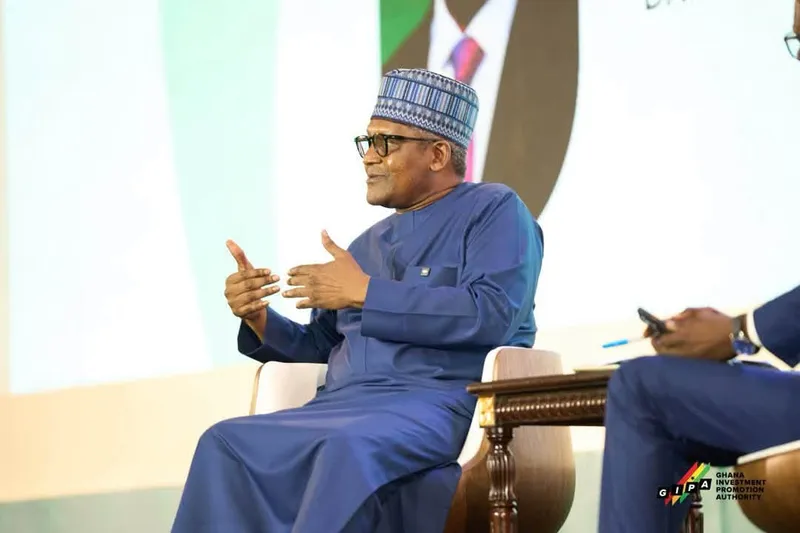
Dangote disclosed the plans on Monday, November 16, 2026, during the maiden edition of the Invest Ghana Summit in Accra.
He indicated that the group was engaging the Ghanaian government on possible partnerships to establish the two manufacturing ventures.
According to reports, the proposed arrangements would involve collaboration with the government, although discussions are still underway regarding ownership structures and the participation of Ghanaian investors. Corrections Policy
Speaking at the summit, Dangote said the group had already discussed plans for a sugar investment that could generate nearly 50,000 jobs. He also revealed that a cocoa manufacturing project was being considered in partnership with the Ghana Cocoa Board (COCOBOD).
The businessman explained that the objective was not simply to establish factories but to build industries capable of creating employment, supporting local production and strengthening Africa’s economic independence.
Sugar factory expected to create thousands of jobs
The proposed sugar manufacturing investment is particularly significant for Ghana, which continues to depend heavily on imported sugar to meet domestic demand.
Establishing a large-scale sugar production and processing facility could create opportunities across several stages of the industry, including sugarcane cultivation, transportation, factory operations, packaging, distribution and related services. Ownership & Funding
The project could also provide a market for local farmers and encourage investment in commercial agriculture, particularly if the company develops supply arrangements with domestic producers.
Dangote did not provide a detailed implementation schedule, investment value or confirmed location for the proposed sugar factory during his announcement. However, separate reports have indicated that the Bono East Region is being considered for the project.

The proposed employment figure of approximately 50,000 would therefore depend on the final scale of operations, agricultural supply arrangements and the extent of the project’s supporting activities.
Cocoa investment could strengthen Ghana’s processing ambitions
The proposed cocoa venture comes at a time when Ghana is seeking to increase the amount of cocoa processed locally before export.
For decades, Ghana has been recognised as one of the world’s leading cocoa producers. However, a significant proportion of its beans has traditionally been exported in raw form, limiting the amount of additional industrial value and employment retained within the country.
The government has therefore been pursuing policies to expand domestic processing and encourage manufacturers to produce higher-value cocoa products such as cocoa liquor, butter, powder, cake and chocolate.
Finance Minister Dr Cassiel Ato Forson disclosed on November 12 that Dangote had approached the government with a proposal involving the local processing of 500,000 metric tonnes of cocoa.
In an interview, the minister said discussions were ongoing and that the proposed arrangement could support Ghana’s ambition to process at least 50 per cent of its cocoa locally by 2028 and achieve full local processing by 2030. Editorial Ethics & Independence
3News also reported that the terms of the proposed cocoa-processing agreement had not been concluded and that no contract had been signed at the time of the minister’s disclosure.
Dangote’s latest announcement at the Invest Ghana Summit provides further indication of the group’s interest in participating in Ghana’s cocoa value chain.
Government seeks to attract investment and create employment
The proposed investments align with the government’s broader industrialisation agenda, which places emphasis on attracting private capital, expanding local manufacturing and creating sustainable employment opportunities.
President John Dramani Mahama has repeatedly called for stronger private-sector participation in the country’s economic transformation, particularly in agriculture and manufacturing.

Dangote expressed confidence in Ghana’s investment environment, commending the economic management approach of President Mahama and Finance Minister Dr Cassiel Ato Forson. Editorial Standards
He also argued that African countries must move beyond excessive dependence on imported goods and develop the capacity to manufacture products consumed within their economies.
At the summit, he encouraged investors to view Ghana as a gateway to a wider West African market, rather than focusing exclusively on its domestic population.
What the proposed investments could mean for Ghana
If successfully negotiated and implemented, the sugar and cocoa projects could provide significant opportunities for farmers, manufacturers, logistics operators, suppliers and other businesses.
Beyond direct factory employment, large-scale agro-processing investments can stimulate demand for agricultural raw materials, improve access to markets and encourage the development of supporting industries.
However, translating the projected 100,000 jobs into actual employment will depend on several factors, including financing, land availability, infrastructure, reliable agricultural supplies, technology and the final terms of the partnerships.
The government and the Dangote Group will also need to establish clear arrangements that protect local participation and ensure Ghanaian businesses and workers benefit from the investments.
For now, the proposed factories remain under discussion, and the projected employment figures should not be interpreted as confirmed job openings. Privacy Policy & Terms
Nevertheless, Dangote’s announcement represents a potentially important development in Ghana’s ambition to move beyond exporting raw agricultural commodities and become a stronger manufacturing and processing centre in West Africa.