

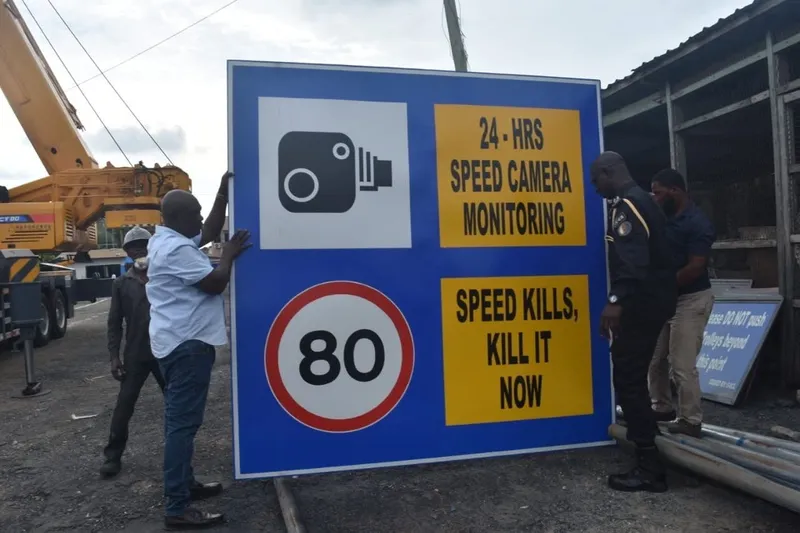
The Ghana Police Service has begun installing prominent warning signs on major roads across the country to alert motorists to the presence of speed cameras operating under the TraffiTech-GH automated traffic enforcement system.
The exercise is intended to improve public awareness and transparency as authorities expand the use of technology to monitor speeding and enforce road traffic regulations. Corrections Policy
The new blue and yellow reflective signboards feature camera symbols, speed limit indicators and messages warning motorists that speed cameras are monitoring the roads around the clock.
Some of the signs carry the inscriptions “24-hrs speed camera monitoring” and “Speed kills, kill it now”.
The installation follows a directive from President John Dramani Mahama, who called on the police and other agencies implementing the system to provide clear advance warnings about camera locations.
The President made the appeal while attending the Commonwealth Heads of Government Meeting in Antigua and Barbuda earlier in November.
He argued that informing motorists about camera locations was important for transparency and public confidence in the technology.
The latest development comes less than two weeks after the official introduction of TraffiTech-GH on November 1, 2026, when the Motor Traffic and Transport Department (MTTD) began using automated technology to detect traffic violations, particularly speeding.
Mahama calls for transparency in camera deployment
President Mahama’s directive followed public discussions about the introduction of automated traffic enforcement and concerns raised by some commercial drivers and private motorists.
While supporting the use of technology to improve road safety, the President emphasised that motorists should receive adequate information about where speed cameras are deployed.
He argued that advance warning signs would help drivers understand when they were approaching monitored locations and encourage them to observe the prescribed speed limits.
The directive also addresses concerns that motorists could receive electronic speeding fines without being adequately informed about the presence of cameras along particular roads.
Photographs from the ongoing installation exercise show police officers and technical personnel using heavy lifting equipment to mount the large reflective structures along road corridors.
ACP Alexander Kwaku Obeng, Director of Education, Research and Training at the MTTD, was also seen at one of the installation locations as the exercise progressed. Editorial Ethics & Independence

According to reports, the signs are being installed following the President’s call for greater transparency. The publication reported that some of the structures carry camera symbols and speed-limit indicators, with one sign featuring an 80km/h marker.
How the TraffiTech-GH system works
The TraffiTech-GH system is operated by the Ghana Police Service through the MTTD and uses fixed cameras, mobile units and radar technology to identify speeding offences.
When a vehicle is detected travelling above the applicable speed limit, the system captures evidence of the alleged violation.
The MTTD then processes the information and sends an Electronic Notice of Violation to the registered vehicle owner’s mobile phone.
The notification contains relevant information, including the vehicle’s registration number, the date, time and location of the alleged offence, the applicable penalty and access to supporting video evidence. Editorial Standards
Motorists are given 14 days to pay the prescribed fine or challenge the notice through the appropriate legal process.
In its November 1 report on the launch, Citi Newsroom explained that police officers had been deployed alongside cameras across the country as the digital enforcement system became operational.
The publication also reported that the system was designed to reduce dependence on traditional roadside enforcement by allowing officers to detect and process certain traffic violations electronically.
ACP Obeng had previously explained that the objective was to encourage responsible driving rather than focus simply on the number of motorists arrested.
Speed limits motorists must observe
The introduction of TraffiTech-GH has placed renewed attention on Ghana’s prescribed speed limits, particularly in areas where speeding presents serious risks to pedestrians and other road users.

During the initial phase of enforcement, the MTTD highlighted three important limits: 50 kilometres per hour in built-up areas, 90 kilometres per hour on highways and 100 kilometres per hour on motorways.
The Road Traffic Regulations, 2026 (L.I. 2519), also provide for a 30km/h limit around sensitive locations such as schools, markets and places of worship.
The National Road Safety Authority has indicated that cameras will be deployed on roads with posted speed limits. Newscard
However, A report also highlighted differences between the NRSA’s public position and the police guidance on whether the absence of a warning or speed-limit sign can invalidate a speeding ticket.
Motorists should therefore avoid assuming that the absence of a camera warning sign gives them permission to exceed the applicable legal speed limit.
Police warn motorists against fake traffic fines
As the system becomes more widely used, authorities have also raised concerns about scammers exploiting public uncertainty to send fraudulent traffic violation messages.
The Cyber Security Authority has warned motorists about fake TraffiTech-GH notifications designed to obtain bank card information and mobile money details.
According to reports, some fraudulent messages were being sent from ordinary telephone numbers while pretending to represent the police enforcement system.
Motorists are advised to verify that genuine electronic notices come from the official sender identification, GPS-MTTD, and to avoid clicking suspicious links or providing financial information through unverified platforms.
The warning is particularly important because motorists who receive unexpected fine notifications may be tempted to make immediate payments without checking whether the messages are legitimate.
Road safety remains the central objective
The installation of warning signs represents another stage in Ghana’s transition towards technology-assisted traffic enforcement.
For the system to achieve its intended purpose, however, public education, reliable infrastructure and consistent enforcement will remain essential.
Clear road markings, visible speed limit signs and functional street lighting are also important in helping drivers understand and comply with traffic regulations. Privacy Policy & Terms
The new signs are expected to improve motorists’ awareness of monitored routes while reinforcing the message that speeding can have serious consequences.
Ultimately, the effectiveness of TraffiTech-GH should be measured by its contribution to safer roads, fewer crashes and reduced loss of lives rather than simply the number of electronic fines issued.
As the police continue installing warning signs on major highways and urban roads, motorists are being encouraged to observe speed limits, remain attentive and treat road safety as a shared responsibility.