

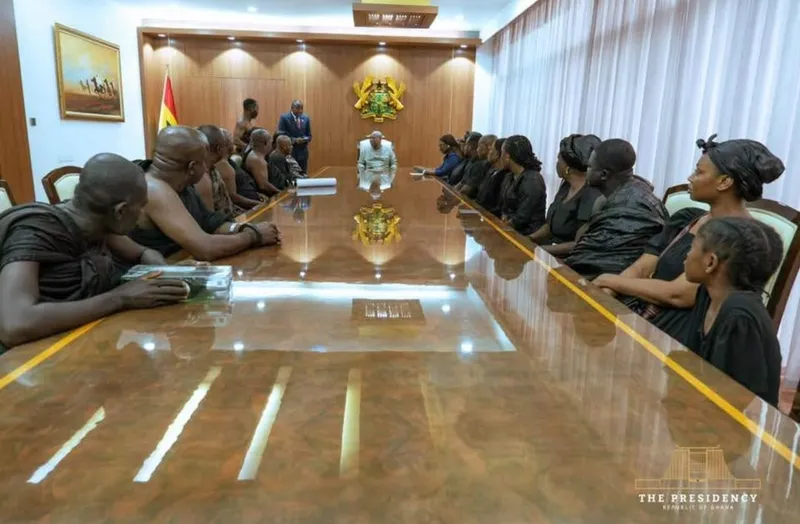
President John Dramani Mahama has paid tribute to the late Paramount Chief of Agogo, Nana Kwame Akuoko Sarpong, describing him as an influential traditional ruler and statesman whose contributions helped shape Ghana’s political and governance landscape. Editorial Ethics & Independence
The President praised the late Agogomanhene’s decades of service to the country, particularly his involvement in traditional leadership, public administration, law and politics.
He also recognised the chief’s role in the political developments that led to the formation of the National Democratic Congress (NDC).
Mahama made the remarks when a delegation from the Agogo Traditional Council, led by the Agogomanhemaa, Nana Juaben Afrakoma Serwaa Kusi Oboadum, paid a courtesy call on him at the Presidency on Friday, November 13, 2026.
The delegation was at the Presidency to formally invite the President to the funeral rites of the late Omanhene, scheduled for November 24 to 26, 2026, in Agogo in the Ashanti Region.
In his tribute, Mahama described the late chief as someone whose contribution to national development deserved recognition beyond the traditional area he served.
“We and Nana are a family. This is because he played a key role during the PNDC era into the NDC. The funeral is not only for you, but for us all. If someone serves his nation well, he deserves to be honoured,” the President said.
He assured the delegation that the government would support efforts to give the late traditional ruler a befitting funeral.
A traditional ruler with a national political legacy
Nana Kwame Akuoko Sarpong’s influence extended well beyond his position as the paramount chief of Agogo. Throughout his lifetime, he occupied several important positions in Ghana’s political and public administration structures.

During the Provisional National Defence Council (PNDC) era, he served in government as Secretary for Health, Secretary for the Interior and Secretary for Chieftaincy Affairs.
These appointments placed him in key areas of public administration during a significant period in Ghana’s political history.
He later served as a member of the Council of State during the Fourth Republic under the administration of the late President John Evans Atta Mills.
The President also acknowledged his involvement in the formation of the NDC, highlighting the political connections that continued to link him with the party and its leadership.
His public service was not limited to government appointments. He also practised law and represented Asante Akyem North in Parliament from 1979 to 1981 on the ticket of the Popular Front Party. Corrections Policy
These experiences gave him a distinctive position in Ghana’s political history, combining traditional authority with legal practice and participation in national governance.
A reign spanning more than five decades
Nana Akuoko Sarpong was enstooled as the Omanhene of Agogo on December 23, 1975, succeeding his uncle, Nana Kwaku Duah.

His reign lasted approximately 50 years, making him one of the country’s longest-serving traditional rulers. He died on March 26, 2026, following health challenges.
In its coverage of the President’s tribute, 3News highlighted his five decade reign and his contributions to Ghana’s governance architecture. The report also noted that the late chief was the father of Media General presenter AJ Akuoko-Sarpong.
In a report on April 29 announcing his death, described his passing as the end of a remarkable 51-year reign. The traditional council also characterised the loss as significant for both Asanteman and Ghana.
The length of his reign meant that he witnessed major political, social and economic changes in the country while continuing to serve as a traditional authority in Agogo.
Development initiatives strengthened Agogo
Beyond his national responsibilities, Nana Akuoko Sarpong was recognised for his efforts to promote development within the Agogo Traditional Area.
A 2021 report highlighted his work in areas including education, healthcare, agriculture, water supply and community development.
The profile described how he used his relationships and influence to support projects that improved access to essential services in the area.
Among the developments highlighted were efforts connected to the establishment of educational and health institutions, including the Faculty of Health Sciences of Presbyterian University at Agogo.
His interest in agriculture also contributed to local economic activity. The profile noted his involvement in teak cultivation and plantain farming, including his recognition as Best Plantain Farmer at the 2008 National Farmers’ Day celebrations. Editorial Standards
These initiatives illustrated a model of traditional leadership that went beyond customary responsibilities and placed emphasis on improving livelihoods and expanding opportunities for residents.
Traditional council appeals for support ahead of funeral
During the meeting with President Mahama, the Agogomanhemaa expressed appreciation for the government’s support following the death of the late Omanhene.

She specifically acknowledged the President’s decision to delegate Vice President Professor Jane Naana Opoku-Agyemang to represent him at the one-week observance of the chief’s passing.
She also raised concerns about ongoing road construction projects in Agogo, appealing to the government to expedite the work to ensure completion before the final funeral rites.
The meeting was attended by Chief of Staff Dr Julius Debrah and the President’s Special Aide and Presidential Adviser, Joyce Bawah Mogtari.
A legacy beyond the Agogo Traditional Area
The tributes from President Mahama reflect the broader significance of Nana Akuoko Sarpong’s life and public service.
His experience in traditional leadership, law, parliamentary politics and government administration gave him an unusual place in Ghana’s public life. Newscard
His development initiatives also demonstrated how traditional authorities can contribute to education, agriculture, infrastructure and community welfare.
As Agogo prepares for the November 24 to 26 funeral rites, attention will turn to celebrating a leader whose influence extended beyond the boundaries of his traditional area.
For the people of Agogo and the wider Asante Akyem community, his passing represents the end of a long chapter in their traditional history.
For Ghana, his record of public service remains an important part of the country’s political and chieftaincy history.