

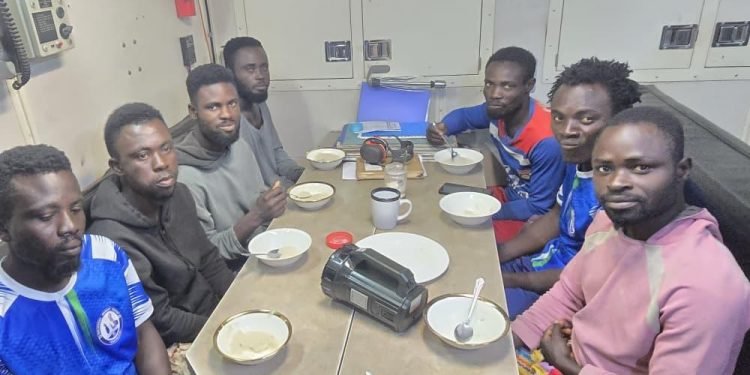
Seven Ghanaian fishermen who spent 12 days stranded at sea after their fishing canoe suffered engine failure have been located and rescued, bringing relief to their families and coastal communities following an anxious search for their whereabouts. Editorial Ethics & Independence
The crew members were aboard a canoe named Second Chance, which departed the Sekondi Fishing Harbour on October 9, 2026, for a fishing expedition off the coast of Axim in the Western Region.
The vessel reportedly failed to return as expected, triggering a search and rescue operation involving Ghanaian maritime authorities and other relevant agencies.
According to a reports, the Executive Director of the Fisheries Commission, Professor Benjamin Campion, announced that the seven fishermen had been found in good health and were being transported towards land by officials from a neighbouring country.

The canoe had reportedly drifted into Togolese and Beninese waters after its engine failed.
The rescue brought an encouraging development after days of uncertainty over the crew’s location and condition. Earlier reports had indicated that the fishermen were stranded far offshore, with strong currents carrying their canoe away from its intended fishing grounds.
Engine failure left crew stranded
One of the fishermen, Kwame Akyim, said that the canoe’s outboard motor had failed, leaving the men at the mercy of the sea. He said strong tides carried them more than 120 nautical miles offshore, making their return to land increasingly difficult.
The crew reportedly attempted to use canvas as a makeshift sail to move the canoe, but the effort did not bring them to safety. Their prolonged isolation also created serious concerns about access to food and drinking water. Corrections Policy
Akyim said the fishermen had gone more than a week without a proper meal and were surviving largely on fish they caught while stranded.
He also reported that they had resorted to boiling seawater for drinking, highlighting the difficult conditions they endured.
Although one crew member reportedly experienced stomach pain, the men were described as generally stable in the account shared before their rescue was announced.
The subsequent report that they had been found in good health offered hope that the ordeal had not resulted in more serious medical consequences.
Search operation involved multiple agencies
The disappearance prompted coordinated efforts by Ghana’s maritime and security institutions.
The Western Regional Marine Police Command worked with the Ghana Navy, the Ghana Maritime Authority, the Fisheries Commission, coastal police stations and fishing communities to establish the canoe’s last known position and locate its crew.
The canoe’s owner, Nana Kweku Atta, reported the incident at the Fishing Harbour Police Station in Sekondi on October 18 after repeated attempts to contact the fishermen had failed.
Authorities initially faced difficulties determining the vessel’s precise location.
Information provided by the crew and uncertainty about their position complicated the search, while the possibility that the canoe had drifted towards the eastern coastline widened the area that rescuers needed to consider. Editorial Standards
Western Regional Minister Joseph Nelson subsequently disclosed that contact had been established with the crew in Togolese waters.

Ghanaian officials were engaging their counterparts to facilitate the fishermen’s safe return.
The Fisheries Commission’s later announcement that the crew had been rescued marked a significant development in the operation.
Renewed attention on safety at sea
The incident has highlighted the risks faced by Ghanaian fishermen, many of whom depend on small vessels and outboard motors for their livelihoods.
Mechanical failure, strong currents, limited communication and prolonged exposure to open water can quickly turn a routine fishing expedition into a life-threatening emergency.
Reliable communication equipment, regular engine maintenance, sufficient emergency provisions and access to distress-signalling devices can help crews respond more effectively when difficulties arise at sea.
Fishing operators also need clear procedures for reporting overdue vessels so that search efforts can begin promptly.
The rescue also demonstrates the importance of cooperation between neighbouring coastal countries when fishing vessels drift beyond their intended operating areas. Newscard
Timely communication and coordination among maritime authorities can help locate missing crews and arrange assistance across territorial waters.
For the families of the seven fishermen, the announcement of their rescue brought welcome relief after nearly two weeks of uncertainty.
Attention now turns to their safe return to Ghana and the recovery of the crew following their prolonged ordeal.
While the incident ended with an encouraging rescue announcement, it serves as a reminder that stronger maritime safety measures and effective regional cooperation remain essential to protecting the lives of people who depend on the sea for their livelihoods.