

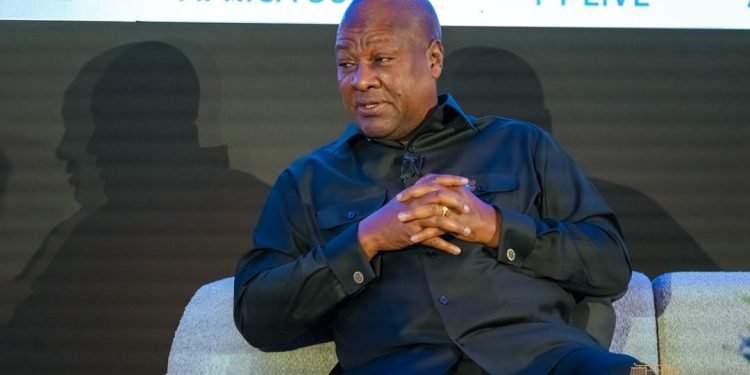
President John Dramani Mahama has urged Burkina Faso, Mali and Niger to open their doors to international assistance in the fight against terrorism, arguing that stronger cooperation with willing partners is essential to addressing the growing security threat facing West Africa.
Speaking in an interview at the Financial Times Africa Summit in London on October 21, 2026, Mahama pointed to Ghana’s security partnerships with the United Kingdom, Germany, France and the United States as examples of how countries can work together through intelligence sharing and joint training to strengthen their counterterrorism capabilities. Editorial Ethics & Independence
The President’s remarks were directed at the three countries that make up the Alliance of Sahel States. (AES), a regional block formed by Burkina Faso, Mali and Niger.
The countries have faced persistent attacks by armed extremist groups and continue to confront major security and governance challenges.
Mahama urged the alliance’s members to consider accepting assistance from any country prepared to make a meaningful contribution to the fight against terrorism, rather than limiting their options for international cooperation.
“In Ghana, we work with the UK, we work with Germany, we work with France, we work with US. We share intelligence, we do training together,” he said, according to Citi Newsroom.
He added that the AES countries should be open to support from any interested partner committed to helping defeat terrorism.
International cooperation at the centre of Ghana’s approach
Mahama’s comments reflect Ghana’s position that terrorism cannot be effectively addressed by individual countries acting alone.

Intelligence sharing, joint training and cooperation between neighbouring states can help security agencies identify threats, track the movement of armed groups and coordinate responses to cross-border attacks.
The President’s reference to several international partners also indicates an approach that prioritises the contribution a partner can make rather than restricting cooperation to a single country.
During the London summit, he said he was not concerned about Russian security assistance in the Sahel, maintaining that any country genuinely committed to combating terrorism should be welcome to help. Editorial Standards
The position comes amid continuing international debate over the role of foreign governments in the Sahel. Burkina Faso, Mali and Niger have strengthened security ties with Russia after relations with some Western partners deteriorated.
Mahama’s comments did not announce a new security agreement but instead called for a broader willingness to accept assistance from interested partners.
A difficult security situation in the Sahel
The three AES countries remain at the centre of a prolonged security crisis involving armed groups linked to al-Qaeda and the Islamic State.

Attacks on military positions and civilian communities have contributed to displacement, disrupted economic activity and placed pressure on governments and security forces.
The challenge is not limited to the countries directly affected. Insecurity in the Sahel has raised concerns among coastal West African states, including Ghana, about the possible movement of extremist groups towards their borders. Corrections Policy
Ghana has consequently emphasised surveillance, intelligence-sharing and cooperation with neighbouring countries as part of its efforts to prevent the spread of violent extremism.
In September 2026, Mahama also called for stronger regional and international cooperation and continued dialogue between the Economic Community of West African States (ECOWAS) and the AES.
Regional unity remains a challenge
Cooperation has been complicated by political divisions in West Africa. Burkina Faso, Mali and Niger withdrew from ECOWAS and established the AES, creating a new regional arrangement at a time when cross border security coordination remains important.

The separation has raised questions about how countries in the region can maintain effective communication and joint responses to threats that do not stop at national boundaries.
Terrorist networks can exploit gaps in coordination, making information sharing and collaboration between neighbouring states particularly important. Newscard
Mahama has previously supported efforts to strengthen regional security cooperation, including calls to improve existing frameworks.
Ghana’s approach has included engagement with regional governments and international partners, with the aim of building a more coordinated response to terrorism and violent extremism.
Funding and practical support
The President also addressed the proposed deployment of a West African standby force to help tackle insecurity.
According to reports from the Financial Times Africa Summit, he said delays in deploying the force were linked to the absence of a United Nations resolution that could help provide the financing required.
The issue highlights a broader challenge facing regional security efforts, political commitments must be backed by reliable funding, equipment, training and operational coordination.
Without these resources, even well intentioned security arrangements can struggle to deliver sustained results.
Mahama’s appeal therefore places renewed emphasis on cooperation that can translate into practical support for countries confronting armed groups. Corrections Policy
It also raises the question of how international assistance can be coordinated in ways that respect national sovereignty while improving security outcomes.
For Ghana, the stability of the Sahel is closely linked to wider West African security.
Mahama’s message is that countries facing terrorism should remain open to meaningful assistance and work with partners willing to contribute to the effort.
Whether the AES countries adopt the approach he has proposed remains to be seen.
However, his remarks underline Ghana’s call for broader international engagement and stronger regional cooperation as West Africa continues to confront the threat of violent extremism.