

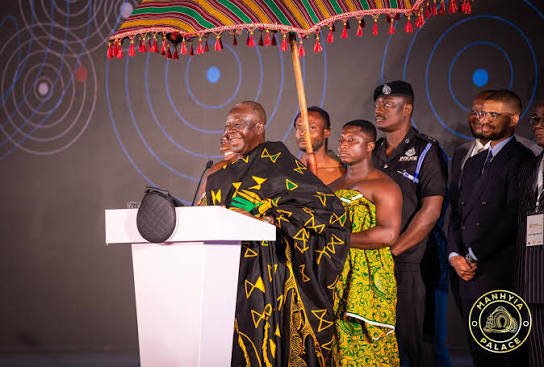
The Asantehene, Otumfuo Osei Tutu II, has endorsed President John Dramani Mahama’s mineral sector reforms, saying Ghana’s renewed focus on local processing and value addition could help break the cycle of poverty and ensure the country benefits more significantly from its natural resources. Editorial Ethics & Independence
The traditional ruler’s position was communicated by the Essumejahene, Nana Okyere Kusi Ntrama, at the Mining in Motion Conference in Accra on Monday, October 19, 2026.
He said the government’s agenda to move Ghana beyond exporting raw minerals could provide a foundation for industrialisation, job creation and broader economic transformation.
According to a report, the Asantehene believes Ghana must focus not only on extracting minerals but also on what the country produces from them.

Retaining more value domestically, he argued, would help ensure that the nation’s mineral wealth contributes more directly to its economic development.
The endorsement comes as the government intensifies efforts to reform mineral governance, strengthen local processing capacity and increase the economic benefits Ghana receives from its gold, bauxite, manganese, iron and other mineral resources.
Moving beyond raw mineral exports
Ghana has substantial mineral deposits, but the economic benefits of extraction depend partly on how much processing, manufacturing and related commercial activity takes place within the country.
When minerals are exported in largely unprocessed form, opportunities for refining, manufacturing and other value-added activities may be developed elsewhere.
Expanding domestic processing could create new opportunities for Ghanaian businesses, skilled workers, engineers, technicians and entrepreneurs.
The Asantehene’s endorsement reflects a longstanding national ambition to connect mineral wealth with industrial development.
Nana Okyere Kusi Ntrama linked the current policy direction to the vision of Ghana’s first President, Dr Kwame Nkrumah, who sought to strengthen the country’s control over its natural resources and establish domestic mineral-processing capacity.
The message is that natural resources should serve as a foundation for building productive industries rather than remaining primarily a source of raw material exports.
However, achieving this ambition will require substantial investment in infrastructure, reliable electricity, technical skills, financing and modern processing facilities. Without these supporting conditions, local industries could struggle to compete in international markets.
GoldBod and the wider mineral reform agenda
The Asantehene also backed the broader direction of the government’s mineral policies, including the establishment of the Ghana Gold Board, commonly known as GoldBod.

GoldBod is intended to strengthen the organisation and oversight of Ghana’s small-scale gold trading sector and improve the country’s ability to retain value from gold production.
The government has presented the institution as part of its wider strategy to improve mineral governance and increase domestic participation in the gold value chain. Editorial Standards
Nana Okyere Kusi Ntrama acknowledged that GoldBod has faced controversy but maintained that such concerns should not automatically undermine the broader objective of securing greater benefits from Ghana’s mineral resources.
The position highlights the distinction between supporting a policy objective and assessing how effectively individual institutions deliver it. Transparent operations, credible oversight and clear reporting will be important if the reforms are to maintain public confidence.
Mahama sets 2030 target for ending raw ore exports
At the same conference, President Mahama announced a target of 2030 for Ghana to end exports of raw mineral ores, outlining plans to introduce phased restrictions supported by legal measures and mineral-specific implementation timelines.

The proposed policy covers resources including bauxite, manganese, iron and lithium. The government wants these minerals to support domestic processing and manufacturing, creating more economic activity within Ghana rather than allowing much of the value addition to occur abroad. Corrections Policy
According to reports, the President said the transition would require clear obligations for investors and deliberate investment in infrastructure, skills, energy and financing.
The target represents a significant policy ambition, but its success will depend on whether Ghana can develop processing facilities at a competitive scale and attract investors willing to commit capital over the long term.
National consensus and accountability
The Asantehene’s support also comes with a broader question about the continuity of mineral policy.

Long-term industrial projects often require years of investment, making consistent rules and political commitment important for businesses and communities.
Keeping the mineral agenda above partisan politics could help prevent major policy reversals whenever governments change.
At the same time, reforms must be accompanied by effective regulation, environmental safeguards and meaningful protections for communities affected by mining.
The fight against illegal mining, popularly known as galamsey, remains another important part of the challenge.
President Mahama reported at the conference that authorities had seized more than 8,200 items of equipment associated with illegal mining, including 135 excavators, and recovered nearly 200 firearms.
These enforcement efforts sit alongside the wider ambition to make the mining sector more accountable and productive. Newscard
Ultimately, Ghana’s mineral wealth can contribute to reducing poverty only if the benefits translate into jobs, stronger local businesses, public revenue and improved opportunities for communities.
The Asantehene’s endorsement strengthens the call for a long-term approach that combines domestic processing with responsible mining, transparent governance and sustained investment.
The government’s challenge now is to turn its mineral reform agenda into measurable outcomes.
If Ghana can retain more value from its resources while building competitive local industries, the country could establish a stronger link between mineral wealth and lasting economic development.