

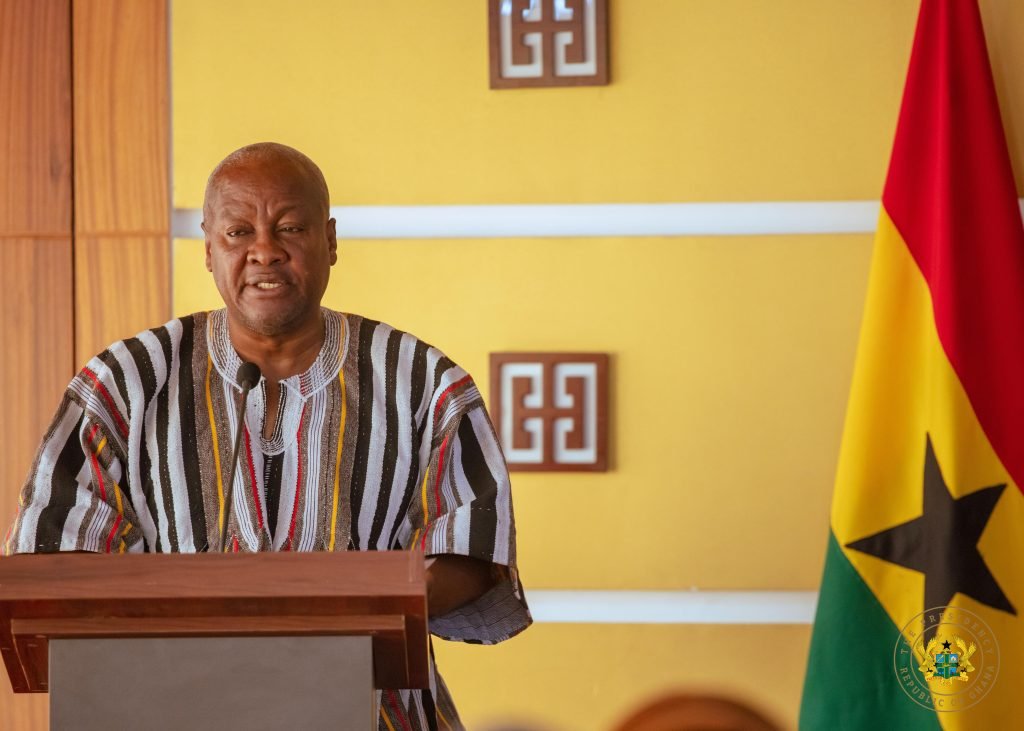
President John Dramani Mahama says the Ghana Gold Board’s (GoldBod) policy to strengthen local gold testing and refining will help Ghana retain more value from its gold resources and increase the economic benefits of the sector.
He made the remarks at the 2026 Mining in Motion Forum, organised by the African Minerals Policy Centre at the Mövenpick Ambassador Hotel on Monday, October 19, 2026.

The policy is expected to expand local participation in gold testing and refining, two critical stages of the gold value chain that influence quality verification, processing and commercial value.
Strengthening domestic capacity in these areas could create skilled employment opportunities, support related industries and reduce reliance on foreign facilities for essential gold-processing services.
The initiative also aligns with broader efforts to increase local value addition to Ghana’s mineral resources by moving beyond the extraction and export of raw materials towards a more integrated domestic gold industry.
GoldBod plays a central role in regulating Ghana’s gold-trading framework, particularly the formalisation of the artisanal and small-scale mining (ASM) gold sector. Improved local testing and refining capacity could complement these efforts by supporting quality assurance, transparency and the development of the domestic gold value chain.
Mahama Commends GoldBod Over US$10.8bn in Foreign Exchange Earnings
President Mahama also commended GoldBod for its contribution to the growth of Ghana’s artisanal and small-scale mining gold exports, citing an increase in export volumes and foreign exchange earnings in 2025.
He compared the sector’s performance in 2024 with that of 2025, when GoldBod began operations in April.
“I wish to commend the GoldBod for the successes that it has chalked. In 2024, from the artisanal and small-small mining sector, Ghana exported 64 tonnes of gold,” he said.
According to the President, exports rose to 104 tonnes in 2025, an increase of 40 tonnes over the previous year. The 2025 figure covered the period from April to December, following GoldBod’s establishment.
He also highlighted the increase in foreign exchange earnings from the formalisation and regulation of small-scale gold exports.
“I’m happy to note that the GoldBod in 2025 alone, with the regulation of export of small-scale gold, brought into this country 10.8 billion dollars, which is an almost 100% increase over the 4.66 billion USD that came into the country in 2024,” President Mahama said.
The figures, as cited by the President, point to the growing contribution of the artisanal and small-scale mining sector to Ghana’s gold trade and the importance of channelling exports through formal regulatory structures.
GoldBod’s Role in Ghana’s Gold Industry
Established under the Ghana Gold Board Act, 2025 (Act 1140), GoldBod is mandated to regulate and develop the country’s gold-trading industry, formalise artisanal and small-scale mining gold transactions and support foreign exchange generation.
The government’s focus on expanding local testing and refining is intended to help Ghana capture more of the value generated from its mineral resources rather than relying primarily on the export of gold for processing elsewhere.
Further details on the implementation of the policy, including timelines, applicable requirements and plans to expand domestic testing and refining capacity, will be important in assessing its potential economic impact.
President Mahama’s remarks underscore the government’s stated ambition to strengthen oversight of the gold sector while expanding local participation in the activities that generate value from the country’s mineral wealth.
By:Rachael Djabakie