

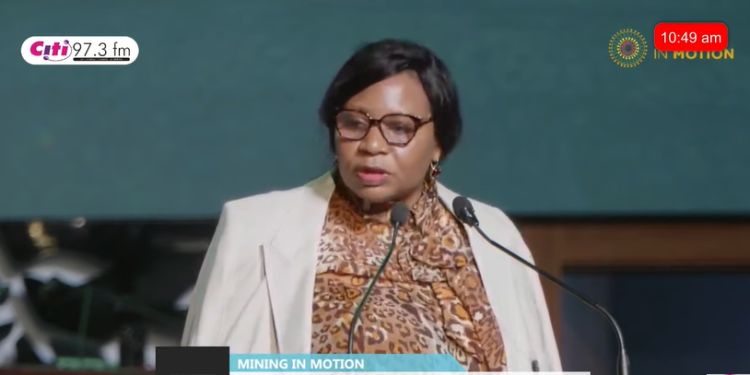
African Union (AU) Commissioner for Economic Development, Trade, Tourism, Industry and Minerals, Francisca Tatchouop Belobe, has identified Ghana’s Gold Board (GoldBod) as a potential model for African countries seeking to strengthen foreign exchange reserves, support currency stability and improve economic resilience.
Speaking at the Mining in Motion Conference in Accra on Monday, October 19, 2026, Ms Belobe said Ghana’s approach to managing its gold sector demonstrated how mineral resources could be linked to broader national development objectives.
According to reports, the commissioner commended President John Dramani Mahama’s administration for reforms aimed at strengthening local participation, supporting domestic enterprises and increasing the economic value retained from mineral resources. Editorial Standards
She explained that Ghana’s experience offered lessons for other African countries looking to use their natural resources more effectively, particularly in building stronger external financial buffers and reducing vulnerability to international economic shocks.
“The establishment of the Ghana Gold Board illustrates how mineral sector reforms can serve broader national development objectives by improving foreign exchange, strengthening international reserves and supporting currency stability as well as macroeconomic resilience,” Ms Belobe said, according to the report.
Her comments highlight growing interest in African-led approaches to resource management that seek to retain more economic value within producing countries instead of relying predominantly on raw mineral exports.
Ghana established GoldBod to regulate the gold trading sector, formalise artisanal and small-scale mining transactions, and strengthen the country’s ability to generate foreign exchange from gold exports.
Its activities have increasingly become part of the government’s wider strategy to improve reserve accumulation and support the domestic foreign exchange market.
GoldBod’s role in strengthening Ghana’s reserves
GoldBod’s approach centres on purchasing and aggregating gold, particularly from the artisanal and small-scale mining sector, and generating foreign exchange through its trading operations.

The foreign currency generated can then be channelled through authorised commercial banks and the Bank of Ghana to support market liquidity and reserve accumulation.
The model is intended to improve the formal recording of gold transactions while ensuring that more of the foreign exchange generated by Ghana’s mineral resources enters the country’s financial system. Editorial Ethics & Independence
In September 2026, GoldBod reported generating US$1.871 billion in foreign exchange from its artisanal and small-scale mining gold trading operations, exceeding its monthly target of US$1.4 billion. Of the total, US$701.3 million was sold to authorised commercial banks, while US$1.17 billion was provided to the Bank of Ghana to support reserve accumulation.
These figures illustrate the potential scale of gold-related foreign exchange flows under the programme. However, the long-term contribution to economic stability will depend on the sustainability of gold production, the cost of operations, transparent accounting and effective management of the resulting funds.
Lessons for other African countries
Ms Belobe’s endorsement comes as other African countries show interest in Ghana’s approach to organising and regulating its gold sector.

A report indicated that delegations from Sierra Leone, Mozambique, Tanzania, Zimbabwe, Zambia, Sudan and Namibia had visited Ghana to learn about the GoldBod model and its approach to formalising gold trading and centralising market regulation.
The interest reflects a wider continental challenge: many African countries possess substantial mineral resources but struggle to translate their exports into stronger foreign exchange positions, domestic industrial growth and broad-based economic benefits.
Adapting the Ghanaian model could help interested countries explore better oversight of mineral transactions, improve the traceability of gold and increase the proportion of export earnings captured through formal financial channels.
Nevertheless, the approach would need to reflect the economic circumstances of each country. Differences in mining structures, regulatory capacity, production volumes and financial systems mean that a model that works in Ghana may require adjustments elsewhere.
Effective implementation would also require cooperation between mining regulators, central banks, commercial banks and licensed operators.
Currency stability and the wider economy
One of the key objectives of GoldBod’s foreign exchange operations is to improve the availability of dollars in Ghana’s domestic market.

When exporters generate foreign currency through formal channels and supply it to the financial system, it can help meet the foreign exchange needs of businesses importing fuel, machinery, medicines and other essential goods.
Greater dollar availability may ease pressure on the cedi, although exchange-rate movements also depend on factors such as import demand, investor confidence, fiscal policy, international commodity prices and monetary conditions.
GoldBod’s activities therefore represent one component of Ghana’s broader economic stabilisation efforts rather than a guarantee of permanent currency appreciation.
The programme must also balance its foreign exchange objectives with responsible gold sourcing, effective regulation and environmental protection. Corrections Policy
In particular, formalising small-scale gold trading should be accompanied by measures to combat illegal mining and ensure that gold entering the supply chain can be traced to legitimate sources.
A broader strategy for Africa’s mineral wealth
The commissioner’s remarks reinforce calls for African countries to take a more strategic approach to natural resources by combining stronger regulation, local participation and value addition.

Beyond generating foreign exchange, mineral sector reforms can create opportunities for domestic businesses, improve employment prospects and support industries involved in refining, processing and manufacturing.
For Ghana, the challenge will be to ensure that GoldBod continues to deliver measurable economic benefits while maintaining transparency and operational efficiency. Newscard
For other African countries, the model offers an opportunity to examine how resource management can contribute to stronger financial systems and greater economic independence.
Ultimately, Ms Belobe’s message is that Africa’s mineral wealth should play a more deliberate role in building resilient economies.
By improving how resources are traded, foreign exchange is managed and domestic industries are supported, countries across the continent could strengthen their capacity to withstand external shocks and pursue sustainable development.