

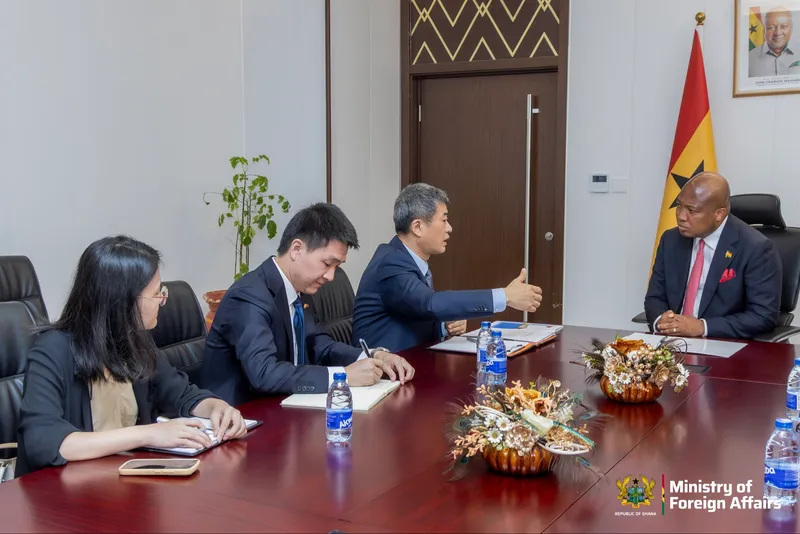
Ghana is preparing to receive a team of technical experts from China to advance three major development projects, the proposed Damongo University of Science and Engineering, the Aflao Modern Market Complex and the refurbishment of the National Theatre in Accra. Editorial Standards
Foreign Affairs Minister Samuel Okudzeto Ablakwa announced the development after meeting Chinese Ambassador to Ghana Cong Song on Thursday, October 8, 2026. The discussions focused on progress made on the three projects, which form part of Ghana’s development cooperation with China.
According to Ablakwa, funding for the projects remains secured, while all feasibility reports have been completed, clearing the way for the next stage of preparations.
“Ghana looks forward to receiving a team of technical experts from China in the coming weeks for the three key projects to commence,” the minister said in a post on social media.
The announcement signals renewed momentum for the projects, which are expected to contribute to educational development, commercial activity and the growth of Ghana’s creative arts industry.
Although the arrival of the technical team is an important step, further work will be required to translate the plans into completed infrastructure. Technical assessments, implementation arrangements and the coordination of relevant institutions will be important as the projects move forward.
Damongo university to support science and technology education
One of the major projects is the proposed Damongo University of Science and Engineering, which is intended to expand access to tertiary education and strengthen Ghana’s capacity to train professionals in science and technology.

The planned institution is expected to provide opportunities for students seeking specialised education in areas that are increasingly important to economic development, including engineering and emerging digital technologies.
The project could also support efforts to distribute educational infrastructure more evenly across the country. Expanding tertiary education opportunities outside established university centres may help students in northern Ghana access higher education closer to their communities.
In September 2026, Education Minister Haruna Iddrisu indicated that the US$30 million grant secured from China would not be sufficient to cover the full cost of establishing and equipping the university. He said the project could require more than US$100 million, making additional funding and partnerships necessary to complete it.
The arrival of technical experts could help clarify project requirements and support the next stages of planning and implementation. However, the funding gap previously identified by the Education Minister remains an important consideration for the project’s long-term delivery. Editorial Ethics & Independence
Beyond the construction of lecture halls and other facilities, establishing a functional university will require laboratories, equipment, qualified academic staff, student accommodation and sustainable operational funding.
The success of the project will therefore depend not only on the completion of physical infrastructure but also on the government’s ability to ensure that the institution can deliver quality education and respond to Ghana’s skills needs.
Aflao market expected to strengthen trade
The second project is the Aflao Modern Market Complex in the Volta Region, a proposed commercial facility intended to improve trading conditions and strengthen economic activity in the border town.

Aflao occupies an important position in cross-border commerce between Ghana and neighbouring Togo. A modern market could provide traders with improved facilities for selling goods, storing products and serving customers from both countries.
Ghana announced a US$30 million Chinese grant for the market redevelopment in July 2025. The initiative was presented as an opportunity to improve commercial infrastructure and strengthen trade links between Aflao and Lomé.
If implemented effectively, the project could benefit traders, transport operators, food vendors and other businesses whose activities depend on the movement of goods and people across the border.
Improved market facilities may also help address challenges associated with congestion, sanitation, security and the organisation of commercial activities. These benefits, however, will depend on the final design, management arrangements and the availability of adequate utilities. Corrections Policy
Consultation with traders and other affected groups will be important to ensure that the market meets the needs of those expected to use it. Authorities will also need to consider access, affordability and arrangements for relocating traders if construction affects existing commercial spaces.
The technical team’s involvement could help advance preparations for the project, although the precise construction timetable and implementation details have not been fully outlined in the latest announcement.
National Theatre refurbishment to support the creative arts
The third project involves the refurbishment of the National Theatre in Accra, one of Ghana’s major venues for theatre, music, dance and other cultural performances.

Since opening in 1992, the facility has played an important role in supporting the country’s performing arts and hosting cultural events. Its proposed modernisation is expected to improve the building’s infrastructure, technical systems and overall functionality.
A refurbishment could provide performers and production teams with improved facilities for staging concerts, plays, exhibitions and other events. It may also help the theatre accommodate changing technical demands within the entertainment industry.
The National Theatre’s importance extends beyond performances. It serves as a platform for promoting Ghanaian culture, supporting creative professionals and showcasing local talent to domestic and international audiences.
Modern lighting, acoustics, digital systems and improvements to the building could strengthen its ability to host high-quality productions. Better facilities may also create opportunities for partnerships, training and exchanges between Ghanaian and international arts practitioners.
The proposed renovation builds on longstanding cooperation between Ghana and China. The Chinese government supported the construction of the original theatre, which was handed over to Ghana in December 1992.
The latest project could therefore renew a longstanding partnership while helping preserve an important national cultural institution.
Ghana–China cooperation enters another phase
Ablakwa’s announcement highlights the role of diplomatic engagement in advancing development projects that require international technical and financial cooperation.

The meeting with Ambassador Cong Song provided an opportunity to review the three initiatives and assess their progress. The minister said Ghana would continue working with international partners to support development and transformation.
Nevertheless, securing funding and completing feasibility studies are important milestones rather than proof that construction has been completed or that all implementation challenges have been resolved.
The next phase will require coordination among government ministries, Chinese technical experts, contractors and the institutions responsible for each project. Newscard
Transparent procurement, effective supervision, realistic timelines and proper maintenance plans will also be important to ensure value for money.
For communities in Damongo, Aflao and Accra, the central concern will be whether the projects deliver practical improvements in education, livelihoods and cultural opportunities.
The expected arrival of the Chinese technical team therefore marks a significant step in Ghana’s efforts to move the three projects forward.
Their eventual impact will depend on how quickly preparations translate into implementation and whether the completed facilities can be operated sustainably for the benefit of the public.