

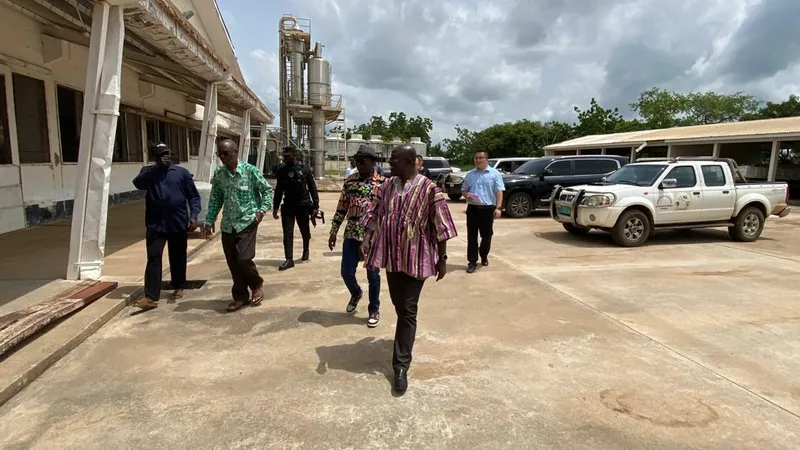
The Upper East Regional Minister, Donatus Akamugri Atanga, has led a delegation of Chinese investors to assess the abandoned Pwalugu Tomato Factory as the government explores opportunities to restore the facility and strengthen local agricultural processing. Editorial Standards
The visit by representatives of Hanway International Investment Ltd., led by the company’s Chief Executive Officer, Cui Yongzhi, focused on examining the factory’s condition, assessing the surrounding agricultural potential and discussing possible investment arrangements to return the facility to production.
The factory, also referred to as the Northern Star Tomato Factory, has remained inactive since 2012. Its prolonged closure has deprived farmers and businesses in the area of a major potential market for locally produced tomatoes while leaving the industrial facility vulnerable to deterioration and theft.
The latest engagement signals renewed efforts to attract private investment into the facility, which could play an important role in reducing post-harvest losses, creating employment and expanding opportunities for farmers in the Upper East Region.
During the visit, the delegation inspected the factory premises and nearby agricultural lands along the White Volta to assess the resources available to support a possible revival.
The inspection reportedly revealed significant deterioration across parts of the facility, including overgrown vegetation, damaged roofing and decaying wooden structural supports. Some properties have also reportedly been stolen over the years.
Despite the visible deterioration, officials indicated that some of the tomato-processing machinery and equipment appeared to remain in relatively good condition and might be restored with repairs and testing. A technical assessment would, however, be required to establish the actual condition of the equipment and the investment needed to make the factory operational.
The factory was designed to process approximately 500 metric tonnes of tomatoes, with the potential to support a substantial workforce. Reports indicate that it could provide direct employment for about 600 people and indirect opportunities for approximately 2,500 others, including farmers supplying raw materials.
If those employment opportunities can be realised, the facility could provide a significant economic boost to communities whose livelihoods depend on agriculture and related commercial activities.
Plans for local processing and packaging
One of the key issues discussed during the visit was the need to establish a canning and packaging facility at Pwalugu if production resumes.

The Regional Minister explained that under the factory’s previous operating arrangement, tomato paste was processed at Pwalugu, placed in drums and transported to Tema in the Greater Accra Region for canning.
The proposed arrangement would bring that final stage of production closer to the source of the raw materials. This could reduce transportation requirements, improve efficiency and allow finished products to reach markets in a more convenient form. Editorial Ethics & Independence
Local canning could also help address concerns about the storage and shelf life of processed tomato paste. Properly packaged products can be stored and distributed more efficiently when produced under suitable food-safety and quality-control standards.
The proposal would therefore require investment not only in the factory’s existing processing equipment but also in packaging technology, quality assurance, storage facilities and reliable distribution systems.
Expanding beyond tomato processing
The minister also suggested that the factory should not depend exclusively on tomatoes. He proposed that the facility could eventually process other agricultural products, including onions, pepper, garden eggs, beans and dawadawa-based products.
Diversifying production could help the factory operate for longer periods of the year instead of relying on a single crop with seasonal supply patterns.
Such an approach could create additional markets for farmers and provide the company with a wider range of products for local and regional consumers. However, the feasibility of processing each crop would depend on market demand, suitable equipment, production costs and reliable supplies. Corrections Policy
The minister further emphasised the need to improve agricultural productivity and the quality of crops supplied to the factory.
A processing plant requires a dependable supply of raw materials to operate efficiently. Without sufficient volumes of suitable tomatoes, even a rehabilitated factory could struggle to maintain production, meet orders and generate revenue.
The proposed revival would therefore need to be supported by a coordinated agricultural supply chain involving farmers, extension services, irrigation and water management, storage, transportation and agreed purchasing arrangements.
White Volta offers agricultural potential
The delegation’s visit to agricultural lands along the White Volta was intended to help investors assess the area’s potential for tomato production.
Access to suitable farmland and reliable water supplies could support expanded cultivation, although the scale of production would depend on land availability, irrigation infrastructure, environmental considerations and the needs of local communities.
If the factory is restored, farmers could benefit from a more predictable market for their crops. A reliable buyer may reduce the risk of produce remaining unsold during periods of high supply, when prices can fall and perishable tomatoes may go to waste.
For such benefits to materialise, however, the proposed investment would need transparent purchasing arrangements and prices that make production commercially viable for farmers.
Regional markets and import substitution
The minister also highlighted Pwalugu’s location near neighbouring countries, including Burkina Faso and Togo, as a potential advantage for regional trade. With appropriate packaging, quality standards and distribution arrangements, a revived factory could explore markets beyond Ghana.
The government is also interested in using local processing to reduce dependence on imported tomato products. The minister proposed that public institutions, including schools and hospitals involved in government feeding programmes, could provide a potential market for locally manufactured products.

He further raised the possibility of tax relief on machinery and equipment required for rehabilitation, saying he would engage the government after the investors identified their requirements.
These proposals remain part of the discussions surrounding the potential investment. The final arrangements, including any tax incentives, procurement commitments or export plans, would need to be formally agreed and implemented.
A revival plan must address long-term challenges
The renewed interest in the Pwalugu Tomato Factory offers an opportunity to reconsider how industrial investment can support agriculture and employment in northern Ghana.
However, restoring the facility will require more than repairing buildings and machinery. Investors and government authorities will need to establish a viable business model, secure reliable supplies, provide working capital, maintain equipment and identify dependable markets for finished products.
The experience of the factory’s prolonged inactivity also underlines the importance of sustainable management, accountability and long-term planning.
For farmers, the most important outcome would be a dependable market that rewards production and reduces losses. For workers and surrounding communities, a successful revival could generate jobs and stimulate economic activity.
The assessment by Hanway International Investment Ltd. is an early step in exploring that possibility. Whether it leads to a formal investment agreement and the resumption of production will depend on the technical findings, financing arrangements and commitments made by the parties. Newscard
For now, the Upper East Regional Minister’s engagement with the Chinese delegation has renewed attention on the abandoned factory and its potential role in strengthening local food processing, agricultural incomes and regional trade.