

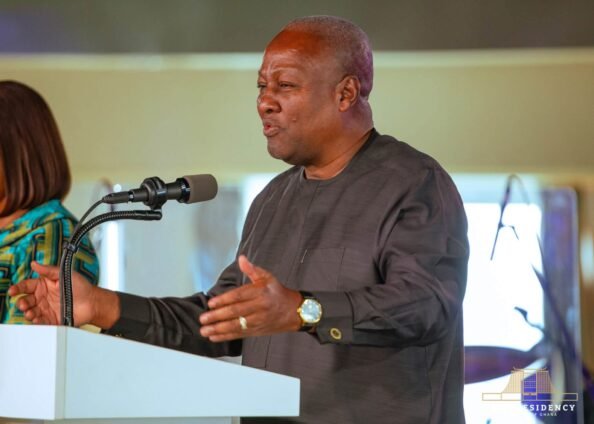
President John Dramani Mahama has directed Metropolitan, Municipal and District Chief Executives (MMDCEs) in regions where he has conducted the Presidential Accountability Series to organise similar engagements within their respective jurisdictions.
The directive, issued by the Ministry of Local Government, Chieftaincy and Religious Affairs, seeks to extend the government’s accountability and transparency agenda to the local level.

Under the directive, MMDCEs are to hold town hall meetings twice a year to account to residents for the implementation of government policies and programmes within their respective assemblies.
“The MMDA Accountability Series is intended to provide a structured platform for MMDCEs to account to citizens for the implementation of government policies and programmes at the local level bi-annually through town hall meetings,” the directive stated.
The Ministry said the initiative would complement the Presidential Accountability Series by creating opportunities for direct engagement between local authorities and residents.
The sessions are expected to cover the performance of each Metropolitan, Municipal or District Assembly against its approved Medium-Term Development Plan and Annual Action Plan, as well as the implementation of government flagship programmes.
MMDCEs will also be required to account for the use of public funds, including the District Assemblies Common Fund (DACF), Internally Generated Funds (IGF) and other resources.
Other areas to be addressed include infrastructure and development projects, sanitation and waste management, education, healthcare, social protection, local economic development, revenue mobilisation and expenditure management.
The engagements will also cover employment, youth development and skills programmes, support for persons with disabilities and vulnerable groups, security and disaster management, and the status of Assembly commitments and projects.
MMDCEs are further expected to outline their priorities and commitments for the next implementation period, allowing residents to assess both previous performance and planned interventions.
The Ministry has directed that the engagements be broad-based, involving traditional authorities, Members of Parliament, Assembly Members, Unit Committee representatives, religious leaders, organised labour, civil society organisations, youth and women’s groups, persons with disabilities, market associations, businesses, professional bodies, development partners, community-based organisations, the media and the general public.
The directive emphasised that residents must have sufficient opportunity to ask questions and seek clarification on the performance and activities of their respective assemblies.
“Adequate opportunity should be provided for members of the public to ask questions and seek clarification on matters relating to the performance and activities of the MMDA,” it stated.
Affected MMDAs have been instructed to begin preparations immediately and organise the sessions within a period to be communicated by the Regional Coordinating Councils, preferably shortly after the Presidential Accountability Series in each region.
The Regional Coordinating Councils will coordinate and monitor the exercise, ensure that eligible MMDAs participate and assess the quality and inclusiveness of the engagements.
The Ministry will also conduct monitoring visits or participate in selected sessions as part of its oversight responsibilities.
The directive described the initiative as a “priority accountability and citizen-engagement assignment” and instructed MMDCEs to personally lead the process in their respective jurisdictions.
The Ministry also directed MMDAs to make the necessary budgetary arrangements within their approved budgets and in accordance with applicable financial management procedures to facilitate the engagements.
It said the exercise is expected to promote open, citizen-centred discussions and strengthen accountability in local governance.
By:Rachael Djabakie