


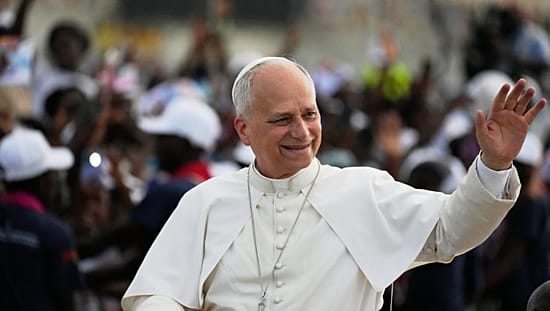
The Government of Ghana has welcomed Pope Leo XIV’s historic apology over the Catholic Church’s role in slavery, describing the gesture as a courageous step toward truth, healing and global justice while urging continued international dialogue on historical accountability and reparative justice.
Ghana’s Ministry of Foreign Affairs issued an official statement praising the Pope’s remarks after the Pontiff acknowledged the Catholic Church’s historical involvement in legitimising slavery and the transatlantic slave trade in his first papal encyclical, titled Magnifica Humanitas.
In the encyclical, Pope Leo XIV described slavery as “a wound in Christian memory” and apologised for the Church’s complicity in centuries of oppression linked to the transatlantic slave trade and colonial systems. He also called for restorative justice for communities still affected by the long-term consequences of slavery, although he stopped short of directly endorsing financial reparations.

According to Ghana’s Foreign Affairs Ministry, the apology represents “an act of moral courage” and an important contribution toward promoting human dignity, historical truth and reconciliation. The ministry further stated that the Pope’s comments reinforce the global understanding that historical injustices cannot be ignored and must be confronted openly through honest reflection and dialogue.
The statement also conveyed President John Dramani Mahama’s appreciation to Pope Leo XIV and reiterated Ghana’s commitment to continued international conversations on justice, memory and the legacy of slavery.
Pope Leo XIV’s apology is being widely described as one of the strongest acknowledgements ever made by a pope regarding the Vatican’s historical role in slavery. While previous popes, including Pope John Paul II and Pope Francis, condemned aspects of slavery and colonial abuse, they stopped short of explicitly admitting the Vatican’s formal role in authorising and legitimising slavery through papal decrees.
The Associated Press reported that Pope Leo XIV specifically referenced historical papal bulls that authorised the enslavement of non Christians during the colonial era, making him the first pope to publicly acknowledge the Vatican’s direct institutional involvement in legitimising slavery.

The apology has also reignited conversations about reparative justice across Africa and the African diaspora. Ghana has become one of the leading African voices advocating stronger international recognition of slavery as a crime against humanity and pushing for continued dialogue on reparations and historical accountability.
Earlier this year, Ghana secured broad international support at the United Nations for a resolution declaring the transatlantic slave trade one of the gravest crimes against humanity. The initiative was championed by President Mahama on behalf of the African Union and received backing from over 120 countries.
Ghana’s government has repeatedly argued that the economic and social consequences of slavery continue to affect African nations and diaspora communities today, making historical justice discussions relevant beyond symbolic apologies.
Analysts say Pope Leo XIV’s remarks may place additional moral pressure on religious institutions, Western governments and international organisations to engage more seriously with ongoing demands for historical justice and reconciliation.
The Pope’s apology also comes at a time when African and Caribbean countries are strengthening partnerships focused on cultural restoration, historical remembrance and reparatory advocacy. Ghana has increasingly positioned itself as a major centre for Pan African remembrance initiatives through programmes such as the Year of Return and Beyond the Return campaigns, which seek to reconnect the African diaspora with the continent.
Historians estimate that millions of Africans were forcibly taken from the continent during the transatlantic slave trade over several centuries, with many passing through forts and castles located along Ghana’s coast before being transported to Europe and the Americas.

The Catholic Church itself has faced growing criticism in recent decades over its historical relationship with colonialism and slavery. Scholars and activists have long argued that some Church institutions profited from slave labour while religious doctrines were sometimes used to justify slavery and European imperial expansion.
Although Pope Leo XIV’s apology has been praised globally, some activists believe more concrete action is still needed. Several reparations advocates have argued that symbolic statements must eventually lead to practical measures, including historical education reforms, cultural restoration initiatives and broader international commitments toward addressing inequalities linked to slavery and colonial exploitation.
Still, many observers view the apology as a major moment in global historical discourse, particularly because it came directly from the head of the Catholic Church and acknowledged institutional responsibility in unusually direct language.
For Ghana, the development reinforces its growing international role in conversations surrounding historical justice, Pan African identity and the long-term legacy of slavery.