

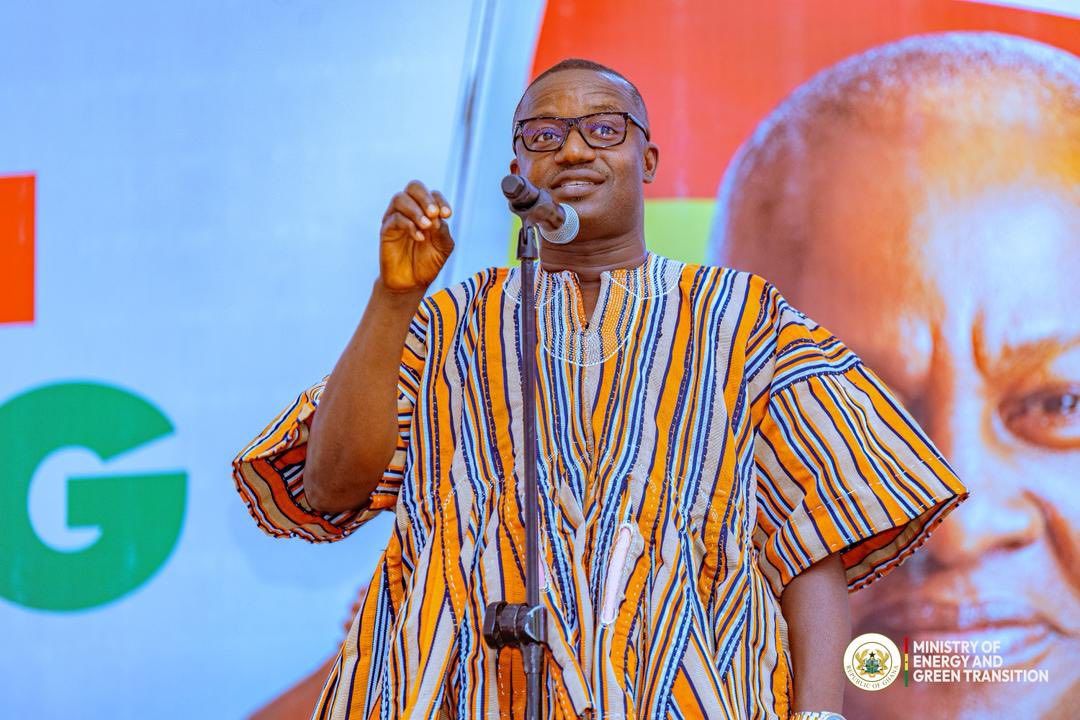
Ghana’s Minister for Energy and Green Transition, John Abdulai Jinapor, has assured the public that electricity supply across the country has remained largely stable despite recent disruptions in some communities.
The Minister’s comments come amid renewed public concerns over intermittent power outages and fears of a return to widespread “dumsor” after a series of technical challenges affected parts of the national grid in recent months.
According to reports, the Ministry maintains that Ghana’s overall power generation system remains stable and capable of meeting national demand, even though certain areas have experienced temporary interruptions linked to maintenance works and technical faults.
Government officials have repeatedly rejected claims that the country has returned to nationwide load shedding. Earlier this year, the Ministry of Energy stated that recent outages in areas such as Achimota, Dodowa, Tesano, Adenta and Lakeside were largely localised technical problems rather than evidence of insufficient generation capacity.

The concerns intensified following the major fire incident at the Akosombo Dam complex in April 2026, which temporarily disrupted operations at one of Ghana’s most important power generation facilities. The incident damaged parts of the GRIDCo substation and forced engineers to implement emergency interventions to restore stability to the national grid.
President John Dramani Mahama later announced that all six turbines at the Akosombo Hydroelectric Dam had been successfully restored after engineers from the Volta River Authority and Ghana Grid Company bypassed the damaged control systems and brought the units back online.
Energy Minister Jinapor also confirmed that all affected generation units were restored to service following the disruption, praising engineers and technical teams for working around the clock to stabilise the system.
Despite these assurances, discussions around power reliability continue to dominate public conversation, particularly on social media, where some residents have complained about recurring outages in specific communities. Online discussions among Ghanaian residents suggest that while many areas have experienced improved stability, others continue to report intermittent blackouts lasting several hours or more.
The Ministry, however, insists that the current situation differs significantly from the prolonged nationwide power crisis Ghana experienced during previous years. Officials argue that ongoing maintenance exercises and infrastructure upgrades are necessary to prevent more severe long term breakdowns within the system.
As part of efforts to improve reliability, the government has launched nationwide safety audits of power substations and transformer systems following the Akosombo fire incident. Authorities say more than 3,000 ageing transformers across the country are being assessed for replacement or upgrades to strengthen grid stability.

The government has also undertaken financial reforms within the energy sector to address longstanding debt problems that have historically affected power generation and fuel supply. Earlier this year, Ghana’s Finance Ministry announced that the country had cleared approximately $1.47 billion in legacy energy sector debts owed to independent power producers and gas suppliers in a move aimed at restoring confidence and operational stability within the sector.
Meanwhile, officials say several energy infrastructure projects are underway in regions such as Ashanti to improve electricity distribution and meet rising demand. These projects include new transformer installations, substation upgrades and expansion of generation facilities expected to support long term power reliability.
Although concerns over outages remain politically sensitive in Ghana due to the country’s history with power shortages, the Energy Ministry maintains that current interventions are focused on ensuring stable and sustainable electricity supply rather than implementing nationwide load shedding.