

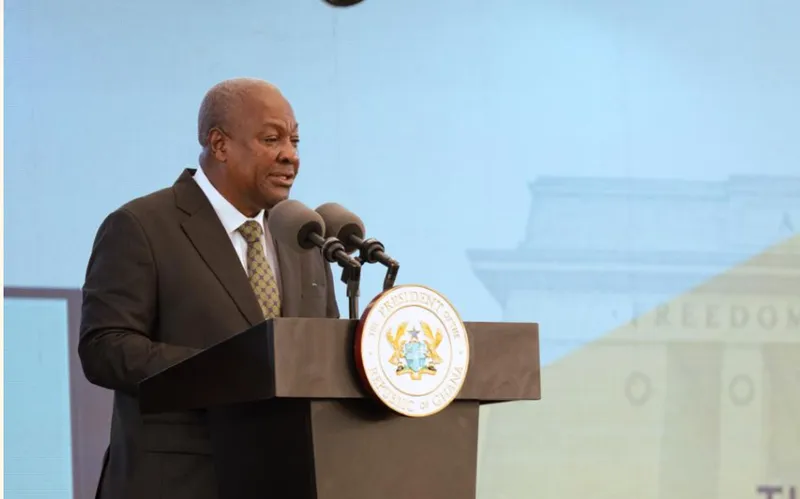
President John Dramani Mahama has called on ECOWAS member states that meet the requirements for adopting the proposed single currency, the ECO, to proceed with its launch rather than wait for all 15 countries to become ready.
He made the call on Tuesday in Sierra Leone at the West African Integration and Investment Summit (WAIIS), where he also outlined five strategies to address irregular and dangerous migration.

The proposal for a phased introduction of the ECO was jointly presented by President Mahama and his Sierra Leonean counterpart, Julius Maada Bio, at the last ECOWAS summit.
“If two countries are ready,” President Mahama said, “let them start,” with other member states joining when they meet the required convergence criteria.
Under the proposed arrangement, the ECO would initially operate alongside national currencies, allowing traders within the region to settle transactions without relying on the US dollar.
President Mahama said the number of countries meeting the convergence requirements had fluctuated over time, moving from two to five, then three and seven before declining again.
He argued that waiting for all 15 ECOWAS countries to qualify before introducing the currency could delay the process indefinitely.
“Waiting for all 15 members to qualify is waiting for Jesus Christ to come back,” he said.
The President noted that trade among West African countries remained relatively low, accounting for between 12 and 15 per cent of total trade in the region. ECOWAS has set 2027 as its target for launching the single currency.
Ghana offers to host regional financial institutions
On Monday, President Mahama received the new President of the ECOWAS Commission, General Birame Diop (Rtd.), for discussions that included plans for the single currency.
During the engagement, he announced Ghana’s readiness to host the proposed West African Central Bank and the West African Monetary Institute.
Mahama pushes regional energy cooperation
On energy, the President said only about seven per cent of electricity generated in West Africa currently crosses national borders through the West African Power Pool.
He argued that increased investment in electricity transmission infrastructure could raise cross-border power trade to nearly 30 per cent within five years.
According to him, Ghana has the capacity to supply an additional 2,000 megawatts of gas-fired electricity to the regional pool if the necessary transmission infrastructure is developed.
Energy Minister John Jinapor has also made a similar case for stronger regional energy cooperation during engagements with ECOWAS energy ministers.
Calls for stronger regional food production and infrastructure
President Mahama further highlighted the need for West African countries to reduce their dependence on imported food.
He said Ghana alone imports about US$3 billion worth of food annually, arguing that the situation undermines efforts to retain economic value within the region.
“Every time we eat that foreign rice or we eat the foreign chicken, we are exporting value and importing poverty,” he said, attributing the expression to Nigerian businessman Aliko Dangote.
He also cited the proposed Lagos-Abidjan highway as an example of delays in implementing major regional infrastructure projects.
The President said the project was first discussed when he served as a minister in 1998 and 1999 but remained on the drawing board decades later.
He argued that ECOWAS had for too long operated as an organisation driven mainly by heads of state rather than one whose integration efforts directly benefit its citizens.
President Mahama commended the summit, an initiative of President Bio, saying it could help move the region’s integration agenda forward.
By:Rachael Djabakie