

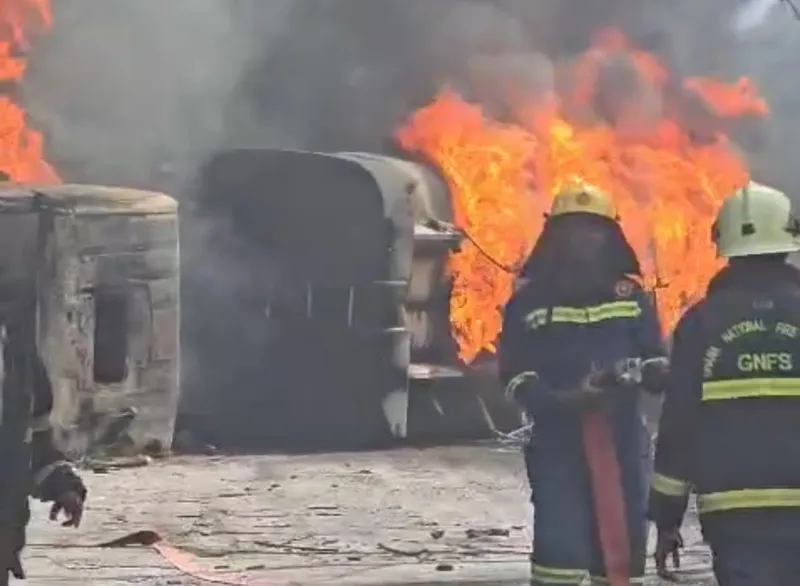
One person has died, while a fuel tanker driver has sustained serious injuries after a road accident triggered a major fire outbreak at Amamprobi Junction along the Mamfe–Adawso road in the Eastern Region. Ownership & Funding
The deceased, identified as the fuel tanker’s mate, was reportedly burnt beyond recognition following the incident, which involved a Kia Rhino truck and a fuel tanker.
The accident has raised fresh concerns about road safety and the dangers associated with fuel tanker crashes, particularly in areas where heavy-duty vehicles regularly share busy roads with commercial and private motorists.
According to information gathered, the tanker driver also suffered serious injuries and was reported to be in critical condition following the fire.
The incident prompted an emergency response from personnel of the Ghana National Fire Service (GNFS), who were dispatched to the scene to assist in containing the blaze and preventing further danger to road users and nearby communities.
Authorities have also issued a safety advisory, urging motorists and commuters to avoid the affected stretch until the situation is brought under control.
Details of the Amamprobi Junction accident
Preliminary information indicates that the accident involved a Kia Rhino truck with registration number GN 5021 2016 and a fuel tanker.

The collision reportedly triggered a fire that engulfed the vehicles, creating a dangerous situation along the Mamfe–Adawso stretch.
The tanker’s mate was caught in the blaze and died at the scene. The severity of the fire reportedly left the deceased burnt beyond recognition, making the incident particularly distressing. Corrections Policy
The tanker driver sustained serious injuries and was reported to be in critical condition.
However, detailed information about the exact circumstances that led to the collision, including the direction of travel of the vehicles and the possible cause of the accident, had not been established in the initial reports.
Authorities are expected to establish the circumstances surrounding the crash as further information becomes available.
Fire Service responds as road users receive warning
Following the outbreak of the fire, personnel of the Ghana National Fire Service were deployed to the scene to assist with the emergency response.

The presence of fuel in tanker accidents creates additional risks because spilled petroleum products and their vapours can ignite, potentially causing explosions and spreading fires beyond the vehicles directly involved.
Such incidents require specialised emergency response measures to protect victims, firefighters, motorists and residents in surrounding communities. Editorial Ethics & Independence
The Eastern Regional Fire Command has consequently urged motorists, commuters and other travellers to stay away from the affected road section until the situation is brought under control.
The Regional Public Relations Officer of the Command, DOIII Ohemeng Aaron, advised motorists to use the Adukrom route as an alternative.
He also cautioned the public against approaching the accident scene, stressing the importance of prioritising personal safety while emergency personnel attend to the incident.
The advisory is intended to reduce congestion around the affected area and allow emergency responders to carry out their duties without unnecessary interference.
Adukrom route recommended as alternative
Motorists travelling along the Mamfe–Adawso corridor have been encouraged to consider alternative routes while the emergency response continues.
The recommendation to use the Adukrom route is particularly important for drivers who regularly travel through the area for commercial activities, work and other daily commitments.
Road users have also been advised to pay attention to instructions from emergency personnel and avoid attempting to pass through restricted sections. Editorial Standards
Fuel tanker accidents can create unpredictable hazards, particularly when fires are involved. Even after visible flames have been brought under control, emergency responders may need additional time to assess the surrounding area and ensure that it is safe for traffic to resume.
Drivers should therefore avoid relying on assumptions about road accessibility and follow official safety instructions.
Fuel tanker accidents raise wider road safety concerns
The incident at Amamprobi Junction adds to continuing concerns about accidents involving petroleum tankers on Ghanaian roads.
These vehicles transport highly flammable products across different parts of the country, making road safety and emergency preparedness particularly important.
A collision involving a fuel tanker can have consequences beyond the immediate vehicles, especially when fire spreads to nearby properties or other road users. Newscard
In recent months, authorities have repeatedly warned the public against gathering around crashed tankers or attempting to collect spilled fuel.
In a November 2026 warning, the Minister for Energy and Green Transition, Dr John Jinapor, urged the public to stay away from tanker accident scenes and allow trained emergency personnel to manage such incidents.
The National Petroleum Authority has also highlighted the dangers of fuel siphoning, warning that approaching damaged tankers to collect petroleum products can result in serious injuries or death.
The Amamprobi incident reinforces the importance of these warnings, particularly for communities located along major transportation routes.
Investigation and public safety remain priorities
While the emergency response remains the immediate priority, establishing the cause of the accident will be important in determining whether factors such as driver behaviour, vehicle condition, road conditions or other circumstances contributed to the collision.
A thorough investigation could also help identify measures needed to reduce similar incidents along the Mamfe–Adawso corridor. Privacy Policy & Terms
For now, motorists have been urged to avoid the affected stretch, use the recommended alternative route and cooperate with emergency personnel.
The death of the tanker’s mate and the serious injuries sustained by the driver highlight the human cost of road accidents involving dangerous cargo.
As authorities respond to the incident, the public is reminded that safety must take priority over curiosity or attempts to assist without proper training.