

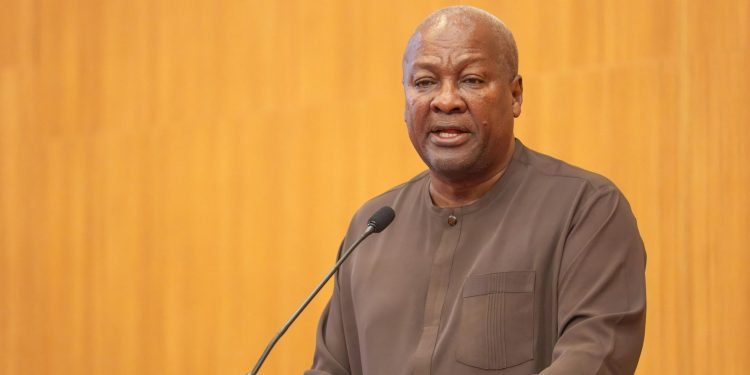
President John Dramani Mahama has sworn in a new seven member National Labour Commission (NLC), urging its leadership to strengthen public confidence in Ghana’s labour dispute resolution system through fairness, consistency and timely decisions. Corrections Policy
The new Commission is chaired by retired Court of Appeal Justice Isaac Delali Duose, who will lead the team responsible for helping resolve industrial disagreements between employers, workers and organised labour.
At the swearing in ceremony on Friday, November 13, 2026, President Mahama stressed that the Commission plays an important role in protecting workers’ rights, promoting industrial harmony and ensuring that disagreements in workplaces are addressed through established legal procedures.
He emphasised that workers who approach the Commission with complaints must be confident that their concerns will receive a fair hearing and be resolved without unnecessary delays.
“A worker with a grievance wants to know that somebody will hear it and deal with it fairly and expeditiously. And the National Labour Commission has a responsibility to apply rules to the letter,” the President said.
His remarks highlighted the importance of an independent and effective dispute resolution institution in maintaining trust between employees and employers.
Justice Duose leads the new seven-member Commission
The newly inaugurated Commission brings together representatives of employers, organised labour and presidential nominees, reflecting the tripartite structure of Ghana’s industrial relations system.
According to reports, Justice Duose will serve as chairman, supported by six other members drawn from different stakeholder groups.

The Ghana Employers Association is represented by Joseph Kingsley Amuah and Isaac Sackey, while Prince William Ankrah and Abdul-Samad Ali Gomdah represent Organised Labour.
The remaining members are Rosemond Freeman-Tettey and Antwi-Boasiako Sekyere, who were nominated by the President.
The composition is intended to ensure that different interests within the labour market are represented in discussions and decisions involving workplace disputes.
Speaking on behalf of the new members, Justice Duose expressed appreciation to President Mahama for the confidence placed in the team. He assured the President that the Commission would perform its responsibilities with transparency and fairness. Editorial Ethics & Independence
He also pledged that matters brought before the institution would be handled in accordance with the principles governing its work.
President Mahama congratulated the members on their appointments and acknowledged the contributions of the outgoing Commission, thanking its members for their service to the country.
NLC’s role in maintaining industrial harmony
The National Labour Commission is an independent institution established under Part XVIII of the Labour Act, 2003 (Act 651). Its central responsibility is to promote peaceful industrial relations and facilitate the settlement of disputes between employers and workers.

Its work includes mediation, facilitation and other legally recognised dispute resolution procedures. The Commission also has responsibilities relating to complaints about unfair labour practices and disagreements arising from conditions of employment.
These functions are particularly important in Ghana, where disputes over salaries, allowances, working conditions and the implementation of agreements can lead to industrial action.
When such disagreements remain unresolved, workers may consider strikes, while employers and public institutions can face disruptions to their operations. Effective intervention can therefore help prevent prolonged conflicts and protect the interests of both parties.
The Commission’s ability to act impartially is essential because workers and employers must have confidence that decisions are based on the law rather than political, financial or institutional influence.
Recent labour disputes underline the importance of the Commission
The new leadership assumes office at a time when labour relations remain an important issue for government institutions and organised labour.
In October 2026, the NLC intervened in a planned strike by the Judicial Service Staff Association of Ghana (JUSAG), which had raised concerns over delays in reviewing salaries and related allowances.
Reports stated that the Commission asked the Minister of Jobs, Labour and Employment Relations to lead discussions with relevant government stakeholders and engage JUSAG to address the issues behind the intended industrial action.
The Commission also advised the association to suspend its planned strike in accordance with Section 161 of the Labour Act, 2003 (Act 651), following its intervention. Editorial Standards
JUSAG had threatened to begin an indefinite strike on November 2 if its concerns were not addressed.
The dispute demonstrated how disagreements over compensation and conditions of service can place pressure on public institutions and affect service delivery.
Such cases underline the need for a Commission capable of facilitating meaningful negotiations and ensuring that parties respect established dispute resolution procedures.
Expectations for the new leadership
For Justice Duose and his colleagues, the immediate responsibility will be to translate the President’s expectations into practical improvements in the Commission’s operations.
Workers expect a system where complaints are acknowledged, hearings are conducted fairly and decisions are delivered within reasonable periods.
Employers, meanwhile, need confidence that disputes will be handled objectively and that agreements reached through the process will be respected.
Reducing unnecessary delays will be particularly important because prolonged labour disputes can affect productivity, public services and the financial security of employees.
The Commission will also need to strengthen communication with employers, trade unions and government institutions to encourage early engagement before disagreements escalate into industrial action.
Ultimately, the success of the new NLC will depend on its ability to demonstrate independence, transparency and consistency in handling cases.
President Mahama’s charge sets a clear expectation Ghana’s labour dispute resolution system must provide workers and employers with a credible avenue for addressing grievances.
As the new seven-member team begins its work, its performance will be measured by its ability to protect fairness, promote cooperation and contribute to stable workplaces across the country.