

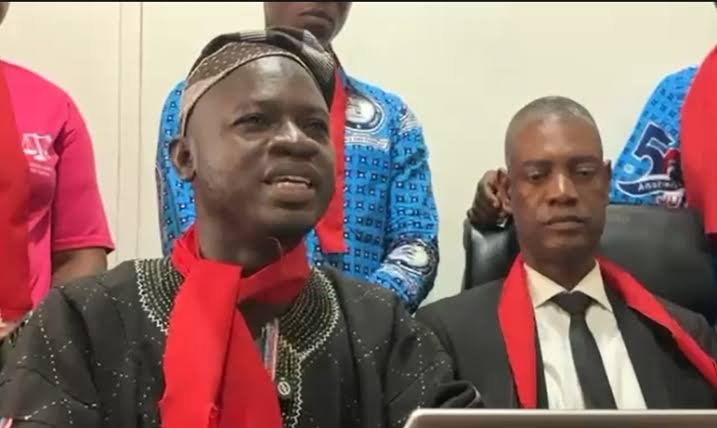
The Judicial Service Staff Association of Ghana (JUSAG) has reaffirmed its decision to continue its nationwide industrial action until the government fully implements the revised conditions of service approved for Judicial Service emtployees.
The association says it will not direct its members to resume work until outstanding concerns surrounding the approval of their salaries, allowances and other employment benefits have been adequately addressed. Corrections Policy
The position signals that the ongoing disagreement between the association and the government remains unresolved despite recent engagements aimed at finding a lasting solution.
Speaking on the Citi Breakfast Show on Monday, November 9, 2026, JUSAG General Secretary Abdulai Yakubu explained that the association’s concerns go beyond the payment of salary arrears.
He maintained that the central issue is the government’s approval of the revised conditions of service recommended by the Judicial Council.
According to him, the approval granted by President John Dramani Mahama did not fully reflect the provisions of Constitutional Instrument 141 (C.I. 141), which governs the conditions of service of Judicial Service employees.
Mr Yakubu argued that the President was expected to ensure that the recommendations submitted by the Judicial Council were reflected in the final approval rather than selectively accepting certain provisions while leaving out others.

He explained that the association considers the approved arrangements inconsistent with the applicable legal framework and has therefore called for a revision to bring them into conformity with the provisions governing Judicial Service employees.
The General Secretary stressed that JUSAG’s demand is based on what it considers the legal entitlements of its members, insisting that the government must respect the relevant provisions rather than determine which benefits should be granted.
The association’s position follows an indefinite nationwide strike that began on Monday, November 2, 2026, after prolonged disagreements over the government’s failure to approve the proposed review of salaries and related allowances for Judicial Service staff.
The industrial action has disrupted court operations across the country, with several court premises and registries remaining closed as employees withdraw their services.
The situation has affected litigants, lawyers and other individuals who depend on the courts to resolve legal disputes and access judicial services.
Although the government has taken steps to address some of the financial concerns raised by the association, JUSAG insists that those measures have not resolved the fundamental disagreement.
The Ministry of Finance has directed that 10 months of salary arrears owed to Judicial Service employees and the lower court bench be paid in two instalments.
Under the proposed arrangement, arrears covering January to May 2026 are expected to be paid in November, while payments for June to October are scheduled for December.
JUSAG has welcomed the proposed payment arrangement but maintains that clearing outstanding arrears alone cannot justify ending the strike. Editorial Ethics & Independence
The association argues that the arrears are connected to the delayed implementation of the revised salary structure, making the substantive approval of the conditions of service the more important issue.
Mr Yakubu previously explained that the association had already made compromises by revising its original demands to make it easier for the government to reach an agreement.
However, he said the government’s response did not adequately address the association’s expectations.
The disagreement has also attracted the attention of other government institutions.
Attorney General and Minister for Justice Dr Dominic Ayine has engaged JUSAG leadership as part of efforts to resolve the impasse.

He reportedly assured the association that its concerns would receive attention following further discussions with the Finance Minister.
Despite these engagements, the association has maintained that a satisfactory revision of the approval remains necessary before its members can return to their duties.
There is, however, some indication that further developments could emerge.
Speaking on Monday, November 9, Mr Yakubu said the association had received an indication that an official communication would be issued later in the evening.
He expressed hope that the outstanding demands would be addressed, potentially creating an opportunity for the strike to end.
The expected communication is therefore likely to be important in determining whether the government and JUSAG can reach an agreement and restore normal operations within the Judicial Service. Editorial Standards
The dispute is particularly significant because Judicial Service employees play an essential role in supporting the administration of justice.
Their responsibilities include court administration, registry operations, documentation and other services necessary for the effective functioning of the country’s judicial system.
The prolonged closure of court facilities can create difficulties for people seeking legal remedies, particularly individuals involved in urgent cases, bail applications and other time-sensitive proceedings.
For now, JUSAG’s position remains that its members will not return to work until the revised conditions of service are properly approved and implemented.
The government faces increasing pressure to resolve the disagreement through negotiations and ensure that judicial operations resume without further disruption.
The outcome of the expected government communication and subsequent engagements will determine the next steps in the dispute, as court users across Ghana await a resolution that will restore normal judicial services.