

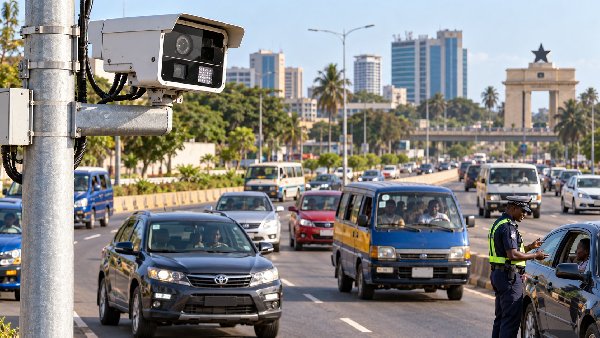
A member of the communications team of the New Patriotic Party (NPP), Kwasi Kwarteng has defended the introduction of the country’s automated traffic enforcement system, TRAFFITECH-GH, insisting that protecting human lives must take priority over concerns about the financial cost of implementing the technology. Corrections Policy
His position comes amid growing public discussions about the government’s decision to introduce automated traffic monitoring and electronic penalties for motorists who violate road traffic regulations.
Speaking on TV3’s The KeyPoints programme on Saturday, November 7, 2026, Mr Kwarteng argued that the importance of preventing road accidents and reducing fatalities should not be overlooked when assessing the value of the initiative.
His comments reflect the broader argument that road safety interventions should be judged by their potential to protect lives rather than simply by the financial resources required to introduce and maintain them.
TRAFFITECH-GH was officially rolled out by the Ghana Police Service on November 1, 2026, as part of efforts to improve compliance with road traffic regulations through technology-driven enforcement.
The system uses automated cameras and other monitoring equipment to detect traffic violations, particularly speeding, and generate evidence that can be used to issue electronic notices of violation.
Under the arrangement, vehicle owners and motorists identified through the system can receive electronic notifications when their vehicles are captured committing relevant traffic offences.
The initiative is intended to discourage dangerous driving practices and encourage motorists to take greater responsibility for their actions on the road.
For years, speeding has remained a major concern in Ghana’s road safety discussions. Excessive speed reduces the time available for drivers to react to unexpected situations and increases the severity of injuries when collisions occur.
According to the Ghana Police Service, speeding contributes significantly to serious crashes and road fatalities.
Assistant Commissioner of Police (ACP) Alexander Kwaku Obeng has previously indicated that between 50 and 62 per cent of road fatalities or serious crashes are associated with speeding.

This has strengthened calls for more effective enforcement measures to complement public education campaigns.
Mr Kwarteng’s defence of TRAFFITECH-GH comes against this background, with supporters of the system arguing that automated monitoring could help address persistent violations that traditional enforcement methods have struggled to control.
Unlike conventional traffic enforcement, which often requires police officers to be physically present at specific locations, automated systems can monitor selected roads and capture violations using electronic evidence.
This approach could improve consistency in traffic enforcement and discourage drivers from speeding simply because they believe police officers are not nearby. Editorial Ethics & Independence
President John Dramani Mahama has also defended the initiative, emphasising that its primary objective is to save lives rather than punish motorists.

Speaking in Antigua following a Commonwealth engagement, the President highlighted the devastating consequences of speeding, particularly for children and other vulnerable road users.
He explained that children continue to be knocked down, killed or permanently injured because some motorists fail to observe appropriate speed limits.
However, President Mahama also stressed the importance of transparency in the implementation of the technology.
He called on the police to ensure that speed camera locations are clearly communicated through appropriate road signs so motorists understand where enforcement is taking place.
He further reminded drivers that the general maximum speed limit in urban areas is 50 kilometres per hour, unless otherwise indicated by applicable road signs and regulations.
The introduction of TRAFFITECH-GH has generated mixed reactions among motorists, transport operators and members of the public.
While some have welcomed the system as a necessary intervention to address reckless driving, others have raised concerns about the visibility of speed cameras, the fairness of enforcement and the financial implications of traffic penalties.
Some commercial drivers have also questioned how the system will affect their daily operations, particularly in situations where road infrastructure and speed-limit signage are inadequate.
These concerns have made public education and transparent enforcement important considerations for the success of the initiative.
The National Road Safety Authority (NRSA) has acknowledged some of the concerns, particularly those relating to road signs and infrastructure.

Deputy Director of Planning and Programmes Henry Asomani said the Authority was engaging relevant agencies to ensure motorists received adequate guidance on applicable speed limits.
He also explained that the introduction of automated enforcement was already influencing driving behaviour, with initial observations suggesting that some motorists had become more cautious since the system became operational.
According to the NRSA, the initiative forms part of the enforcement pillar of road safety management, which also includes road engineering, emergency response and public education.
The Authority has maintained that technology alone cannot eliminate road crashes. Improvements in road infrastructure, responsible driving, effective emergency services and continuous public education must work together to achieve lasting results. Editorial Standards
For TRAFFITECH-GH to gain public confidence, authorities will also need to ensure that violations are properly verified, electronic notices are accurate and motorists have clear procedures for challenging disputed penalties.
Public communication about camera locations, applicable speed limits and payment procedures will be equally important in preventing confusion and strengthening trust in the system.
Ultimately, the debate surrounding TRAFFITECH-GH raises an important question about Ghana’s approach to road safety and concerns about implementation costs discourage investment in technology that could potentially prevent deaths and serious injuries?
For Kwarteng, the priority should remain clear. Protecting human lives must come before financial considerations.
As the automated enforcement system continues to operate, its effectiveness will be measured not simply by the number of violations detected or penalties issued, but by whether it contributes to safer roads, responsible driving and fewer preventable deaths across Ghana.