

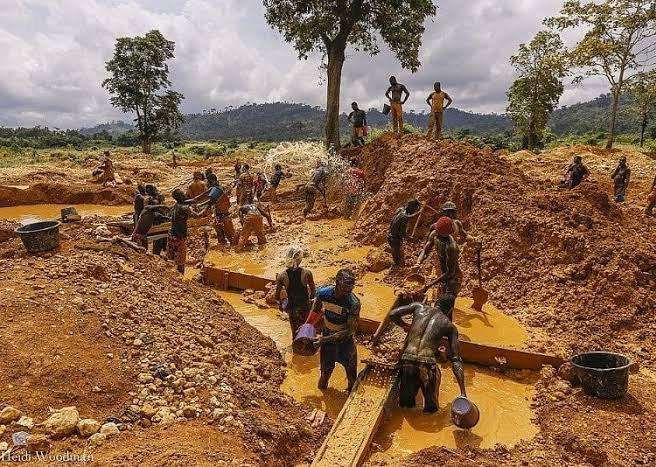
An alarming environmental assessment conducted in Ghana’s Savannah Region has revealed widespread heavy metal contamination in communities affected by artisanal and small-scale gold mining, commonly known as galamsey.
The European Union-funded study found that cadmium levels exceeded recommended environmental guidelines in 100 per cent of the soil samples examined, while mercury concentrations were above acceptable limits in approximately 94 per cent of the samples. Corrections Policy
The findings have raised fresh concerns about the environmental consequences of illegal mining and the potential health risks facing residents who live and work in affected communities.
They have also exposed significant weaknesses in mining regulation, public awareness and institutional oversight in parts of the region.
The findings were presented in Accra on Thursday, November 5, 2026, during the launch of baseline studies conducted under the European Union-funded Gold for Good (G4G) Project.
According to a reports, the research focused on three districts in the Savannah Region being West Gonja Municipality, Bole District and Sawla Tuna Kalba District.
Researchers combined community surveys, environmental sampling and mining-site assessments to establish the extent of the challenges associated with small-scale mining activities.
The assessment covered 953 respondents across 30 communities and identified 94 mining sites, providing an overview of the economic, environmental and governance conditions surrounding artisanal mining in the selected areas.
One of the most concerning findings was the widespread presence of cadmium above recommended levels in every soil sample tested.
Mercury, another toxic heavy metal associated with certain gold-processing activities, was also found above recommended limits in approximately 94 per cent of the samples.
Both substances are associated with serious environmental and public health concerns when exposure occurs at harmful levels.
Cadmium can accumulate in the body over time and affect the kidneys and bones, while mercury exposure can damage the nervous system and other vital organs.
The findings are particularly concerning for communities where residents depend on surrounding land for farming, livelihoods and other everyday activities.
Continued exposure to contaminated soil, dust and potentially affected food or water sources could increase health risks, depending on the level and duration of exposure. Editorial Standards
However, the soil assessment does not establish that every resident has been exposed to harmful concentrations or developed a health condition.
Further investigations involving water, agricultural produce and human health assessments would be necessary to determine the actual exposure levels and associated health consequences.
Beyond environmental contamination, the study identified serious regulatory challenges affecting mining activities in the three districts.
Only 2.92 per cent of respondents were found to hold mining licences, highlighting the limited level of formalisation within the communities surveyed.
Even more concerning, approximately 74 per cent of respondents said they were unaware of the regulations governing mining activities in their respective communities.
The findings suggest that illegal mining is not simply an environmental enforcement problem but also reflects wider challenges involving public education, institutional coordination and community participation.
Speaking at the launch, Deputy Minister of Lands and Natural Resources, Alhaji Yusif Sulemana, said the findings should provide a stronger evidence base for addressing illegal mining across the country.

He observed that discussions about galamsey had often taken place without sufficient reliable data to guide interventions, stressing that the new research should encourage stakeholders to move towards more coordinated and practical solutions.
The study also highlighted security concerns associated with unregulated mining activities along the Black Volta tri-border frontier.
Team Leader of the Gold for Good Project and Country Director of Coginta Ghana, Rev. Fr. Dr. Clement Aapengnuo, warned that informal mining networks, cash-based gold trading and armed informal security groups were creating additional challenges in areas where government presence and oversight remained limited.

He stressed that enforcement measures alone would not resolve the situation, arguing that mining communities and traditional authorities must become active partners in efforts to bring mining activities within the law.
The research further identified weak institutional collaboration, inadequate enforcement mechanisms and limited conflict prevention structures as major obstacles to effective mining governance.
Women and young people were also found to have limited representation in mining related decision making processes, with women largely concentrated in lower paid activities within the sector. Editorial Ethics & Independence
Interestingly, the research revealed that households in mining communities recorded average incomes nearly six times higher than those in communities without mining activities.
This finding highlights the economic dependence some residents have developed on small-scale mining despite its environmental and regulatory challenges.
European Union Ambassador to Ghana, Rune Skinnebach, said the Gold for Good Project was designed to support Ghana in developing a mining sector that is lawful, environmentally responsible, socially inclusive and economically beneficial to local communities.

The findings will guide the next phase of the project, which will focus on improving institutional coordination, preventing conflicts, encouraging responsible gold sourcing, formalising mining operations and rehabilitating degraded lands.
Dollar Power and Tinga have been identified as priority communities for integrated interventions.
The Gold for Good Project is an 18 month initiative funded by the European Union with €3 million and implemented by Coginta across West Gonja, Bole and Sawla Tuna Kalba.
The latest findings add to growing concerns about the long-term consequences of galamsey on Ghana’s environment, particularly the country’s agricultural lands, water bodies and rural livelihoods. Newscard
For the affected communities, addressing the situation will require more than periodic arrests and mining-site demolitions.
Authorities must strengthen regulatory education, improve monitoring, support responsible mining practices and ensure that contaminated and degraded areas receive appropriate environmental attention.
Ultimately, the study provides important evidence that Ghana’s response to illegal mining must address both the economic realities driving participation in the sector and the environmental damage associated with poorly regulated operations.
Without sustained intervention, communities in the Savannah Region could face increasingly difficult challenges in protecting their land, livelihoods and future generations.