

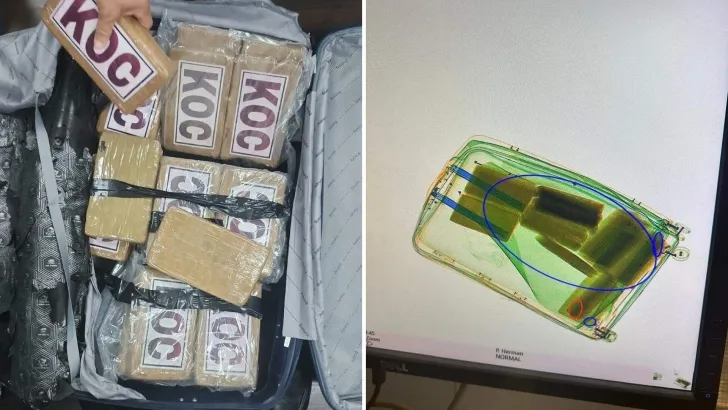
Ghana’s Narcotics Control Commission (NACOC) has arrested three foreign nationals in connection with a 46.7-kilogramme cocaine consignment intercepted at Rafic Hariri International Airport in Beirut, Lebanon, as investigations into an alleged international drug trafficking network widen.
The suspects, comprising a Syrian, a Tunisian and a Lebanese national, were arrested in separate intelligence led operations on Tuesday, November 3, 2026, following information shared by Lebanese law enforcement authorities. Editorial Standards
According to reports, the group consists of two men and a woman.

Two suspects were arrested in Accra earlier in the day, while the third was apprehended at about 5 p.m.
Their identities have not been made public, and investigators are working to establish the extent of their alleged involvement in the shipment and the wider trafficking operation.
The arrests follow the interception of the cocaine shipment at Beirut airport on Saturday, October 31, after a Syrian passenger arrived from Accra aboard a Middle East Airlines flight.
Lebanese Customs officers reportedly discovered 40 packages containing a total of 46.7 kilogrammes of cocaine concealed in two pieces of luggage.
The drugs had allegedly been hidden using sophisticated packaging and insulation materials intended to make detection by airport scanning equipment more difficult.
Electronic tracking devices were also reportedly found among the packages, suggesting a level of preparation that investigators will need to examine as they trace the shipment’s movement.
Lebanese authorities described the seizure as the largest drug bust in the history of Rafic Hariri International Airport.
The passenger was arrested after the discovery, while the seized substance and other items were taken for further investigation.
Preliminary investigations in Lebanon indicated that the passenger had entered the country through the Masnaa border crossing from Syria several weeks earlier. Editorial Ethics & Independence
He subsequently travelled to Accra before returning to Beirut with the cocaine consignment.
Investigators are now seeking to establish who organised the shipment, where the drugs originated, who was expected to receive them and whether additional individuals or criminal groups facilitated the operation.
NACOC’s account of the operation
Before the arrests in Ghana were reported, NACOC had announced that the seizure in Beirut resulted from a coordinated controlled-delivery operation conducted in collaboration with Lebanese drug enforcement authorities.
In a statement issued on November 1 and signed by Francis Opoku Amoah, the Commission’s Acting Director of Public Affairs and International Relations, NACOC said the operation was designed to identify and apprehend individuals at both ends of the supply chain.

A controlled delivery is a law enforcement technique in which authorities monitor a suspected illegal consignment as it moves towards its intended destination.
The approach can help investigators identify not only the person transporting the goods but also individuals suspected of arranging, receiving or facilitating the shipment. Corrections Policy
NACOC said intelligence-sharing and operational cooperation with Lebanese counterparts were central to the exercise.
The Commission also indicated that investigations were continuing to identify suspected accomplices in Ghana.
The reported arrests of the three foreign nationals represent an important development in that effort.
However, authorities have not publicly disclosed the specific roles the suspects allegedly played or whether additional arrests are expected.
Questions surrounding the cocaine seizure
The operation has also generated public questions about Ghana’s border security and the circumstances under which such a large quantity of suspected cocaine travelled from Accra to Beirut.
The Jatikay Centre, through its Chief Executive Officer, Adib Saani, has questioned NACOC’s explanation of the controlled delivery operation.
Among the concerns raised are how the shipment was monitored, why the passenger was allowed to depart Ghana and what evidence demonstrates the level of cooperation between the two countries.
The organisation has also called for greater transparency from the relevant security agencies, arguing that the incident requires a clear explanation to maintain public confidence in Ghana’s anti-narcotics efforts.
Another issue concerns the quantity of cocaine reported.
While Lebanese Customs identified 46.7 kilogrammes, some initial accounts of the operation, including NACOC’s earlier communication, referred to approximately 40 kilogrammes.

The difference may relate to how the consignment was weighed, including its packaging, but an authoritative clarification would help resolve the discrepancy.
These questions do not establish wrongdoing by NACOC or any other institution.
They nevertheless underline the importance of providing accurate information about the operation, the evidence gathered and the procedures followed by the agencies involved.
International cooperation remains central
The case highlights the cross-border nature of organised drug trafficking and the importance of cooperation between countries.
A shipment can involve individuals operating in different jurisdictions, making intelligence-sharing and coordinated investigations essential to identifying those responsible.
For Ghana, the investigation provides an opportunity to establish whether local individuals or networks helped facilitate the movement of the consignment and to strengthen measures aimed at preventing the country’s transport and commercial routes from being exploited by drug traffickers.
The three arrested foreigners remain suspects, and their alleged involvement will have to be established through the appropriate investigative and judicial processes.
No charges or court dates had been publicly announced in the reports available at the time of writing. Privacy Policy & Terms
As Ghanaian and Lebanese authorities continue their investigations, attention will focus on the evidence linking the suspects to the shipment, the identity of its intended recipient and whether investigators can uncover the wider network behind the attempted movement of the cocaine.
The outcome could have important implications for Ghana’s efforts to combat international narcotics trafficking and demonstrate the effectiveness of cooperation between its security agencies and their foreign counterparts.