

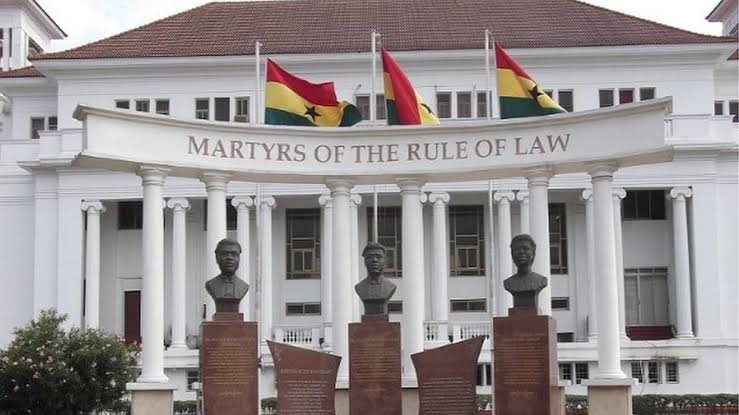
The nationwide strike by the Judicial Service Staff Association of Ghana (JUSAG) has disrupted court operations across the country, leaving major judicial facilities, including the Supreme Court and Court of Appeal, closed as staff demand payment of outstanding salary arrears. Corrections Policy
The industrial action began on Monday, November 2, 2026, following months of disagreement over the approval and implementation of a revised salary structure for Judicial Service employees.
The shutdown has affected court users, lawyers and litigants who expected to attend hearings or access administrative services.
According to a report, the Supreme Court, Court of Appeal, Accra Circuit Court and some District Court offices were among the facilities affected.
Security personnel reportedly restricted access to the premises, with officers instructed not to open the gates.
Red pieces of cloth were also placed at the entrances of some court buildings to signal the association’s protest and draw attention to its demands.
The disruption has raised concerns about the impact of the industrial action on the administration of justice, particularly for people with pending cases and legal matters requiring urgent attention.
Dispute over revised salaries and outstanding arrears
JUSAG’s central demand is the approval and payment of revised salaries and related allowances for Judicial Service employees.

The association says its members have been waiting for the implementation of a proposed salary review for 2026, with outstanding arrears dating back to January.
It maintains that efforts to secure approval through the relevant authorities have not produced the outcome expected by its members.
In its strike declaration, JUSAG directed employees to stay away from work from November 2 until its demands were addressed.
The association’s position is that the revised salaries should be approved and paid, alongside arrears covering the period from January to October 2026.
The General Secretary of JUSAG, Abdulai Yakubu, previously explained that the association had pursued the matter through several engagements since December 2025. Editorial Standards

A report indicated that the association had also agreed to honour an invitation to meet government representatives over the dispute.
However, Yakubu stressed that attending the meeting should not be interpreted as a decision to abandon the demands that led to the strike.
The association has maintained that it remains open to dialogue but expects concrete action towards resolving the salary issue.
Judicial Service appeals for workers to return
Management of the Judicial Service has appealed to JUSAG leadership and its members to reconsider the industrial action and return to work while negotiations continue.

In a memorandum dated October 31, 2026, the Judicial Service acknowledged the frustration among employees over delays in the salary review process but said management was engaging relevant government stakeholders in high-level discussions.
Judicial Secretary Musah Ahmed said the engagements were being conducted in good faith, with the objective of finding a fair and sustainable resolution. Editorial Ethics & Independence
Management also warned that the absence of essential court personnel affects more than administrative activities.
It can interfere with the delivery of justice and create difficulties for citizens seeking legal remedies, including vulnerable individuals and accused persons.
The Judicial Service urged workers to consider the wider public interest and the consequences of prolonged disruption to court operations.
However, the appeal had not prevented the commencement of the strike, with court premises remaining closed as the industrial action took effect.
Court users stranded in Accra and Kumasi
The impact of the strike has extended beyond Accra, with reports confirming disruptions at several courts in the Ashanti Region.

According to reports, the Kumasi High Court, Court of Appeal, Asokwa Circuit Court and Kumasi Metropolitan Assembly Court were among the facilities affected.
Some litigants who travelled to attend scheduled proceedings reportedly arrived to find the gates locked and court staff absent.
One affected court user, Joyce Konama, told JoyNews that she had travelled from her town for a High Court judgment but was unaware that the strike had begun. Newscard
She expressed frustration over the disruption and called for government to accelerate negotiations.

The situation illustrates the difficulties that industrial action within the justice system can create for people who may have spent considerable time and money preparing for court appearances.
For individuals awaiting judgments, bail-related proceedings, civil settlements or other legal decisions, delays could create additional uncertainty and financial pressure.
Government negotiations and the way forward
The dispute has placed pressure on government and Judicial Service management to reach an agreement that addresses employees’ concerns while restoring normal court operations.

JUSAG had notified the National Labour Commission of its intention to embark on an indefinite strike before the November 2 commencement date.
The association has also expressed dissatisfaction with the timing of earlier interventions and proposals for settling the outstanding arrears.
Although management says discussions with government stakeholders are ongoing, the key challenge remains securing an agreement acceptable to the association and ensuring that the revised salary arrangements are implemented.
A prolonged shutdown could further increase the backlog of cases and inconvenience people who depend on the courts for timely decisions.
For now, court users are likely to face uncertainty over scheduled hearings and administrative services until the industrial dispute is resolved.
The duration of the strike will depend largely on the progress of negotiations and whether the government can address JUSAG’s outstanding demands. Privacy Policy & Terms
The situation highlights the importance of resolving employment disputes within the justice system without allowing disagreements over staff conditions to undermine public access to essential judicial services.