

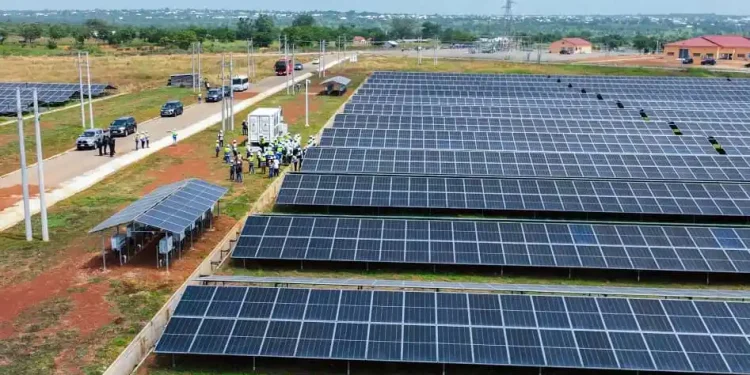
The 50-megawatt solar power plant developed at Galgu in the Yendi Municipality of the Northern Region has begun commercial operations, marking an important step in Ghana’s efforts to expand renewable energy generation and strengthen electricity supply in the northern part of the country.
The project, developed by First Sky Limited for the Bui Power Authority (BPA), is valued at approximately US$59 million, rather than US$50 million as suggested in some references to the project. Editorial Ethics & Independence

The facility has been connected to the national grid and is expected to support electricity supply in Yendi and surrounding communities, including areas along Ghana’s Eastern Corridor.
The development was highlighted after members of Parliament’s Select Committee on Energy and Mines inspected the completed facility on October 26, 2026.
Reports published by Graphic Online and Ghanaian Times on October 28 said the plant had been completed, tested and connected to the grid.
The project represents a significant investment in solar energy infrastructure and demonstrates the capacity of Ghanaian companies to deliver major power-generation projects.
It also comes as the government pursues its target of increasing renewable energy penetration to at least 10 per cent by 2030.
A Major Investment in Northern Ghana
The Yendi solar plant occupies approximately 140 acres of land at Galgu, a farming community within the Yendi Municipality. Its 50-megawatt-peak capacity is expected to contribute additional electricity to the national grid while helping to diversify Ghana’s energy sources.
First Sky Limited executed the project under an engineering, procurement, construction and financing arrangement with the Bui Power Authority. Under this model, the contractor arranged the financing and undertook the construction work, while BPA is responsible for the facility as part of its electricity-generation operations.
Earlier reports indicated that the project was being developed as a US$59 million investment, with First Sky undertaking the engineering and construction work and arranging financing.
The project’s financial structure is important because it allows the infrastructure to be developed without requiring the full investment to be paid upfront by the state-owned authority.
The arrangement also provides for BPA to repay the financing over an eight-year period beginning from the start of commercial operations.
The commencement of commercial operations therefore marks not only a technical milestone but also the beginning of a significant repayment period for the authority.
Strengthening Electricity Supply
One of the main objectives of the facility is to improve electricity supply in Yendi and neighbouring communities while reducing pressure on existing transmission infrastructure.

The project includes supporting infrastructure designed to evacuate the electricity generated by the solar panels into the national grid. The plant’s connection to the Tamale–Yendi transmission network is expected to help deliver power to the wider electricity system. Editorial Standards
Reliable electricity is essential for households, schools, healthcare facilities, businesses and industrial operations. In communities where supply interruptions or voltage fluctuations create difficulties, additional generation capacity can support economic activity and improve service reliability.
However, the extent of the improvement will depend on how the electricity is integrated into the wider grid, transmission capacity and overall demand. The solar plant is an important contribution to the system, but it is not a standalone solution to every electricity challenge facing northern Ghana.
The facility is also expected to support economic development by providing opportunities for local employment and attracting investment to the Yendi area.
Ghanaian Expertise Takes Centre Stage
The project has attracted attention because it was executed by First Sky Limited, a wholly Ghanaian company.

During the Parliamentary Select Committee’s inspection, committee chairman Emmanuel Kwasi Bedzrah reportedly commended the company for delivering the project using local expertise.
The achievement highlights the potential role of domestic engineering and construction companies in Ghana’s energy transition. Developing local technical capacity can help retain more project expenditure within the economy, create skilled employment and build experience that can be applied to future infrastructure projects.
Citi Newsroom and 3News previously reported on the project during its construction phase. In October 2024, 3News covered a parliamentary inspection of the facility, while Citi Newsroom reported on Bui Power Authority’s plans to expand solar capacity and explore other renewable energy sources.
The project’s completion provides a practical example of how local companies can participate in the delivery of large-scale energy infrastructure.
Supporting Ghana’s Renewable Energy Target
The Yendi facility forms part of wider efforts to diversify Ghana’s electricity generation mix and reduce dependence on conventional fossil-fuel-based generation.
Solar power offers an opportunity to use the country’s abundant sunshine to generate electricity without directly producing carbon emissions during operation. Corrections Policy
Expanding solar capacity can therefore contribute to climate objectives while diversifying the sources available to meet electricity demand.
The Bui Power Authority has been expanding its renewable energy portfolio alongside its hydropower operations. The authority has also pursued solar projects and battery storage infrastructure intended to strengthen the reliability of electricity generated from renewable sources.
In August 2026, A source reported that the government remained committed to achieving at least 10 per cent renewable energy penetration by 2030, a target requiring sustained investment and stronger grid infrastructure.
Nevertheless, solar generation depends on sunlight and varies throughout the day. Effective integration, adequate transmission infrastructure and complementary generation or storage will remain important to ensuring that the additional capacity delivers dependable benefits.
Maintenance and Long-Term Sustainability
The plant’s long-term contribution will depend on consistent maintenance, effective security and responsible management. Solar panels, electrical equipment and transmission infrastructure must be maintained to ensure that the facility continues to operate efficiently over its expected lifespan.
Members of the Parliamentary Select Committee have urged stakeholders and local residents to protect the facility against theft, damage and encroachment. Newscard
For the Yendi Municipality, the project offers an opportunity to strengthen electricity supply, create employment and support business development. For the national energy sector, it adds another major renewable energy asset built with Ghanaian expertise.
The beginning of commercial operations is an important milestone, but the ultimate measure of success will be the plant’s sustained performance, its contribution to the national grid and its ability to deliver lasting economic and environmental benefits.