

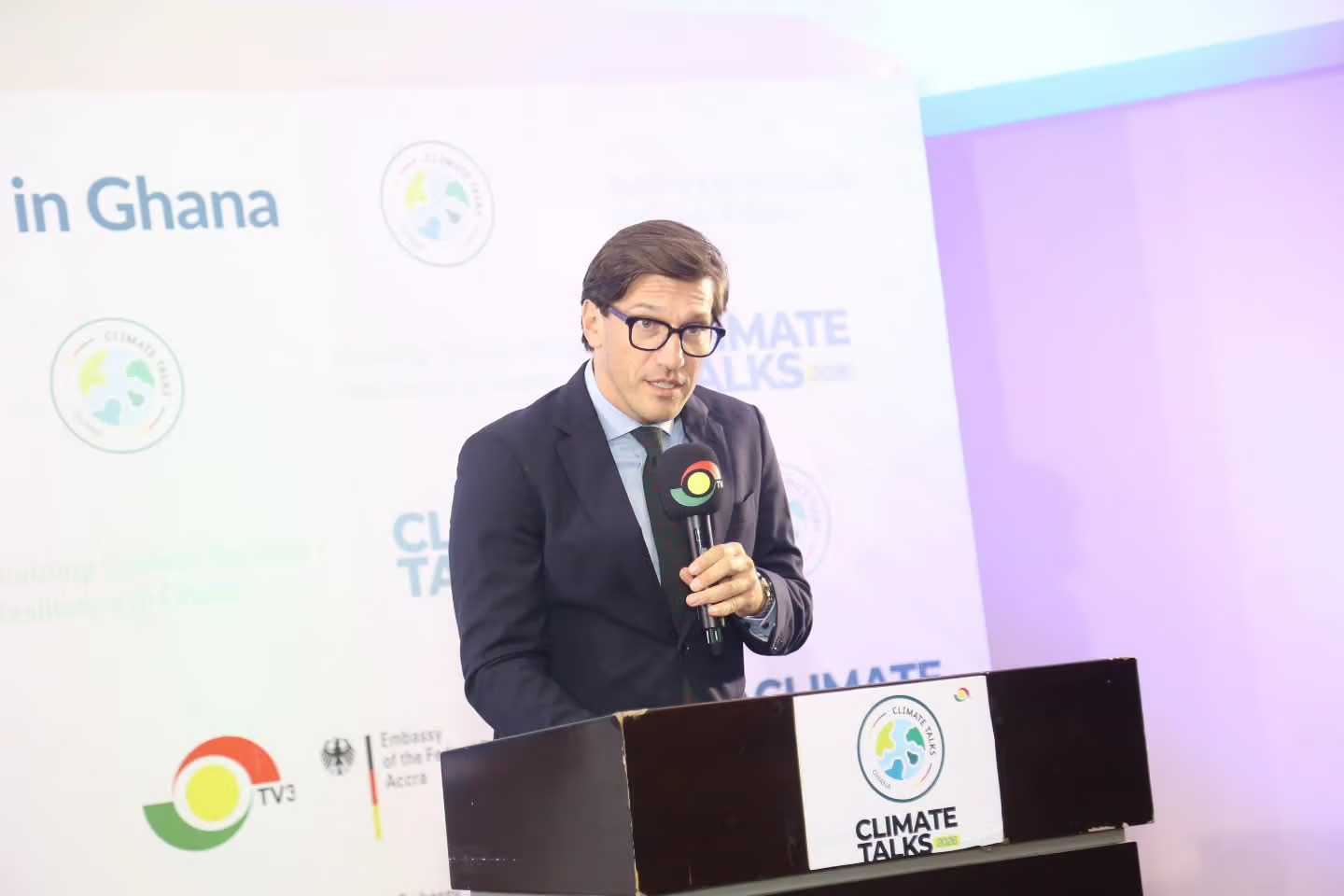
German Ambassador to Ghana Frederik Landshöft has warned that climate change should be treated as a human security issue, stressing that its consequences extend beyond environmental damage to threaten livelihoods, social cohesion and the future opportunities of vulnerable communities. Editorial Ethics & Independence
Speaking at the Accra edition of Climate Talks 2026 on Tuesday, October 27, the ambassador said climate-related pressures were increasingly affecting people’s safety, dignity and ability to sustain their livelihoods.
He called for coordinated responses that address the connections between environmental challenges, economic hardship and community security.
According to reports, Landshöft illustrated his concerns through the experiences of communities across Ghana, including families in Keta facing coastal erosion, farmers in Tamale depending on access to land and water, refugee families in Zini seeking acceptance, and firefighters in Kumasi who require adequate resources to respond to emergencies.
Although these communities face different challenges, the ambassador said they share a common concern: protecting people’s security, dignity and future opportunities.
“Climate change is a human security issue. It does not automatically lead to conflict, but where resources become scarce, where economic opportunities cease, decrease and vulnerabilities already exist, tensions can become harder to manage,” he stated.
His remarks highlight an important distinction in discussions about climate change. Environmental pressures do not inevitably cause violence or instability, but they can worsen existing social and economic difficulties, particularly in communities where access to essential resources is already limited.
Climate pressures and community security
Climate change can affect security in several interconnected ways. Unpredictable rainfall, prolonged dry periods, flooding and rising temperatures can undermine agricultural production, disrupt incomes and increase pressure on water supplies.
When families struggle to maintain their livelihoods, disputes over land, grazing areas and other resources may become more difficult to resolve.
These concerns are particularly relevant to parts of northern Ghana, where agriculture supports many households and changing environmental conditions can place additional pressure on rural livelihoods.
Competition over land and water may interact with existing disputes, making community-level conflict prevention increasingly important. Editorial Standards
According to reports in June 2026 that Landshöft had warned that climate-related pressures on food and other natural resources could intensify existing vulnerabilities and heighten tensions.
Speaking during the launch of Climate Talks 2026 in Tamale, he called for stronger community capacity, improved resource management and cooperation between local actors and security institutions.
The latest remarks in Accra reinforce that message, extending the discussion beyond northern Ghana to include coastal erosion, displacement, emergency response and the social consequences of environmental change.
Coastal erosion threatens livelihoods in Keta
Coastal erosion remains a major concern for communities along Ghana’s coastline. In Keta and surrounding areas, the loss of land to the sea threatens homes, infrastructure, fishing-related livelihoods and community heritage.
When families are forced to relocate, the consequences can extend beyond the physical loss of property. Residents may also lose access to familiar economic activities, social networks and places that hold cultural significance.
Landshöft previously highlighted these concerns during the Keta edition of Climate Talks 2026, arguing that people directly affected by climate change must play a central role in shaping solutions.

The German ambassador has maintained that Ghanaian institutions and communities should lead the response, with international partners contributing technical expertise and support.
The issue also demonstrates why climate adaptation requires more than environmental protection alone.
Coastal planning, public health, social protection and sustainable livelihood opportunities must be considered together if vulnerable communities are to build long-term resilience.
Germany supports dialogue and local solutions
Climate Talks 2026 is being organised in partnership with the German Embassy in Accra and Media General. The initiative has engaged communities across Greater Accra, the Volta Region, the Ashanti Region and the Northern Region to discuss the relationship between climate change and security.
The programme aims to create space for government representatives, security agencies, traditional authorities, researchers, civil society organisations, young people and local communities to share experiences and explore practical responses. Corrections Policy
Landshöft stressed that Germany’s approach was not to dictate how Ghana should address climate challenges, but to support dialogue, knowledge-sharing and collaboration.
This approach places local experience at the centre of climate planning while allowing international partners to contribute expertise and resources where needed.
Effective responses could include strengthening early-warning systems, improving access to reliable water supplies, supporting climate-resilient agriculture, managing natural resources fairly and building cooperation between community leaders and security institutions.
Such measures can help communities prepare for environmental shocks before they develop into wider economic or social problems.
Building resilience through cooperation
The ambassador’s message places human wellbeing at the centre of climate policy. Reducing emissions and protecting ecosystems remain important, but communities also need practical support to adapt to changing conditions and protect their livelihoods.

For Ghana, this means connecting environmental policy with development planning, disaster preparedness, conflict prevention and opportunities for young people and vulnerable households.
Climate Talks 2026 provides a platform for these discussions, but the long-term value of the initiative will depend on whether the ideas raised lead to practical action by institutions, communities and development partners.
Landshöft’s warning is that climate change should not be viewed as a distant environmental concern. Its effects can reach directly into people’s homes, jobs, access to resources and relationships with neighbouring communities.
By recognising climate change as a human security issue, Ghana and its partners can strengthen efforts to protect vulnerable populations, reduce avoidable tensions and build communities better equipped to face environmental challenges.