

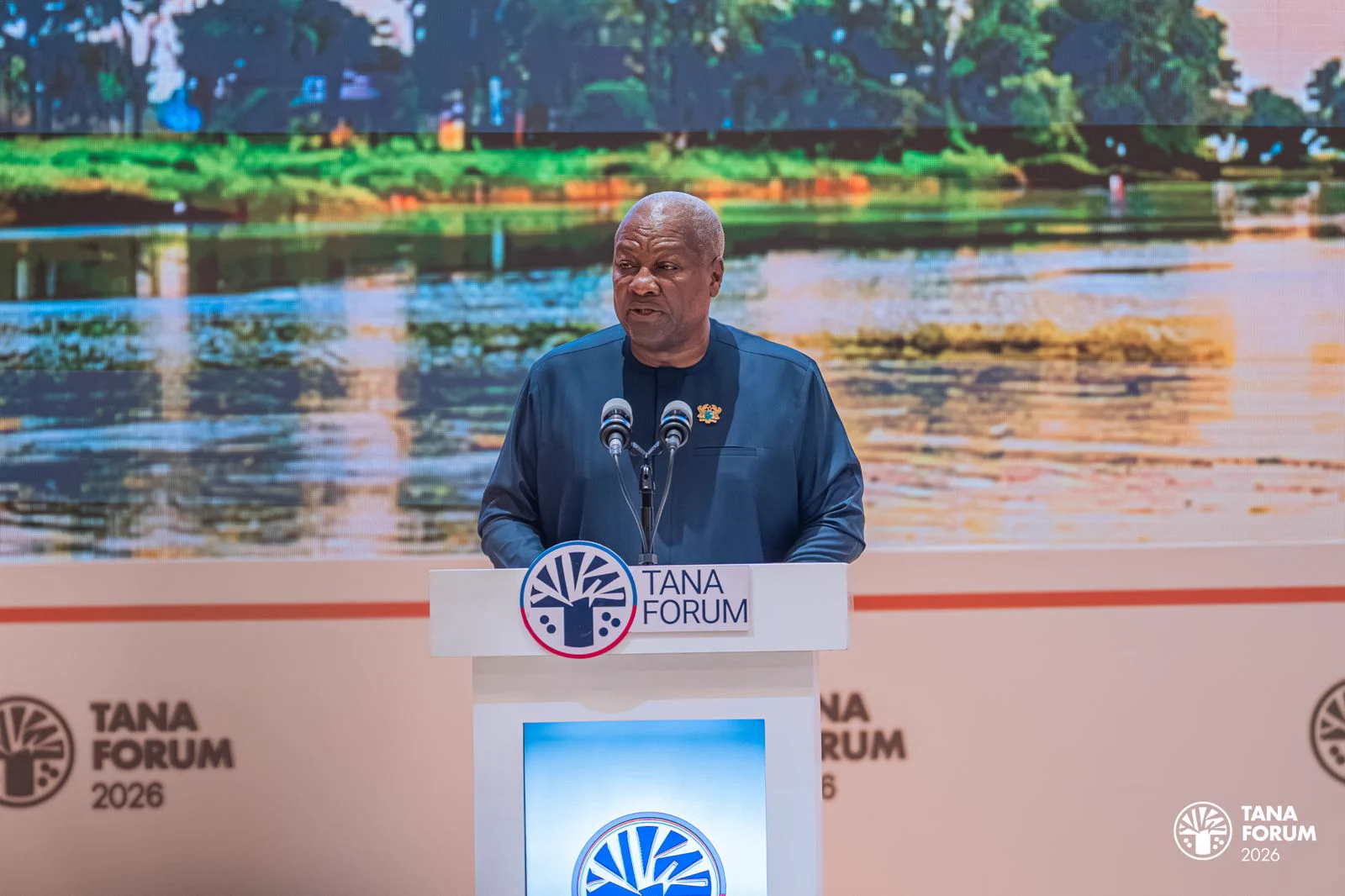
President John Dramani Mahama has called on African leaders to develop and implement continent led solutions to Africa’s persistent peace and security challenges, arguing that lasting stability requires stronger economic sovereignty, regional cooperation and greater responsibility for financing security operations. Corrections Policy
The President made the call on Saturday, October 24, 2026, while presenting the 2026 State of Peace and Security in Africa Report at the 12th Tana High-Level Forum on Security in Africa in Bahir Dar, Ethiopia.
The forum brought together African leaders, policymakers, security experts and other stakeholders to discuss pathways towards peace and stability on the continent.
Mahama, who chairs the Tana Forum Board, said Africa’s security challenges could not be addressed effectively if the continent continued to depend heavily on external actors to determine its priorities and finance its peace operations.
He argued that sustainable peace must be grounded in African ownership, the lived experiences of communities affected by conflict and the continent’s ability to make decisions in its own strategic interest.
The President’s remarks placed economic sovereignty at the centre of the security debate, highlighting the relationship between resource management, economic exclusion and instability.
He said African countries needed to examine not only the activities of armed groups but also the political and economic conditions that allow conflicts to persist.
According to Mahama, some of Africa’s conflicts are closely connected to competition over natural resources and the exclusion of local communities from the benefits of resource extraction.
He cited conflict-affected areas such as eastern Democratic Republic of Congo and Mozambique’s Cabo Delgado region, where mineral and energy resources have not prevented insecurity.

He called for African countries to exercise greater control over their strategic assets, negotiate fairer terms for resource extraction and ensure that the wealth generated from natural resources contributes to improving the lives of citizens.
The President also urged governments to move away from exporting raw materials without sufficient domestic processing. He said building local industries and expanding productive capacity could create jobs, strengthen economies and reduce some of the structural conditions that contribute to instability.
Mahama linked this approach to the Accra Reset, an initiative aimed at reshaping development cooperation around practical sovereignty, stronger implementation capacity and shared prosperity.
He outlined the need for African countries to process more of their raw materials at home, develop domestic industrial capacity, strengthen food and energy security, and make the African Continental Free Trade Area (AfCFTA) an effective driver of economic growth.
The President argued that regional integration should be viewed as a security tool as well as an economic project. Stronger trade relationships and cross-border value chains, he said, could give neighbouring countries greater incentives to cooperate rather than engage in conflict.
He also stressed the importance of creating economic opportunities for young people and women. Mahama warned that when young people are excluded from meaningful employment and economic participation, the foundations of peace become more fragile.Editorial Standards
Investments in education, skills development, employment and local enterprise could therefore form part of a broader strategy to prevent conflict and reduce the appeal of extremist groups.
Another major issue raised by the President was the financing of African peace operations. He called on governments to take greater responsibility for funding the continent’s security priorities rather than relying excessively on external partners.
Mahama pointed to the funding challenges facing African led operations in Somalia, arguing that decisions taken by foreign governments to reduce financial support can have direct consequences for security on the continent.

He urged African countries to strengthen the African Union Peace Fund and develop more predictable domestic financing arrangements.
He also called for stronger implementation of existing continental commitments, including the African Peace and Security Architecture, Agenda 2063 and the Silencing the Guns initiative.
In his view, Africa’s challenge is not simply a lack of policies or agreements, but the difficulty of translating them into measurable results.
The President urged the African Union and regional organisations to improve coordination, assess implementation gaps and hold member states accountable for commitments they have made.
Mahama further highlighted the importance of dialogue and cooperation among countries facing shared security threats. Recent tensions and divisions between regional blocs, he argued, can weaken collective efforts to address terrorism and instability.
He called for continued engagement with countries in the Sahel, including Burkina Faso, Mali and Niger, while maintaining that regional cooperation remains essential to confronting threats that cross national borders.

The President’s call comes as several parts of Africa continue to face conflict, terrorism, political instability and humanitarian emergencies.
These challenges have placed pressure on national governments and regional institutions to strengthen their responses while addressing the underlying causes of violence.
For Mahama, African led solutions do not necessarily mean rejecting international partnerships. Rather, he argued that external support should complement African priorities and strengthen the continent’s capacity to manage its own affairs. Editorial Ethics & Independence
The discussions at the Tana Forum are expected to contribute to broader efforts to improve cooperation, resource mobilisation and implementation of peace and security commitments.
The President’s message was that lasting peace will require more than military interventions or diplomatic declarations.
It will depend on African countries building stronger economies, ensuring that communities benefit from their resources, creating opportunities for young people and investing in institutions capable of responding effectively to emerging threats.
As the continent continues to confront complex security challenges, Mahama urged leaders to move from commitments to action and build a future in which Africa has greater control over its peace, development and strategic direction.