

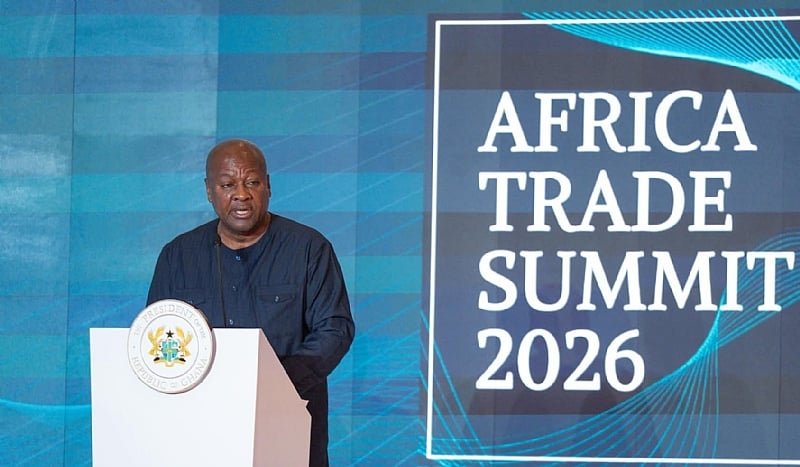
President John Dramani Mahama has defended Ghana’s longstanding policy of non-alignment, saying it has served the country well by allowing it to maintain friendly relations with major global powers while pursuing investment opportunities that support national development. Corrections Policy
Speaking at the Financial Times Africa Summit in London, Mahama said Ghana would continue to engage countries across geopolitical divides rather than allow international rivalries to determine its economic and diplomatic partnerships.
“We are friends to all and enemies to none. And Ghana’s policy of non-alignment has served us well,” the President said, reaffirming the government’s openness to investors from around the world.
His remarks come at a time of heightened competition among major powers, including the United States, China, Russia and the European Union, as countries seek to strengthen their economic influence and secure strategic partnerships.
Mahama stressed that Ghana’s approach was not about choosing sides but about identifying partnerships that offer fair returns to both the country and its international partners.
He explained that Ghana maintains friendly relations with the United States, the European Union, China and Russia, adding that cooperation with one country should not prevent the government from engaging constructively with others.
The President’s position reflects Ghana’s effort to preserve diplomatic independence while attracting the capital, technology and expertise needed to accelerate economic transformation.
Ghana Prioritises National Interest Over Global Rivalries
Mahama’s comments underline his administration’s intention to pursue a pragmatic foreign policy guided by Ghana’s national interests rather than rigid ideological alliances.

The President has previously explained that Ghana’s international partnerships should be evaluated according to their contribution to economic growth, industrial development, employment and technology transfer.
In June 2026, while speaking at Chatham House in London, he argued that countries navigating an increasingly divided global environment needed flexible diplomatic strategies and mutually beneficial partnerships. Editorial Ethics & Independence
For Ghana, this approach could provide opportunities to attract investment from different markets without becoming overly dependent on any single country or economic bloc.
The strategy also recognises that global economic relationships are increasingly interconnected. Countries that maintain constructive diplomatic ties across competing political and economic interests may be better positioned to access diverse sources of financing, technology and international markets.
However, maintaining such relationships requires careful diplomacy, particularly when international partners disagree over security, trade, sanctions or other sensitive matters.
Ghana’s challenge will be to preserve its independent decision-making while ensuring that individual partnerships remain consistent with its laws, constitutional principles and long-term development objectives.
Investment, Industrialisation and Local Value Addition
Beyond diplomatic relations, Mahama used the summit to encourage international investors to explore opportunities in Ghana, stressing that investment must generate benefits for both foreign partners and the Ghanaian economy.

He argued that the country’s economic future depends on attracting businesses capable of creating jobs, supporting local industries and helping Ghana retain more value from its natural resources.
One of the government’s stated ambitions is to end the export of raw minerals by 2030 by expanding domestic processing and adding value before products reach international markets.
The President cited gold processing as an example, stating that approximately 70 per cent of Ghana’s gold was being refined locally. He also outlined a target of processing at least 50 per cent of the country’s cocoa beans domestically.
Achieving these targets would require investment in industrial facilities, reliable energy, transport infrastructure, technical skills and access to international markets. Editorial Standards
Mahama maintained that economic partnerships should not create isolated areas of prosperity while surrounding communities remain poor. Instead, he said investment should contribute to broader development by creating employment and expanding economic opportunities.
For Ghanaian businesses, this approach could create opportunities to participate in supply chains, provide services to investors and develop new capabilities in manufacturing and processing.
The government will nevertheless need to translate its investment commitments into measurable results, including jobs, stronger domestic industries and increased export earnings.
Ghana Maintains Relations With Major World Powers
Mahama’s comments also reinforce Ghana’s longstanding diplomatic tradition of engaging countries across different political and economic systems.
Ghana’s foreign policy has historical roots in the independence era under its first President, Dr Kwame Nkrumah, who supported independent decision-making and cooperation among newly independent states.
Ghana’s Ministry of Foreign Affairs identifies the protection of national interests, respect for international law, peaceful settlement of disputes and adherence to the principles of the United Nations, African Union, ECOWAS, Commonwealth and Non-Aligned Movement as key foundations of the country’s foreign policy.
The Non-Aligned Movement was established during the Cold War to provide countries with an alternative to formally aligning themselves with rival power blocs. Ghana remains part of the movement and participated in its 65th-anniversary summit in Belgrade, Serbia, in September 2026.
At that gathering, Mahama called on member states to move beyond declarations and strengthen coordinated diplomacy to address global challenges.
His latest remarks in London suggest that Ghana intends to maintain this tradition while adapting it to the demands of modern international trade, investment and security cooperation.
A Foreign Policy Focused on Practical Results
The President’s defence of non-alignment presents Ghana as a country seeking partnerships based on mutual benefit rather than geopolitical loyalty.
For the policy to deliver lasting results, Ghana will need to balance relationships with international powers, negotiate favourable investment terms and ensure that foreign partnerships contribute to national development.
The approach also places responsibility on government institutions to assess investment proposals carefully, protect local economic interests and ensure that agreements deliver tangible benefits to citizens. Privacy Policy & Terms
Ultimately, Mahama’s message is that Ghana can maintain friendships with countries that have competing international interests while continuing to pursue its own economic priorities.
As global competition intensifies, the effectiveness of Ghana’s non-alignment policy will depend not only on maintaining diplomatic relationships but also on how successfully those relationships translate into industrial growth, employment, technology transfer and improved living standards.
For Mahama, the guiding principle remains clear: Ghana should remain open to the world while ensuring that its partnerships serve the interests of the Ghanaian people.