

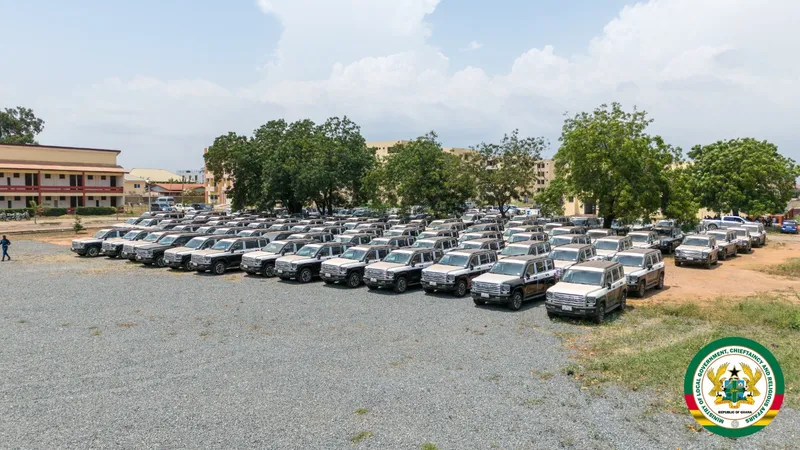
Ghana’s Minister for Local Government, Chieftaincy and Religious Affairs, Mahama Ayariga, has handed over a first batch of vehicles to Metropolitan, Municipal and District Chief Executives (MMDCEs), urging them to use the government-provided assets strictly for official duties and avoid any form of misuse. Editorial Ethics & Independence
The distribution, which took place at the Institute of Local Government Studies in Madina, Accra, on Tuesday, October 20, 2026, forms part of efforts to strengthen decentralised governance and improve the ability of local authorities to monitor development projects and deliver essential services.
According to reports, the vehicles comprise Haval H9 Sports Utility Vehicles (SUVs) for MMDCEs and pickup trucks intended to support the operational activities of coordinating directors.
The first batch includes 128 SUVs, with additional vehicles expected to be distributed after the necessary clearance and administrative processes.
Ayariga said the initiative was intended to address transportation challenges that had affected some local government officials, enabling them to carry out their responsibilities more efficiently across their respective jurisdictions.
Minister warns against misuse of government vehicles
During the handover ceremony, the minister delivered a strong warning to the beneficiaries, stressing that the vehicles were purchased to support public service and were not intended for personal convenience.

He cautioned the MMDCEs against using the vehicles for private activities, including personal errands and visits unrelated to their official responsibilities.
His warning underscored the government’s expectation that public assets should be managed responsibly and used to advance the interests of the communities they serve.
The minister also emphasised the importance of proper vehicle maintenance, cautioning officials against negligence and irresponsible use that could lead to unnecessary damage and additional costs to the state. Editorial Standards
The warning comes amid broader public concerns about accountability in the management of government resources.
Official vehicles are provided to support administrative work, project supervision and public engagement, making their proper use an important part of responsible local governance.
Ayariga’s message places the responsibility on each beneficiary to demonstrate discipline and accountability in the discharge of official duties.
The expectation is that the vehicles will be used to improve access to communities, strengthen field operations and help assemblies respond more promptly to local development needs.
Vehicles intended to improve local governance
A source reported that the SUVs are designed to help mayors and chief executives perform their functions more effectively, while the pickups are intended to support coordinating directors in their day-to-day operational activities.

The vehicles are expected to make it easier for local government officials to travel to communities, inspect ongoing construction projects, assess the condition of local infrastructure and engage directly with residents.
In many districts, the ability of local authorities to reach remote communities can influence how quickly problems are identified and addressed.
Roads, sanitation, drainage systems, schools, healthcare facilities and other public infrastructure require regular monitoring to ensure that development projects meet their intended objectives. Corrections Policy
Without reliable transportation, officials may experience delays in visiting project sites or responding to concerns raised by residents.
The provision of the vehicles is therefore expected to improve operational efficiency, provided the assemblies establish clear systems for their use and maintenance.
Ayariga explained that the government considered investment in transportation necessary to help assemblies monitor activities within their jurisdictions and achieve their development targets.
He also assured assembly members that motorcycles would be provided to support their work, following discussions with President John Dramani Mahama and Finance Minister Dr Cassiel Ato Forson.
Some MMDCEs had worked without official vehicles
The distribution also addresses transportation difficulties faced by some MMDCEs since assuming office.
According to a source, Ayariga said several chief executives had worked for approximately one and a half years without official vehicles.

Some had relied on their private cars, while others had used pickup trucks associated with the District Road Improvement Programme (DRIP) to carry out official assignments.
The minister said he had directed MMDCEs using DRIP pickups to return them as part of the handover arrangements. This would allow the vehicles to be returned to the appropriate DRIP officials for their intended operational purposes.
The development highlights the logistical challenges that can affect local administration when officials lack the equipment needed to perform their duties. Privacy Policy & Terms
It also demonstrates the importance of coordinating government resources to prevent equipment assigned to one programme from being diverted to meet another institution’s needs.
The availability of dedicated official vehicles could help assemblies organise field visits more efficiently and reduce their dependence on private transportation.
However, the extent of the improvement will depend on how effectively the vehicles are deployed and whether the assemblies have sufficient resources for fuel, servicing, insurance and repairs.
Decentralisation and the District Assemblies Common Fund
The vehicle distribution forms part of the government’s broader efforts to strengthen decentralisation and give local authorities greater capacity to address the needs of their communities.
As reported, Ayariga linked the initiative to the government’s approach to the District Assemblies Common Fund (DACF), stating that 80 per cent of the fund would go directly to assemblies.
He also referenced Finance Minister Cassiel Ato Forson’s decision to uncap the fund to enable assemblies to receive their full allocations.
Decentralisation is intended to bring decision-making closer to the people affected by government policies and development programmes.
District assemblies play an important role in identifying local priorities, coordinating infrastructure projects and ensuring that public services respond to community needs.
However, providing additional resources and logistical support also increases the importance of accountability.
Residents need to see evidence that public investments are producing measurable improvements in their communities.
The vehicles will therefore be most beneficial if their use is linked to clearly defined official assignments, effective project monitoring and transparent administrative procedures.
Assemblies can strengthen accountability by maintaining vehicle logbooks, recording official journeys, scheduling preventive maintenance and regularly reviewing fuel and servicing expenses.
Such measures would help protect the vehicles against misuse while ensuring that they remain available for essential public duties.
Accountability remains central to the initiative
Ayariga’s warning reflects a wider principle of public administration: government property must be used for the purpose for which it was acquired.
The conduct of MMDCEs is particularly significant because they serve as visible representatives of government in their respective communities.
Their decisions and daily activities can influence residents’ perceptions of public institutions and the responsible use of taxpayer-funded resources.
The minister’s remarks, as reported, made clear that the vehicles were not intended for private trips or unrelated personal engagements.
He urged the officials to focus on their responsibilities and ensure that the additional logistical support translated into improved service delivery. Newscard
The government has also warned that proper maintenance is essential. Ayariga cautioned beneficiaries that replacement vehicles would not be provided if the vehicles were damaged through poor care or negligence.
The first batch comprises 128 Haval H9 SUVs, while further vehicles, including pickups, are expected to be distributed after clearance and other necessary procedures.
The minister indicated that outstanding vehicles were expected to be released within two weeks, with additional beneficiaries in parts of Greater Accra, Ashanti, Eastern, Western and Central regions awaiting distribution.
Ultimately, the success of the initiative will not be measured simply by the number of vehicles handed over to local government officials.
It will depend on whether the vehicles help assemblies supervise projects more effectively, respond to residents’ concerns faster and improve the delivery of essential services.
For communities across Ghana, the expectation is straightforward better equipped local authorities should deliver more responsive governance.
The minister’s warning serves as a reminder that the benefits of public investment can only be realised when officials exercise their responsibilities with discipline, transparency and a commitment to the public interest.