

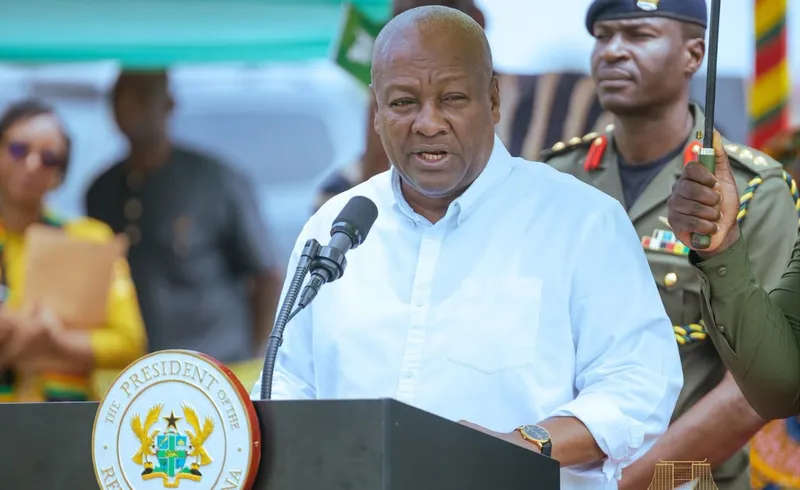
President John Dramani Mahama says improving economic stability is attracting growing interest from international investors, as Ghana steps up efforts to expand manufacturing, increase exports and create sustainable employment. Corrections Policy
The President made the remarks during the groundbreaking ceremony for the 1,238-acre Afienya Industrial Park, where he highlighted a significant increase in foreign direct investment (FDI) inflows and called on businesses to take advantage of opportunities emerging from the country’s economic recovery.
According to figures disclosed by Mahama, Ghana’s foreign direct investment inflows rose to US$2.62 billion in 2025, compared with US$624 million in 2024. He attributed the increase to improving macroeconomic conditions, including declining inflation, lower interest rates and greater stability in the local currency.
“The stability of the Ghanaian economy is attracting strong interest from global investors,” the President said, adding that the government wants to direct investment towards productive sectors capable of generating employment and strengthening the economy.
The announcement comes as the administration prepares to introduce its proposed New Economy Policy in 2027, with industrialisation and private-sector investment expected to play important roles in the next phase of Ghana’s economic development.
Afienya Industrial Park to expand investment opportunities
A major part of the government’s strategy is the development of the Afienya Industrial Park, which is expected to accommodate more than 120 enterprises across sectors including agribusiness, textiles, automotive assembly and pharmaceuticals.
The industrial park is designed to provide businesses with serviced land and essential infrastructure, including electricity, treated water, internal roads and waste-management facilities.
These provisions are intended to address operational difficulties that can discourage investors from establishing manufacturing facilities.
Mahama said the site had been selected to provide investors with a more reliable environment for setting up factories and expanding production. The government also intends to address land-related disputes and infrastructure gaps that have historically increased the cost and complexity of industrial development. Editorial Standards
According to reports, 14 industrial firms had applied to establish operations at the park before construction was completed. The project is expected to complement existing industrial facilities and provide additional space for businesses seeking to expand their operations in Ghana.
The initiative is part of a broader push to strengthen domestic production, reduce reliance on imported finished goods and increase the competitiveness of Ghanaian exports.
Tema Export Processing Zone offers a model
The President also pointed to the performance of the Tema Export Processing Zone as evidence of the potential benefits of industrial investment.

Figures cited from the Ghana Free Zones Authority indicate that the zone has supported more than 80 industrial enterprises and generated over US$24 billion in cumulative export revenue during its 30-year history.
The zone reportedly exported goods worth US$3.1 billion in 2025, while exports reached US$1.4 billion in the first half of 2026. It has also sustained more than 78,000 direct jobs, with Ghanaians accounting for approximately 98 per cent of those positions.
The government hopes the Afienya project can build on that experience by creating additional opportunities for manufacturing, export-oriented businesses and local suppliers.
However, replicating the success of an established industrial zone will require sustained investment, reliable utilities, efficient logistics and a workforce equipped with the technical skills needed by modern industries.
New Economy Policy targets productive sectors
The planned industrial expansion is linked to the government’s proposed US$10 billion New Economy Policy, which is expected to direct US$2 billion annually over five years towards selected productive sectors.
President Mahama has said the programme will focus on areas with the potential to create jobs and expand economic opportunities, including textiles and garments, agriculture and agribusiness, pharmaceuticals and tourism. Editorial Ethics & Independence

Sources reported that the government intends to finance the proposed programme with domestic resources rather than additional borrowing. The policy is expected to be outlined further alongside the 2027 Budget.
The initiative reflects the administration’s intention to turn improved macroeconomic conditions into stronger production and higher employment. Nevertheless, its impact will depend on how the funds are allocated, the quality of project implementation and whether private businesses can operate profitably.
Investors seek predictable economic conditions
Economic stability is an important consideration for investors making long-term commitments. Businesses generally need predictable inflation, manageable borrowing costs, reliable access to foreign exchange and consistent regulations to plan production and calculate future returns.
While improving conditions can strengthen investor confidence, foreign investment figures alone do not establish how much new productive capacity or employment has been created. The composition of investment, the sectors receiving funding and the extent to which projects are implemented remain important measures of success.
For Ghana, the priority will be ensuring that incoming capital supports factories, technology, skills development and businesses capable of competing in regional and international markets.
The African Continental Free Trade Area also presents an opportunity for companies based in Ghana to reach a wider continental market.
The government hopes industrial parks and stronger infrastructure will help manufacturers produce goods for domestic consumption and export.Newscard
Mahama’s message is that Ghana’s improving economic conditions should serve as a foundation for a more productive economy. The next challenge will be to convert investor interest into completed projects, sustainable jobs and stronger incomes for households.
If the government can maintain policy consistency while delivering the infrastructure and services businesses need, the planned industrial expansion could contribute to Ghana’s longer-term economic transformation.