

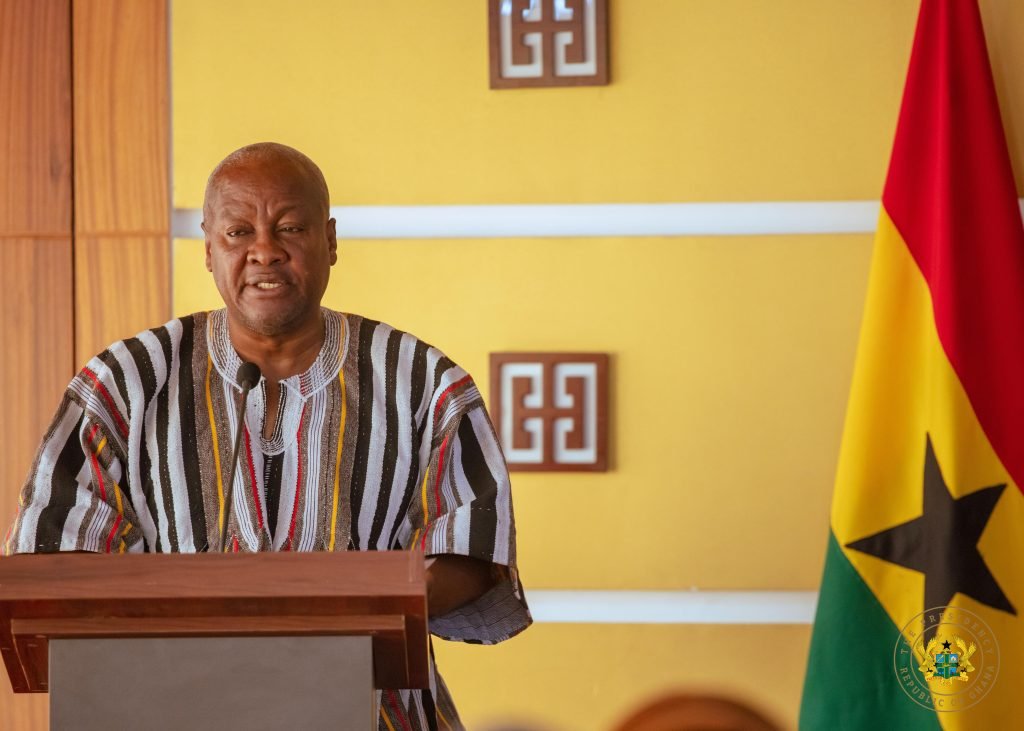
President John Dramani Mahama has announced that authorities have seized 135 excavators and nearly 200 firearms in operations against illegal mining, popularly known as galamsey, as the government intensifies efforts to protect Ghana’s forest reserves and restore degraded land.
Speaking at the Mining in Motion Conference in Accra on Monday, October 19, 2026, the President said more than 8,200 items of equipment associated with illegal mining had been confiscated. Editorial Standards
The seizures include changfan machines, excavators and other equipment allegedly used in mining activities that violate the law.
The figures, reported, offer’s an indication of the scale of enforcement efforts against illegal mining and the security challenges facing personnel deployed to affected areas.
Mahama described the seizures as evidence of progress in the government’s campaign, particularly in forest reserves that had been classified as high-risk zones because of the presence of armed illegal miners.
The announcement comes amid broader efforts to strengthen the regulation of Ghana’s mining sector, improve security in environmentally sensitive areas and ensure that the country’s natural resources are managed responsibly.
Government intensifies action in forest reserves
According to the President, illegal miners had encroached on 48 of Ghana’s 288 forest reserves. Some areas were designated as “red zones” because of the level of environmental destruction and the security risks that made access difficult for forest guards.

Mahama said the government had cleared nine of these red zones of illegal mining operators and was preparing the affected areas for reclamation.
The development marks an important stage in efforts to regain control of forest reserves, which play a vital role in protecting biodiversity, preserving water sources and supporting ecological stability.
However, clearing illegal miners from a location is only one part of the challenge. Authorities must also prevent operators from returning, restore damaged land and ensure that forest protection measures remain effective over time.
The President has previously said security personnel would remain in the nine cleared reserves to deter illegal miners from returning.
That approach reflects concerns that earlier enforcement operations sometimes failed to achieve lasting results because operators returned after personnel withdrew.
Excavator tracking and monitoring measures
The government is also pursuing measures to improve oversight of excavators and reduce the risk of heavy machinery being diverted to illegal mining sites. Editorial Ethics & Independence
Mahama disclosed that 6,060 excavators had been registered and detained at the ports, while 2,059 had been fitted with tracking devices.
The tracking system is intended to help authorities monitor the movement and use of excavators, making it easier to identify where machinery is operating and investigate possible violations.
Heavy equipment is important to legitimate construction, infrastructure and mining projects. However, when used in unauthorised mining operations, excavators can accelerate land degradation and cause extensive damage to riverbanks, farmland and forest ecosystems.
Effective monitoring therefore requires accurate registration records, reliable tracking technology, consistent enforcement and coordination among the agencies responsible for regulating machinery and mining activities.
The figures announced by the President suggest that the government is combining direct enforcement with efforts to improve the monitoring of equipment that could be used for illegal operations.
Nearly 200 firearms highlight security concerns
The reported recovery of nearly 200 firearms also highlights the security risks associated with some illegal mining operations.
The presence of weapons in areas where illegal mining takes place can endanger forest guards, security personnel, residents and other people working to protect natural resources.
It can also make enforcement operations more difficult and increase the risk of violent confrontations.
The President’s announcement did not provide a detailed breakdown of the firearms recovered, the circumstances of each seizure or the number of arrests and prosecutions connected to the operations. Those details would be necessary to assess the full enforcement and judicial outcomes.
The recovery figures should therefore be understood as part of the government’s reported progress, rather than proof that illegal mining has been eliminated.
Reclamation and restoration of degraded land
Beyond seizures and enforcement, the government is seeking to restore areas damaged by illegal mining.
Mahama estimated that approximately 12,000 acres of land had been destroyed by illegal mining across Ghana.
He said work was under way to prepare affected areas for reclamation and commended mining company Newmont for its efforts to restore mined-out land and plant useful crops.
He also highlighted a Ghana Gold Board contract with the Ghana Armed Forces to reclaim 253 acres of land damaged by illegal mining in the Tano Nimri Forest. The President said the work was ongoing.

In addition, Mahama announced that GH¢200 million had been allocated for the reclamation of 5,000 acres of degraded land, with the exercise expected to begin in 2027.
Successful reclamation can help restore vegetation, reduce erosion and improve the long-term condition of affected landscapes.
However, the outcomes will depend on sound environmental planning, sustained funding and monitoring to ensure that restored sites are not damaged again.
Enforcement must be matched with lasting solutions
The government’s latest figures demonstrate the scale of its reported crackdown, but the wider fight against galamsey will require sustained action beyond confiscating machinery and weapons.
Authorities must maintain effective monitoring, strengthen prosecution where offences are established, protect water bodies and forest reserves, and work with traditional leaders and local communities. Corrections Policy
Creating alternative livelihood opportunities will also be important in areas where people depend on informal mining for income.
Ultimately, the success of the campaign will be measured not only by the number of items seized, but by whether illegal mining declines, degraded land is restored and Ghana’s forests and water resources receive lasting protection.
Mahama’s announcement sets out the government’s reported enforcement progress.
The next test will be whether these measures translate into sustained environmental recovery, improved security and stronger control over illegal mining activities across the country.