

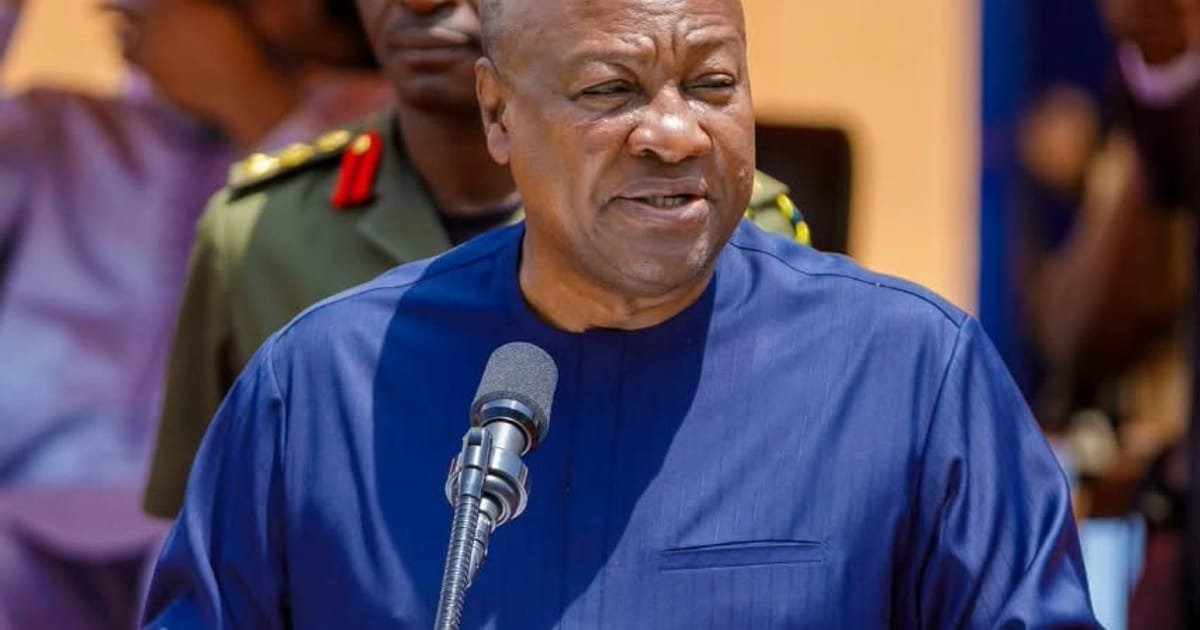
President John Dramani Mahama has appealed to traditional authorities across Ghana to support the government’s fight against illegal mining, warning that resistance to enforcement operations and the lack of alternative livelihoods continue to undermine efforts to tackle the menace. Corrections Policy
The President made the appeal when he received a delegation from the Western North Regional House of Chiefs at Jubilee House in Accra.
The delegation was led by Ogyeahoho Yaw Gyebi II, President of the National House of Chiefs and the Western Regional House of Chiefs, according to a source.
President Mahama stressed that chiefs have an important role to play because of their influence within local communities and their understanding of the social and economic circumstances that drive some residents into illegal mining, popularly known as galamsey.
He acknowledged the work of the National Anti-Illegal Mining Operations Secretariat (NAIMOS), but expressed concern about instances in which task force personnel face resistance from residents, young people and some traditional authorities during enforcement exercises.
“We need the help of our chiefs in the fight against galamsey because you live in the community with the people,” the President said, adding that confrontations between residents and security personnel must be avoided.
His comments highlight the difficulties confronting authorities as they seek to enforce mining laws while addressing the economic pressures that sustain illegal mining in several parts of the country.
Resistance to NAIMOS operations raises concern
NAIMOS has been involved in operations targeting illegal mining activities, particularly in forest reserves and around rivers and other water bodies.

The government considers these areas important because mining-related destruction can damage ecosystems, degrade agricultural land and threaten water supplies.
President Mahama said some operations had encountered resistance from community members, creating dangerous situations for enforcement personnel and residents.
He disclosed that there had been incidents in which soldiers discharged firearms during confrontations, resulting in deaths.
He said stronger cooperation between chiefs, communities and security agencies was necessary to prevent further loss of life.
The President’s appeal suggests that enforcement alone may not be sufficient to achieve lasting results if local communities do not support efforts to stop illegal mining. Editorial Standards
Traditional authorities can help explain the consequences of galamsey, encourage compliance with the law and communicate community concerns to government agencies.
Their involvement could also help authorities identify the economic pressures that make illegal mining attractive to some residents.
However, cooperation must go hand in hand with lawful enforcement, accountability and measures to protect the safety and rights of people living in affected communities.
Youth unemployment and alternative livelihoods
A major concern raised by the President was the involvement of young people, including senior high school students, in illegal mining activities.

He said enforcement exercises had uncovered students working at mining sites because their parents could not afford to provide them with money for school-related expenses.
The situation, he indicated, demonstrated the economic difficulties that can push young people towards dangerous and unlawful work.
President Mahama acknowledged that authorities had arrested several young people, with hundreds reportedly awaiting trial or on bail while their cases remained pending.
He said the situation was troubling and raised questions about what viable alternatives could be provided to those involved.
The President argued that the fight against illegal mining must therefore combine law enforcement with job creation and opportunities for young people to earn sustainable incomes.
He pointed to the government’s New Economy Policy and its focus on job-creating sectors, including tourism, as part of the proposed response. Editorial Ethics & Independence
He said investment in productive sectors could help provide alternative livelihoods and reduce the incentive for young people to enter galamsey.
For such measures to be effective, however, alternative employment programmes must offer practical training, reliable income opportunities and access to markets.
Young people in mining communities may also need support to enter agriculture, small businesses, skilled trades and other sectors capable of providing stable livelihoods.
Government plans more support for water protection
President Mahama also announced that the government had provided for an additional GH¢400 million in the next national Budget to recruit more Blue Water Guards to patrol water bodies.
He said the guards had been instructed to destroy changfang machines encountered during operations.
These machines are commonly associated with illegal mining activities that disturb riverbeds and contribute to the degradation of waterways.
The proposed funding is intended to strengthen monitoring and enforcement on rivers affected by illegal mining.
The effectiveness of the investment will depend on recruitment, training, operational capacity and coordination with other agencies responsible for protecting natural resources.
The President noted that even when the main channels of rivers had been cleared of mining equipment, mud and silt could continue to flow from tributaries extending over long distances.
This means restoring water bodies requires sustained action across entire river systems rather than isolated enforcement exercises.
The issue is particularly significant for communities that depend on rivers for domestic use, farming and other economic activities.
Pollution and sedimentation can increase the cost of treating water and place additional pressure on public utilities and local households.
Forest reserves and land reclamation
President Mahama further stated that the government had cleared all nine forest reserves previously classified as red zones because of extensive destruction and the presence of dangerous, heavily armed illegal miners.

He said soldiers had been stationed in the affected areas to prevent miners from returning after earlier operations were followed by renewed incursions.
The government was also working through GoldBod supported efforts involving the military and the Forestry Commission to reclaim damaged land and replant economic trees.
Reclamation is an important part of the response because removing illegal miners does not automatically restore damaged land.
Degraded sites may require levelling, soil rehabilitation, replanting and long-term monitoring before they can support productive use again.
The government’s approach will therefore need to combine prevention, enforcement and environmental restoration if the gains from operations are to be sustained.
Chiefs urged to work with government
The delegation from the Western North Regional House of Chiefs commended the President for development projects in the region and reaffirmed its commitment to supporting national development and peace, according to the Ghana News Agency.
The meeting placed renewed emphasis on the role of traditional authorities in addressing illegal mining.
Chiefs can influence local attitudes, facilitate communication between communities and government agencies, and help promote economic alternatives for young people.
Ultimately, the government’s anti-galamsey campaign faces two connected challenges: stopping unlawful mining and addressing the conditions that allow it to persist.
President Mahama’s appeal signals that the government wants traditional leaders to become more active partners in the process. Newscard
Whether that cooperation produces lasting progress will depend on consistent enforcement, effective alternative livelihood programmes, protection of water bodies and forest reserves, and sustained efforts to restore degraded land.
For Ghana, the stakes extend beyond mining regulation. Protecting rivers, forests and agricultural land is essential to public health, food production and the livelihoods of future generations.