

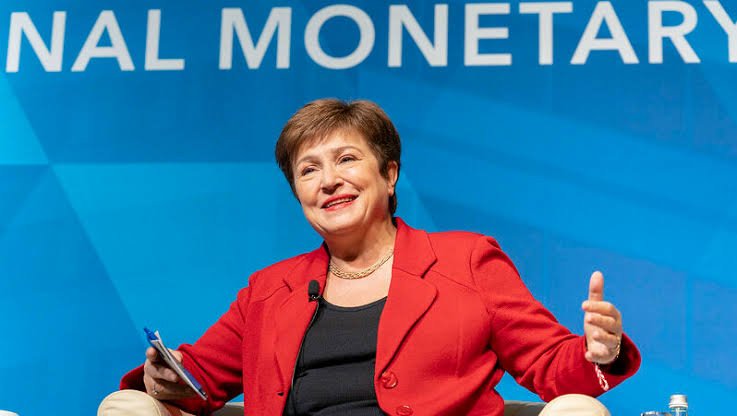
The International Monetary Fund (IMF) has projected the global economy to grow by 3.1% in 2026, warning that escalating geopolitical tensions, elevated energy prices, rising public debt and uncertainty surrounding artificial intelligence could threaten the world’s economic outlook. Newscard
In its October 2026 World Economic Outlook, titled Resilience Under Strain, Urgent Choices, the Fund maintained that the global economy continues to demonstrate resilience despite mounting pressures.
However, the projected growth rate remains below the 3.5% expansion recorded in 2025, highlighting the challenges facing countries as they navigate an increasingly uncertain economic environment.
Although the latest projection represents an improvement from the IMF’s July forecast of 3.0%, the Fund cautioned that the modest upgrade should not be interpreted as evidence that the global economy is free from danger.
Instead, the outlook reflects a combination of strong technology-related investment, economic adaptation and persistent risks that could weaken growth if conditions deteriorate.
The IMF expects global economic growth to improve to 3.4% in 2027. Nevertheless, the pace of recovery is likely to vary considerably between countries, depending on their exposure to energy market disruptions, access to investment and ability to withstand external economic shocks.
One of the most significant threats identified by the Fund is the continuing conflict in the Middle East and its potential consequences for global energy supplies.
Prolonged hostilities and disruptions to shipping routes could push oil and gas prices higher, increasing production and transportation costs for businesses while placing additional pressure on household budgets.
Countries that depend heavily on imported energy are particularly vulnerable. Higher fuel prices can increase the cost of generating electricity, transporting goods and operating factories, potentially forcing businesses to raise prices or reduce production.
For consumers, the consequences could include more expensive food, transport and essential goods. If these pressures persist, central banks may face greater difficulty bringing inflation under control without weakening economic activity.
The IMF projects global headline inflation to reach 4.7% in 2026, up from 4.1% in 2025, before easing to 4.1% in 2027.

The figures underline concerns that higher energy and food costs could complicate efforts to restore price stability across the world.
The report also highlights the growing influence of artificial intelligence on economic performance. Increased spending on AI infrastructure, computing capacity and related technologies has supported investment and helped sustain activity in several economies. Editorial Ethics & Independence
However, the benefits are not being shared equally. Countries involved in technology production and supply chains may gain from rising investment, while economies with limited access to these opportunities risk falling further behind.
The IMF has also warned that excessive optimism about AI could create financial vulnerabilities.
If investors begin to question whether expected productivity gains and profits will justify current spending, a sharp correction in technology-related markets could reduce investment, weaken confidence and affect economic growth beyond the technology sector.
Rising public debt presents another challenge. Governments facing higher borrowing costs may have less room to fund infrastructure, social services and economic development.
Increased debt-servicing expenses can also place pressure on public budgets, particularly in countries already struggling with limited fiscal resources.
The Fund has therefore stressed the importance of credible medium-term fiscal plans, sustainable public finances and policies that strengthen economic resilience.
Governments may need to rebuild financial buffers while directing spending towards priorities that support productivity and long-term growth.
For developing economies, including countries in Africa, these global pressures could have significant implications.
Higher international fuel and food prices can increase import bills, while expensive borrowing may limit the resources available for development projects.
Countries dependent on commodity exports could also face greater uncertainty if global demand weakens. Corrections Policy
For Ghana, changes in international oil prices, global financing conditions and demand for key exports could influence inflation, currency stability, public finances and business costs.
These are potential channels of impact rather than a prediction of a specific outcome for the Ghanaian economy. Domestic policy decisions and local economic conditions will also play important roles.
The IMF’s outlook ultimately presents a global economy that remains capable of expansion but faces an increasingly complicated path ahead.

Strong technology investment and the ability of businesses and governments to adapt have provided support, yet prolonged conflict, renewed inflation, financial market corrections and mounting debt could quickly change the picture.
The Fund’s warning places renewed responsibility on policymakers to strengthen economic safeguards, maintain financial stability and prepare for unexpected shocks. Editorial Standards
Whether the global economy can sustain its resilience will depend not only on investment and innovation but also on how effectively governments manage the risks threatening growth in 2026 and beyond.