

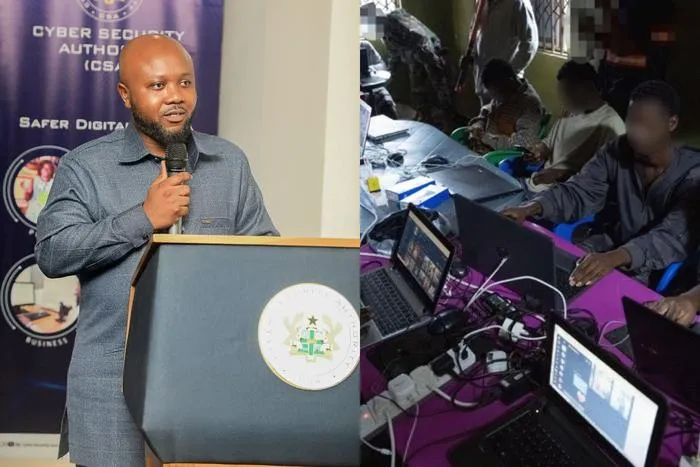
Ghana’s Cyber Security Authority (CSA) has rejected suggestions that the United States Federal Bureau of Investigation (FBI) independently conceived, commanded or executed the recent cybercrime crackdown known as “Operation Blackout”, insisting that the operation was led and coordinated by Ghanaian authorities. Newscard
In a statement issued on Friday, October 9, 2026, the Authority said the exercise, also referred to as “Operation Cyber Hunt”, was planned and carried out under Ghanaian authority and within the country’s legal and institutional framework.
The clarification follows an announcement by FBI Director Kash Patel, who presented the Ghana operation as part of the FBI’s wider international campaign against scam centres accused of defrauding victims, including American citizens.
The CSA said the operation involved cooperation among Ghanaian institutions and international law enforcement partners, stressing that public accounts of the exercise must accurately reflect the roles of the agencies involved.
The Authority has called on the FBI to clarify its public account and acknowledge the contributions of Ghanaian institutions and other international partners.
Ghanaian institutions coordinated the operation
The CSA identified itself as the lead and coordinating agency for Operation Cyber Hunt. It said the operation received support from Ghana’s National Security Council, the Criminal Investigations Department (CID) of the Ghana Police Service, the Ghana Immigration Service and the Office of the Attorney-General.
International partners included the United Kingdom’s National Crime Agency (NCA), the FBI, Nigeria’s Economic and Financial Crimes Commission (EFCC) and the Joint Case Team on Cybercrime.
According to the Authority, the participation of these agencies helped facilitate an intelligence-led response to suspected cybercriminal activities in parts of the Greater Accra Region.
The CSA rejected any portrayal of the operation as an independently conducted FBI exercise or one carried out under foreign operational command.
Its position was reinforced by Communications, Digital Technology and Innovations Minister Samuel Nartey George, who had earlier challenged the framing of the FBI announcement. Editorial Standards

He said Ghanaian law enforcement and intelligence agencies led the Cyber Hunt operations, with support from the UK’s NCA and the FBI.
The Minister warned that presenting the exercise as solely an FBI operation could undermine the spirit of cooperation required to address transnational cybercrime.
FBI announcement prompts response
The disagreement followed a post by FBI Director Kash Patel on October 8, 2026, announcing results from the Ghana crackdown under the name Operation Blackout.
According to Citi Newsroom, Patel said the operation had identified nearly US$10 million in losses and 89 victims. He also reported that more than 130 people had been arrested or detained and that over 300 electronic devices had been seized.
The FBI director described the wider Operation Blackout initiative as an effort to target scam compounds responsible for online fraud, including schemes affecting Americans.

Patel’s announcement also referred to people detained who were believed to be victims of trafficking and were expected to be repatriated to their home countries. Corrections Policy
However, the public account did not fully detail the involvement of Ghanaian agencies or other international partners in the local operation. That omission prompted the Minister and the CSA to clarify who had led the exercise.
The CSA’s response centres on the need for accurate attribution. It acknowledges the importance of the FBI’s contribution while maintaining that international assistance does not change the Ghanaian authorities’ leadership of an operation conducted on Ghanaian territory.
Sovereignty and legal authority
The Authority emphasised that Ghana is a sovereign republic governed by its Constitution and laws. It said foreign law enforcement agencies have no independent authority to exercise police powers or conduct arrests in Ghana.
Any participation by international agencies must take place through lawful cooperation, with the authorisation and involvement of the appropriate Ghanaian institutions.
This distinction is important in cross-border cybercrime investigations, where criminal networks may operate in one country, target victims in another and use digital infrastructure spread across several jurisdictions. Editorial Ethics & Independence
Foreign partners can provide intelligence, technical assistance and investigative expertise. Nevertheless, operations conducted within Ghana must respect local legal processes and the responsibilities of Ghanaian institutions.
The CSA said recognising these responsibilities does not diminish the value of international cooperation. Instead, it helps establish a clear framework for agencies to work together while respecting each country’s authority.
The Authority said it remained available for constructive engagement with the FBI to ensure that future public accounts accurately reflected the respective roles of all participating organisations.
Suspected cybercrime centres uncovered
The CSA said Operation Cyber Hunt followed intelligence received on August 26, 2026, indicating that several apartments were allegedly being used as bases for organised cybercrime, including romance scams.

The locations included Ubuntu Haven Estate in Kpone Katamanso, Franko Estate in Ga North and other sites within Ga West in the Greater Accra Region.
According to the Authority, the operation led to the arrest of eight suspects and the rescue of 120 people suspected of having been trafficked and exploited for online fraud activities.
Items seized included 136 mobile phones, 130 laptops, internet connection devices, four motor vehicles and other digital equipment. The CSA said one of the vehicles was reported to have been stolen from Canada. Investigators also recovered jewellery and 10 Nigerian passports.
Authorities are working to repatriate the rescued individuals, many of whom were identified as Nigerian nationals, while investigations into the suspects and seized devices continue.
The CSA’s figures differ from the totals announced by the FBI, particularly regarding arrests or detentions and electronic devices seized. The agencies have not publicly reconciled all the figures, so the reported totals should not be assumed to describe identical categories or stages of the operation.
Continued cooperation against cybercrime
Despite the disagreement over how the operation has been presented, the CSA reaffirmed Ghana’s commitment to working with international partners to dismantle cybercriminal networks and protect victims of online fraud.
The Authority said its priorities include intelligence-led investigations, stronger inter-agency coordination, digital forensics, victim protection, evidence preservation and prosecution in accordance with due process.
The case also highlights the importance of clear communication when multiple agencies participate in cross-border operations. Accurate public statements can recognise the work of domestic institutions and international partners without undermining the cooperation needed to investigate complex criminal networks.
For Ghana, the immediate priorities remain supporting those rescued, examining the evidence recovered and ensuring that investigations proceed lawfully. Privacy Policy & Terms
The CSA’s position is that international collaboration remains essential, but it must be represented accurately. Ghanaian-led operations conducted within the country, it insists, must be recognised as such while acknowledging the contributions of all partners involved.