

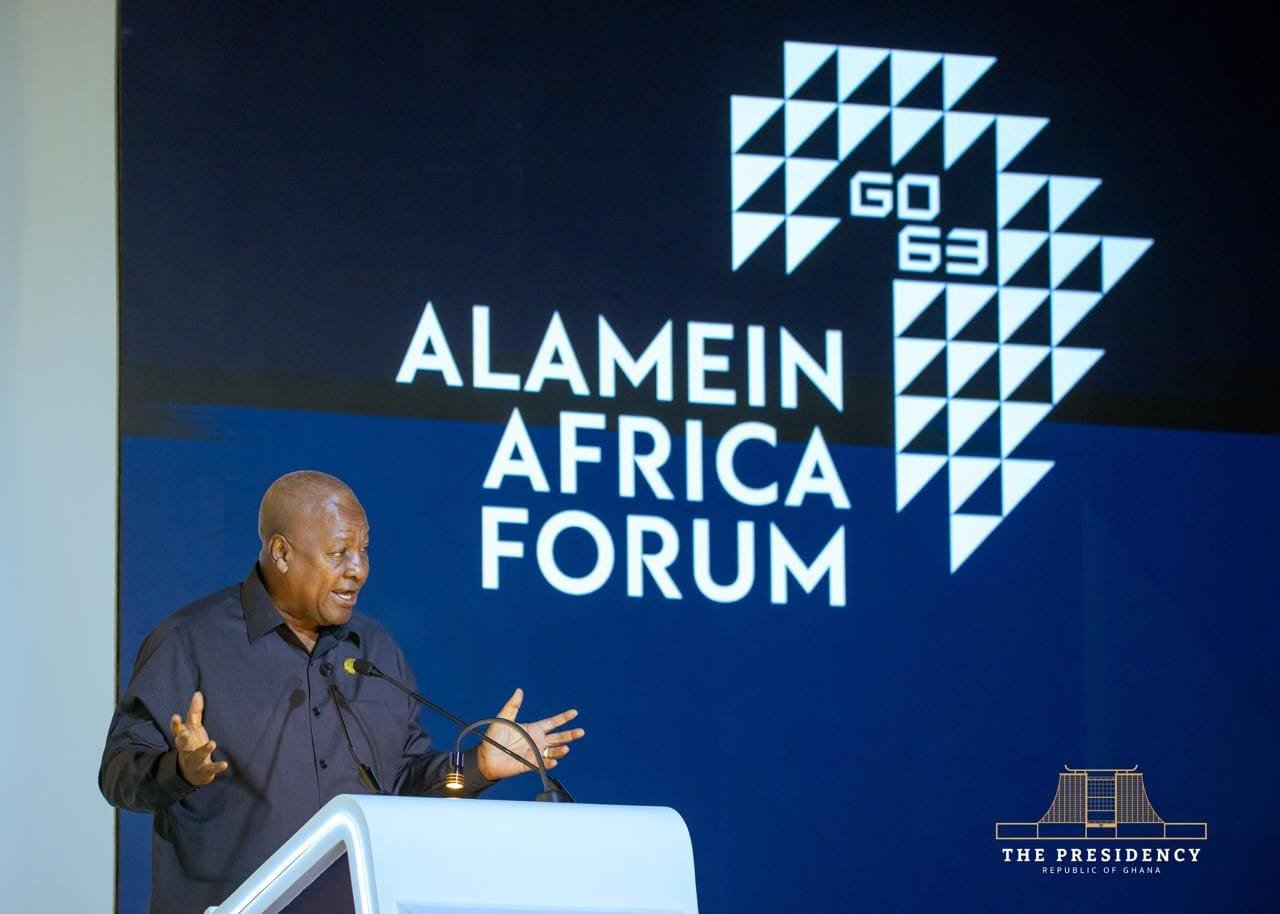
President John Dramani Mahama has urged African governments, investors and financial institutions to reposition the health sector as a major economic investment rather than treating it primarily as a social expense.
Speaking on Saturday at the Health Plenary of the Alamein Africa Forum in Egypt, President Mahama said investment in healthcare could stimulate manufacturing, create jobs, strengthen human capital and contribute to economic stability across the continent.
He made the remarks while delivering a keynote address on the theme, “Investing in Health: Manufacturing and Regional Value Chain.”

Mahama thanked Egyptian President Abdel Fattah el-Sisi for hosting the forum, noting that El Alamein, once associated with a major battlefield, now represents transformation and development.
“For decades, African Finance Ministers and global investors have made a fundamental error: they have treated health as a line-item cost — a social expenditure to be funded only when there is budget left over,” he said.
The Ghanaian President argued that the approach must change, stressing that healthcare has significant potential to generate economic returns.
“Health is not a charitable cause; it is an investable, high-growth economic sector. It drives human capital, manufacturing, job creation, and macroeconomic stability,” he stated.

Mahama referenced economic studies to underline the value of healthcare investment. He cited findings from the Copenhagen Consensus indicating that targeted basic emergency maternal and newborn care can generate substantial economic and social returns, while the Lancet Commission has linked reductions in mortality to significant income growth in developing economies.
He also highlighted Africa’s heavy dependence on imported medicines and vaccines. According to Mahama, the continent currently imports more than 70% of its pharmaceuticals and almost 99% of its vaccines, resulting in significant foreign-exchange outflows.
He warned that declining international health assistance could further expose African countries to vulnerabilities in their healthcare systems.

The President proposed greater investment in pharmaceutical and medical manufacturing based on four key areas: expanding the continent’s growing market, reducing dependence on imports, taking advantage of the African Continental Free Trade Area (AfCFTA), and strengthening pooled procurement.
He noted that Africa’s population is projected to reach 2.5 billion by 2050, creating a large and expanding market for medicines, vaccines and other health products.
On AfCFTA, Mahama said regional integration could allow pharmaceutical manufacturers to serve consumers across the continent rather than being restricted to individual national markets.

“Under the African Continental Free Trade Area, an African pharmaceutical plant does not serve a single country of 10 or 30 million people; it serves a single, unified market of 1.4 billion consumers,” he said.
He further pointed to pooled procurement as a way of reducing costs and creating stronger markets for African manufacturers. Mahama said the Africa CDC’s first pooled tender for maternal and child health products resulted in price reductions of between 30% and 90%, while African manufacturers secured half of the product lines.
“To bankers, institutional investors, and industrial leaders, African pharmaceuticals represent a high-yield, resilient sector ready for investment,” Mahama stated.

He also linked domestic production to health security, arguing that stronger local manufacturing would reduce Africa’s vulnerability during global health emergencies.
“African mothers and children will no longer wait at the end of the global queue for life-saving vaccines or therapies during crises, as seen in COVID-19 and recent Ebola outbreaks,” he said.
Mahama also drew attention to the continent’s employment challenge, particularly the contrast between shortages of healthcare professionals and the number of trained graduates without jobs.

He said Africa faces a shortage of about six million health workers, while nearly 943,000 trained healthcare professionals and science graduates were unemployed in 2024.
According to him, developing pharmaceutical manufacturing and related industries could create opportunities in research and development, clinical trials, engineering and biotechnology while helping African countries retain skilled workers.
He further argued that producing medicines locally could make healthcare more affordable by reducing transportation expenses and intermediary costs.

As an example, Mahama cited Egypt’s progress in tackling Hepatitis C, saying the country reduced prevalence from about 10% to below 0.5% through technology transfers, domestic production and large-scale local treatment.
He also mentioned Nigeria’s African Medical Centre of Excellence in Abuja, developed through a partnership involving Afreximbank and King’s College Hospital, as an example of efforts to strengthen specialised healthcare on the continent and reduce the financial impact of medical tourism.
Turning to Ghana, Mahama said the government was implementing the Accra Reset through measures including the expansion of the National Health Insurance Scheme, the introduction of Free Primary Health Care, the establishment of the Ghana Medical Trust Fund, and efforts to strengthen the Food and Drugs Authority and National Vaccine Institute.

He said these initiatives were intended to help Ghana move from being largely a consumer of health products to becoming a producer.
Mahama also announced the Health Investment and National Gateway Enabler (HINGE), a digital platform developed with the African Medicines Agency, Institut Pasteur and AfroChampions.
“HINGE is a digital platform that streamlines regulation, clinical validation, and commercialization into a unified process for innovators and investors,” he said.
He added that dedicated task forces and a Reform Interlock Observatory under the Accra Reset Presidential Council would monitor investment flows and address barriers affecting health-sector development.

The President stressed that governments alone could not finance the transformation of Africa’s health sector and called for greater participation from private investors, banks, industrial developers and sovereign wealth funds.
“Governments cannot and should not fund this transition alone. We need private capital, industrial developers, commercial banks, and sovereign funds to participate,” Mahama said.
He challenged financiers, regulators and industrialists to identify practical ways of increasing investment, improving drug approvals across African markets and expanding pharmaceutical manufacturing beyond packaging and fill-and-finish operations to the production of active pharmaceutical ingredients.

Concluding his address, Mahama called for a shift in how healthcare is viewed across Africa.
“Let us stop treating health as a line-item expense. Let us build factories, integrate supply chains, fund innovators, and secure our citizens’ future,” he said.
By: Prince Martey-Sogar.