

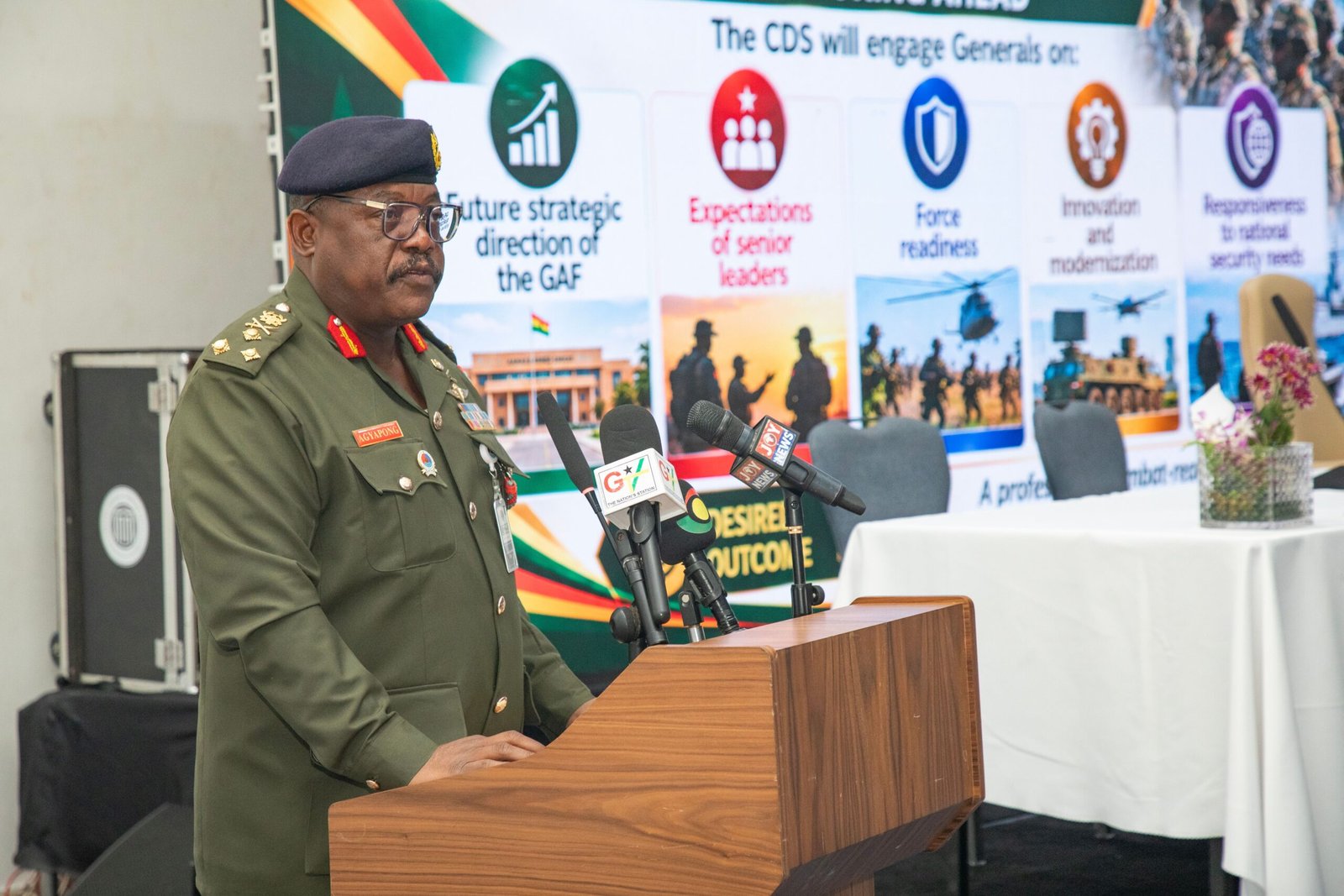
The Chief of the Defence Staff (CDS) of the Ghana Armed Forces, Lieutenant General William Agyapong, has urged senior military officers to anticipate emerging security threats and strengthen strategic leadership to ensure the country remains prepared for an increasingly complex security environment. Editorial Standards
He said the changing nature of security challenges in Ghana and the wider West African sub-region required military leaders to move beyond reacting to incidents and instead develop strategies capable of identifying and addressing threats before they escalate.
Lt. Gen. Agyapong made the call at the maiden Ghana Armed Forces Generals’ Convention in Accra, where senior military officers gathered to discuss leadership, institutional development and the future direction of the Armed Forces.
The convention, which began on Monday, September 28, and is scheduled to end on Wednesday, September 30, 2026, is being held under the theme, “Adaptive Leadership in a Complex Security Environment: The Role of Generals in Shaping Ghana’s Future.”
According to the CDS, the increasingly dynamic security environment requires the military to regularly review its strategies, policies and operational approaches to ensure they remain relevant to current and emerging challenges.

He explained that the convention was intended to provide senior officers with an opportunity to reflect on their experiences, exchange ideas and assess existing military practices rather than simply revisit procedures they already understood.
The discussions are expected to strengthen the capacity of military leadership to make informed decisions and respond effectively to changing national and regional security demands.
Military Leadership Must Look Beyond Immediate Threats
Lt. Gen. Agyapong’s call highlights the importance of forward planning in military operations, particularly as security threats become more complex and less predictable.
For military commanders, anticipating threats involves assessing intelligence, identifying potential vulnerabilities, evaluating changing circumstances and preparing appropriate responses before a crisis develops. Editorial Ethics & Independence
This approach is particularly relevant to West Africa, where security agencies continue to confront challenges involving violent extremism, terrorism and organised crime.

Ghana’s security planners must also consider emerging risks associated with cyberattacks, misinformation and other developments that could affect national stability.
The need for preparedness has also featured in recent discussions on Ghana’s national security strategy.
In September, the National Security Council Secretariat engaged stakeholders in the Volta and Oti regions as part of a review of the country’s 2020 National Security Strategy.
The consultations sought regional perspectives on evolving security threats and possible responses.
For the Armed Forces, regularly reviewing operational plans and strengthening cooperation with other security institutions can help ensure that responses remain appropriate as threats evolve.
Convention Focuses on Professionalism and Institutional Learning
The Generals’ Convention is addressing several issues relevant to military administration and professional development.
These include intelligence management and the handling of classified information, the military justice system, retirement procedures, ethical leadership, command experiences and contemporary military administration.
Such discussions provide an opportunity for senior officers to examine existing practices, share lessons from their professional experiences and consider how institutional procedures can be improved. Corrections Policy
Intelligence management is particularly important because military decisions often depend on the timely collection, assessment and secure sharing of information.

Effective handling of classified information also helps protect operational plans and sensitive national security details.
The convention is therefore intended to encourage a culture of continuous learning and strengthen the ability of senior officers to make decisions in situations that may require rapid assessment and coordinated action.
Discipline, Integrity and Accountability
Beyond operational readiness, Lt. Gen. Agyapong urged the generals to uphold the professional values of duty, honour, integrity, discipline and selfless service.

These values, he indicated, should guide the conduct of officers entrusted with leadership responsibilities within the Ghana Armed Forces.
Military leadership requires more than the authority to issue commands.
It also involves accountability, sound judgement and the ability to maintain the confidence of personnel under one’s command.
Ethical leadership is especially important when officers make decisions involving personnel welfare, the use of resources and the execution of military responsibilities. Privacy Policy & Terms
By emphasising professional values alongside strategic planning, the CDS highlighted the relationship between effective leadership and the Armed Forces’ ability to fulfil its national responsibilities.
Call for a Regular Leadership Forum
Lt. Gen. Agyapong expressed the hope that the Generals’ Convention would become a regular feature of the Ghana Armed Forces’ professional development calendar, taking place every two years.
A recurring forum could provide senior officers with opportunities to review lessons from previous engagements, assess institutional progress and discuss new developments affecting military operations.
It could also support continuity in leadership development by creating a structured platform for sharing experiences across different commands and areas of responsibility.

The convention comes as Ghana continues to assess its security priorities and strengthen coordination among institutions responsible for protecting the country. Newscard
Ultimately, the CDS’s message centres on the need for the Armed Forces to remain adaptable, professionally disciplined and prepared for threats that may emerge with little warning.
Through strategic reflection, effective intelligence management and continuous leadership development, the military aims to maintain its readiness to respond to changing security demands while fulfilling its responsibility to protect Ghana’s sovereignty and territorial integrity.