

The World Health Organisation (WHO) estimates that 62 million tonnes of electronic waste are discarded every year, with less than a quarter recycled through appropriate or formal means.
A 2024 study by the United Nations Institute for Training and Research (UNITAR) also found that 77.7 per cent of global e-waste is not formally collected or recycled, raising serious concerns about environmental pollution and public health.
In Ghana, these concerns are particularly visible at Agbogbloshie, a major electronic waste hub on the banks of the Korle Lagoon, less than a kilometre from Accra’s Central Business District. Editorial Ethics & Independence

For decades, the area has attracted attention from researchers, environmental organisations and the media because of the pollution associated with informal electronic waste processing.
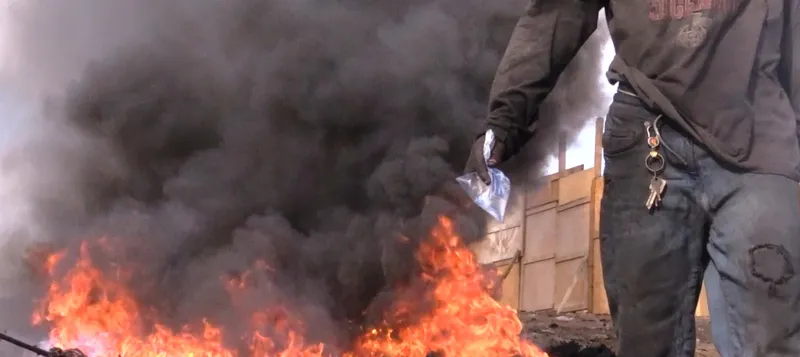
Discarded phones, laptops, refrigerators and vehicle components arrive at the site, where scrap dealers search for valuable materials. One of the most sought-after metals is copper, which can be recovered from electrical cables.
However, the practice of burning cable insulation to extract copper releases harmful pollutants into the atmosphere.
The documentary Toxic Smoke, Fragile Lives, produced by 3News and scheduled to premiere on TV3 Ghana on Sunday, October 4, 2026, at 5:30 p.m., examines the impact of this practice on workers and surrounding communities, including Agbogbloshie, Old Fadama and Abbosey Okai.

Air pollution in the area is not caused by e-waste burning alone. Emissions from idling trucks, general waste, and household and commercial cooking using solid fuels also contribute to poor air quality.
However, findings presented in the documentary indicate that fine particulate pollution remains a persistent concern.
Economic Survival Behind the Smoke
For many scrap dealers and cable burners, the work provides an essential source of income despite the health risks.
Some workers migrated from northern Ghana to Accra in search of better economic opportunities but eventually entered the informal scrap business.
Ibrahim, a scrap dealer and former electrician from Tamale, said poor payment for electrical work influenced his decision to move to the capital.

He explained that copper cables can generate between GH¢300 and GH¢400, while other metals may yield less than GH¢10 after processing.
The difference in earnings makes copper particularly attractive to workers operating with limited resources. Editorial Standards
Another scrap dealer, Issah Kwaku, described the business as profitable but risky.
He recalled that some cables were previously sold to a company that used formal extraction methods before exporting recovered copper to markets including China, the United Arab Emirates, India and Russia.
The cable burners, commonly known as the “Burner Boys”, occupy a crucial position in this informal supply chain.
They burn stripped cables, recover the copper and return it to scrap dealers for payment.
Rahim, a 39-year-old burner who said he had worked in the trade for more than 20 years, acknowledged the dangers but explained that many workers have few alternative ways to support their families. Corrections Policy
He said they were exploring alternative methods of burning cables to reduce pollution.
However, simply directing smoke upwards would not necessarily remove the harmful substances released during the process.
Mohammed Sofo, another burner, said doctors had warned him about the effects of smoke exposure, including coughing, chest pain and potential heart problems.
Fine Particles Pose Serious Health Risks
One of the major concerns is fine particulate matter known as PM2.5. These particles are small enough to penetrate deep into the lungs, making prolonged exposure a significant public health concern.
According to Patrick Attey-Yeboah, data manager for the Breathe Accra project, monitoring results have repeatedly identified Agbogbloshie as one of the most polluted areas covered by the project.
He said measurements recorded in 2024 and 2025 frequently exceeded the WHO’s daily guideline of 15 micrograms per cubic metre, with annual averages also surpassing relevant WHO and Ghana Environmental Protection Authority standards.
Attey-Yeboah identified e-waste burning as a major contributor, alongside emissions from trucks and solid-fuel cooking.

He called for active policies to address the continuing pollution.
Florence Kuukyi, Director of Public Health at the Accra Metropolitan Assembly, said air pollution was a growing concern, particularly because of its links to respiratory and cardiovascular health risks.
She identified older people, children under five and pregnant women as especially vulnerable.
According to her, public health officers have been engaging transport operators, market women and e-waste associations to explain the dangers and encourage safer practices. Corrections Policy
Kuukyi added that the Assembly was combining public education with enforcement, including arrests and penalties for people caught burning waste.
Enforcement and Safer Recycling
The Environmental Protection Authority is also pursuing measures to reduce open cable burning.
Larry Kotoe, its Director of Sustainability and Circular Economy, said a collection centre was purchasing cables from informal operators, allowing materials to be accumulated for safer processing.
Although the initiative has reduced some burning, Kotoe acknowledged that the practice continues.
He warned companies against purchasing materials from sources that rely on illegal cable burning and said enforcement measures were being pursued.

He also highlighted the importance of controlling cross-border e-waste shipments in line with the Basel Convention and applicable procedures.
The WHO estimates that outdoor and household air pollution is associated with approximately seven million deaths worldwide each year, including nearly one million in Africa. Newscard
Agbogbloshie illustrates the difficult balance between economic survival and public health.
Thousands depend on informal recycling for their livelihoods, yet continued exposure to polluted air threatens workers and neighbouring communities.
Addressing the problem will require accessible formal recycling facilities, effective enforcement, public education and viable alternative livelihoods for those who depend on cable burning.
The challenge is not simply to stop a dangerous practice but to ensure that safer ways of recovering valuable materials are economically accessible.
Without sustained action, the environmental and health costs of electronic waste will continue to fall on the people least equipped to bear them.