


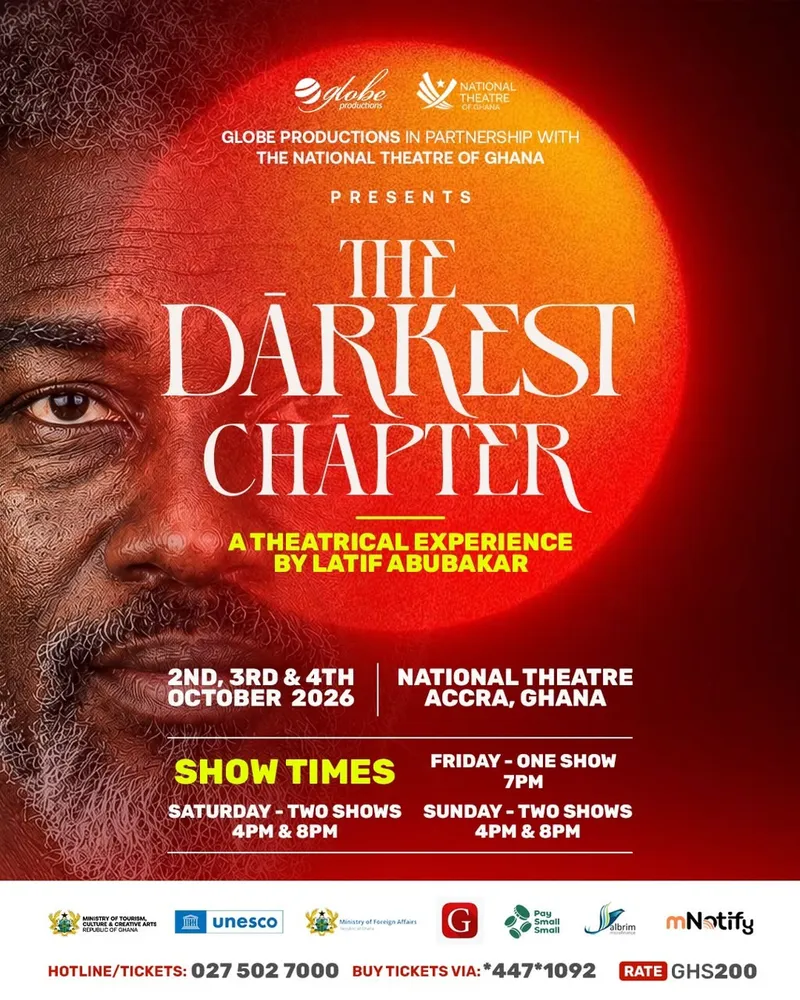
Award-winning Ghanaian playwright and producer Latif Abubakar is set to bring one of the most significant moments in Ghana’s recent international diplomacy to the stage with his 21st theatrical production, The Darkest Chapter. Newscard
The production, by Globe Productions in partnership with the National Theatre, UNESCO, the Ministry of Tourism, Culture and Creative Arts, and the Ministry of Foreign Affairs, is being presented as a major musical dance-theatre production exploring slavery, memory, identity, justice and the unfinished consequences of the transatlantic slave trade.
The production draws inspiration from President John Dramani Mahama’s intervention at the United Nations and Ghana’s subsequent leadership in securing a historic General Assembly resolution on the trafficking of enslaved Africans and racialised chattel enslavement.
On March 25, 2026, the UN General Assembly adopted Resolution A/RES/80/250, declaring the trafficking of enslaved Africans and racialised chattel enslavement of Africans the “gravest crime against humanity.” The resolution was spearheaded by Ghana, with support from the African Union and partners across Africa and the Caribbean. It passed with 123 votes in favour, three against and 52 abstentions.
It is this historic diplomatic development that provides the central inspiration for The Darkest Chapter, transforming an international political and historical conversation into a theatrical experience.
A thousand lives, one witness
At the centre of the production is a fictional figure known as “The Witness”, an immortal narrator who is portrayed as having lived through a thousand lives across four centuries.
Through his character, audiences encounter different periods of the history of enslavement. He appears as a child of the Gold Coast, a man forced into bondage aboard the Middle Passage, a field worker on a Caribbean plantation and a witness to generations of resistance and liberation.
The character eventually moves into the contemporary world, appearing unseen within the halls of the United Nations as history arrives at a moment of formal international recognition.
Through The Witness, the production seeks to connect individual experiences of suffering and survival with the larger historical forces that shaped Africa, the Caribbean and the wider world.
The story is structured around three interconnected worlds: the shores and dungeons of Cape Coast and Elmina, a modern United Nations General Assembly chamber and a timeless spiritual realm accessible through drumming and movement.

The theatrical language combines West African, contemporary and Caribbean dance traditions with live African percussion, orchestral strings and a gospel-highlife choir. Corrections Policy
Latif Abubakar described the production as an ambitious sensory experience designed to connect Ghana’s history with a global audience.
“It is by every measure, a sensory masterpiece; immersive, cinematic, and unapologetically global in its ambition,” he said.
He explained that the intention was not simply to reproduce historical events but to make audiences experience the emotional and human consequences of the history being presented.
“We are not asking audiences to relive four hundred years of pain. We are asking them to walk through it. This is not a re-enactment. It is an inheritance,” the playwright added.
From UN resolution to theatrical conversation
The production comes at a time when Ghana’s role in advancing the global reparatory justice conversation has received renewed international attention.
The UN resolution followed months of diplomatic consultations and consensus-building led by Ghana in its capacity as the African Union Champion for Justice and the Payment of Reparations. The United Nations has said the resolution highlights the scale, duration, systemic nature, brutality and enduring consequences of the trafficking and enslavement of Africans.
While UN General Assembly resolutions are not legally binding, the March 2026 resolution represents a significant political and historical statement by the international body and has provided a new platform for discussions around remembrance, reconciliation and reparatory justice.
The Darkest Chapter seeks to extend that conversation beyond diplomatic chambers and into the performing arts. Editorial Standards
Latif Abubakar’s 21st production
The production also marks the 21st theatrical work of Latif Abubakar, whose career has increasingly focused on using theatre as a platform for public education and social dialogue.
Through his productions, the award-winning playwright has explored health, social issues and contemporary challenges while promoting the concept of Theatre for Development, in which drama serves purposes beyond entertainment.
The Darkest Chapter continues that tradition by bringing history, diplomacy and creative expression together in a single production.
For the playwright, the subject also carries a particular significance because it connects Ghana’s historical experience with the country’s contemporary role in international discussions about slavery and reparatory justice.
When and where to watch The Darkest Chapter
The Darkest Chapter will headline the 2026 Ghana Theatre Festival at the National Theatre in Accra.
The production is scheduled for three days, with performances on Friday, October 2, at 7:00 p.m., followed by shows on Saturday, October 3, and Sunday, October 4, at 4:00 p.m. and 8:00 p.m. The 2026 Ghana Theatre Festival runs from September 29 to October 4.
Tickets are priced at GH¢200 and are available through 4471092# and the Globe Productions website.
With its combination of theatre, music, dance and historical storytelling, the production aims to make the UN resolution and the wider reparatory justice conversation accessible to audiences beyond political and diplomatic circles.
Rather than presenting the history of slavery solely as a chapter in the past, The Darkest Chapter places its consequences within a contemporary conversation about memory, dignity, identity and justice. Editorial Ethics & Independence
For three nights in October, the National Theatre will therefore become a meeting point between Ghana’s past and its present international role, inviting audiences to confront a history that continues to influence societies across Africa and the African diaspora.