


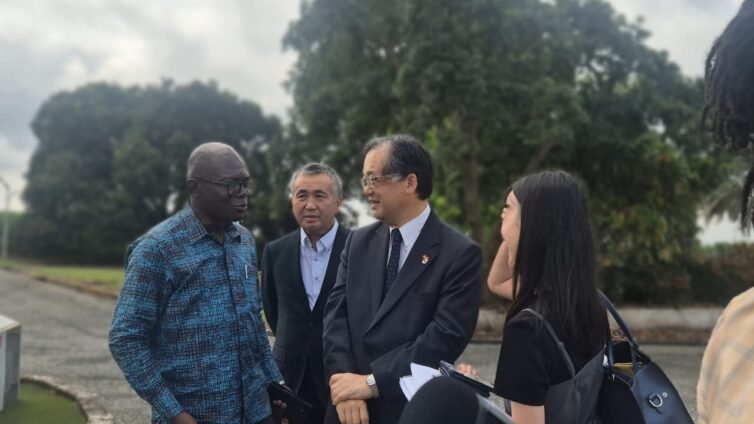
Ghana is positioning itself to play a more active role in the global space economy, with authorities exploring opportunities to move beyond consuming space technologies to developing expertise and contributing to the sector.
The ambition was highlighted during a visit by veteran Japanese astronaut Koichi Wakata, Astronaut and Chief Technology Officer for Asia Pacific at Axiom Space, to the Ghana Space Science and Technology Institute.

According to Dr Tandoh, Ghana already has a Cabinet-approved space policy, while approval was also given last year for the establishment of the Ghana Space Agency.
“We have a policy, and we need to start implementing it. We don’t want to be consumers; we want to partake, and we want to position ourselves in a way that we will contribute to the space economy,” he said.
He acknowledged that Ghana’s space programme remains at an early stage but said sustained investment and commitment could eventually pave the way for the country to produce its own astronaut.
“Currently, we are in the baby stages, but if we are able to put in the right tools and the right commitment, we will be able, in the next few years, also to produce our own astronaut who can go to space,” he said.
Learning from an astronaut
Wakata’s visit also created an opportunity for Ghanaian researchers and students to interact with an astronaut with extensive experience in human spaceflight.
Prof Felix Akomah Asante, a professor at the University of Ghana and Principal Investigator of the Japan Centre Project, said Wakata was invited as the project’s scholar for the year.
He explained that the visit was aimed at exposing the astronaut to Ghana’s aerospace activities while facilitating knowledge-sharing with researchers and students.
Wakata has travelled to space several times and currently works with Axiom Space on the development of commercial space activities.
For students, the engagement provided an opportunity to gain first-hand insights into space exploration beyond what they encounter in textbooks and classrooms.
One student described meeting the astronaut as a significant experience that could inspire greater interest in astronomy and space science.
“Ever since I was in basic school, it’s always been about scientific facts about astronomy, and you never get to experience it, but meeting an astronaut today will definitely help me make an impact,” the student said.
Wakata backs Ghanaian participation
Wakata expressed support for greater Ghanaian participation in space-related activities and said he hoped to see the country develop its capacity to take advantage of opportunities in the sector.
“I would really like to see more people in Ghana who will utilise the space environment,” he said.
He also expressed hope that a Ghanaian astronaut could eventually join a space mission.
“I’m also looking forward to seeing a Ghanaian astronaut flying with us to the International Space Station at Axiom Space Station, and Ghana has huge potential in space exploration,” Wakata said.
Wakata has more than three decades of experience in human space activities. He has flown on four types of spacecraft, including the Space Shuttle, Soyuz and Crew Dragon, and became the first Japanese astronaut to command the International Space Station in 2014.
His visit comes as Ghana seeks to strengthen its capabilities in space science and technology and explore ways the sector can contribute to national development.
For Ghana, the ambition is gradually shifting from simply using space technologies developed elsewhere to building the expertise needed to participate more meaningfully in the global space economy.
By:Rachael Djabakie