

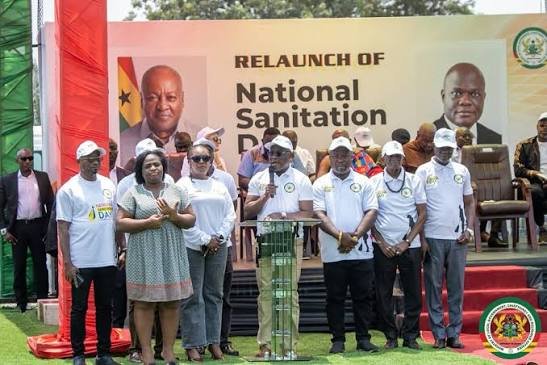
The Government of Ghana is preparing to launch a nationwide “war against indiscipline” aimed at improving sanitation and waste management, with the Minister for Local Government, Chieftaincy and Religious Affairs, Mahama Ayariga, warning that poor waste practices and civic indiscipline continue to undermine efforts to keep communities clean.
The Government of Ghana has announced plans to launch a nationwide campaign against indiscipline as part of efforts to address persistent sanitation and waste-management challenges across the country.
The Minister for Local Government, Chieftaincy and Religious Affairs, Mahama Ayariga, announced the initiative after an early-morning assessment of waste-management activities in Accra.
The Minister said the exercise exposed significant gaps in the collection, transportation and treatment of waste, suggesting that improvements in sanitation would require more than investment in infrastructure.
According to the Minister, the planned campaign will focus on changing public behaviour and strengthening citizens’ responsibility towards sanitation.
The government intends to address practices that contribute to poor sanitation, including improper disposal of waste and failure to comply with statutory payments to Metropolitan, Municipal and District Assemblies.
Mr Ayariga said the campaign would therefore combine infrastructure and financing with efforts to address what he described as behavioural and civic indiscipline.
The announcement comes amid continuing concerns about waste management in Ghana’s urban communities.
Rapid population growth and increased commercial activity have created greater demand for waste collection and disposal services.

When waste is not collected promptly or is disposed of improperly, it can accumulate in public spaces, drains and other areas.
The consequences can include blocked drainage systems, unpleasant surroundings and increased environmental and public-health risks.
Government’s proposed campaign is expected to focus on both citizens and institutions.
Local authorities will have an important role because Metropolitan, Municipal and District Assemblies are responsible for several aspects of sanitation management within their jurisdictions.
The assemblies also rely on statutory payments and other local revenues to provide services.
The Minister therefore emphasized the importance of citizens meeting their financial obligations to local authorities.
The government believes that improved revenue collection could help assemblies strengthen waste-management systems and other municipal services.
However, public education will also be an important part of the campaign.
Residents need to understand the consequences of improper waste disposal and the importance of maintaining clean surroundings.
Schools, religious institutions, traditional authorities and community organizations could play important roles in promoting responsible sanitation practices.
The campaign could also involve stronger enforcement of existing sanitation regulations.
Where laws already exist, authorities may need to ensure that they are consistently enforced.
At the same time, enforcement needs to be supported by adequate waste-collection infrastructure.
Residents are more likely to comply with sanitation rules when reliable systems exist for disposing of household and commercial waste.
The government therefore faces the challenge of improving both public behaviour and the systems that support responsible waste management.
The Minister’s early-morning assessment provided an opportunity to observe waste-management operations directly.
Such assessments can help government identify gaps in the collection and transportation process.
Waste must be collected from communities, transported safely and eventually treated or disposed of at appropriate facilities.
A breakdown at any point in this chain can affect the entire sanitation system.
The planned campaign therefore represents an attempt to address sanitation as a coordinated national issue rather than an isolated local-government problem.
Poor sanitation can affect tourism, business activity and the general appearance of cities.
It can also contribute to environmental problems when waste enters waterways or is burned improperly.
For Ghana’s major cities, maintaining clean public spaces is increasingly important as urban populations continue to grow.
The government is expected to work with local assemblies and other institutions as the campaign is rolled out.

Public participation will also be essential.
Residents, businesses and community leaders will need to cooperate with waste-management systems and comply with relevant regulations.
Businesses that generate large quantities of waste may also be required to adopt appropriate disposal arrangements.
The campaign could therefore lead to increased attention on commercial waste management as well as household waste.
Government’s emphasis on civic responsibility suggests that the initiative will seek to make sanitation a shared national responsibility.
The Minister’s announcement also reflects the government’s view that sanitation cannot be solved solely through spending on equipment and infrastructure.
Behavioural change is required if improvements are to be sustained.
The success of the campaign will therefore depend on whether citizens change practices and whether local authorities are able to provide reliable services.
Authorities will also need to communicate clearly about the rules and responsibilities expected from residents.
The nationwide campaign is expected to form part of broader government efforts to improve environmental management and public services.
As the initiative takes shape, attention will turn to its implementation and the measures that will be used to assess progress.
For now, government has identified civic indiscipline and weaknesses in waste-management systems as key challenges that must be addressed.
The proposed “war against indiscipline” is therefore expected to combine public education, improved sanitation services and stronger enforcement as Ghana seeks a more sustainable approach to waste management.
By: Oppong Frimpong Richard