

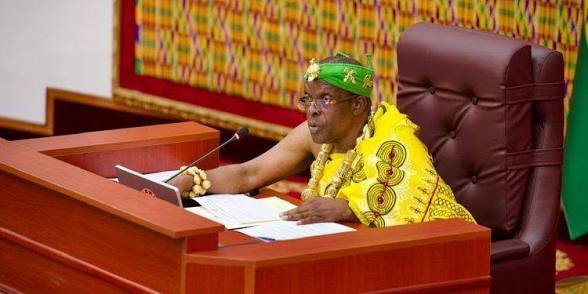
Speaker of Parliament Alban Kingsford Bagbin has ruled that President John Dramani Mahama’s communication nominating Builsa North MP James Agalga as Acting Majority Leader was procedurally incorrect, saying the President does not have the authority to appoint a parliamentary Majority Leader. The Speaker said such a change must be communicated to Parliament by the relevant political party.

A procedural disagreement has emerged in Ghana’s Parliament after Speaker Alban Kingsford Bagbin ruled that President John Dramani Mahama could not directly appoint a Majority Leader for the House.
The Speaker’s ruling concerns President Mahama’s communication nominating James Agalga, Member of Parliament for Builsa North, as Acting Majority Leader.
Speaker Bagbin said the communication was procedurally incorrect because the President does not possess the constitutional or parliamentary authority to appoint the Majority Leader.
According to the Speaker, the position of Majority Leader is determined by the parliamentary group of the political party that has the majority of seats in Parliament.
Any change to the position must therefore be communicated to the Speaker by the relevant parliamentary group or political party.
The ruling has brought renewed attention to the separation between the executive and legislative arms of government.
Under Ghana’s constitutional system, Parliament operates as an independent arm of government responsible for making laws, scrutinising government activities and representing citizens.
The executive branch, led by the President, is responsible for implementing government policies and administering the country.
Although the President may appoint ministers and other officials according to constitutional procedures, parliamentary leadership positions are governed by parliamentary rules and the internal decisions of the political parties represented in Parliament.
The Speaker’s ruling therefore emphasizes the distinction between government appointments and parliamentary positions.
The Majority Leader is a key parliamentary figure responsible for coordinating the business of the governing party’s side of the House.
The position is important because Parliament’s work involves scheduling debates, coordinating legislative business and facilitating communication between the Majority side and other parliamentary actors.

A change in parliamentary leadership can therefore affect the organisation of legislative business.
James Agalga is an experienced legislator and has served in government previously. His proposed role as Acting Majority Leader generated attention because of the importance of the position within Parliament.
However, the Speaker’s ruling means that the formal procedure for recognizing the change must be followed.
The development also demonstrates the importance of parliamentary procedure in maintaining the independence of the legislature.
Parliamentary rules exist to ensure that decisions are made through recognised processes rather than through informal arrangements.
Speaker Bagbin’s position is that the political party holding the majority in Parliament must formally communicate its choice of parliamentary leader.
The decision places responsibility on the relevant parliamentary group to follow the established process.
The ruling is also important because parliamentary leadership can affect the relationship between the executive and legislature.
While the government requires parliamentary support to pass legislation and implement aspects of its policy agenda, Parliament is constitutionally expected to exercise oversight over the executive.
Maintaining clear boundaries between the two institutions is therefore important for democratic governance.
The disagreement comes as Parliament resumes its activities following a recall.
Lawmakers are expected to address several legislative and national issues during the current period, making parliamentary leadership particularly important.

The Majority and Minority sides must coordinate their activities to ensure that legislative business proceeds effectively.
The Speaker’s ruling provides clarification on how changes to parliamentary leadership should be formally communicated.
It also reinforces the role of political parties in determining their parliamentary leadership.
Political parties are responsible for organising their members within Parliament and selecting individuals to occupy leadership positions on their respective sides.
The governing party’s parliamentary group therefore has a central role in determining who leads its side of the House.
The Speaker’s position does not necessarily prevent James Agalga from performing a leadership role in the future. Instead, it establishes that the appropriate parliamentary procedure must be followed.
The governing party can communicate its decision formally to the Speaker, after which Parliament can recognize the change according to its rules.
The development has generated political discussion because of the constitutional and institutional questions involved.
Some observers view the ruling as an important reminder that parliamentary institutions must operate independently from the executive.
Others may focus on the political implications of changes in parliamentary leadership and how they could affect the government’s legislative agenda.
For members of the public, the dispute highlights the importance of understanding the roles of different branches of government.
The President, Parliament and judiciary each have distinct constitutional responsibilities.
Respect for these institutional boundaries is considered essential to maintaining democratic stability.
Speaker Bagbin has therefore used the ruling to clarify the parliamentary procedure governing the appointment or replacement of a Majority Leader.
The matter is expected to remain relevant as the governing party communicates its decision and Parliament continues its legislative work.
The situation demonstrates that even changes involving senior parliamentary figures must follow established constitutional and procedural requirements.
As Parliament continues its work, attention will remain on how the governing party formally communicates its preferred Majority Leader and how the House subsequently recognizes that decision.
The episode has once again placed parliamentary independence and constitutional procedure at the centre of Ghana’s political discussion.
BY: Oppong Frimpong Richard