

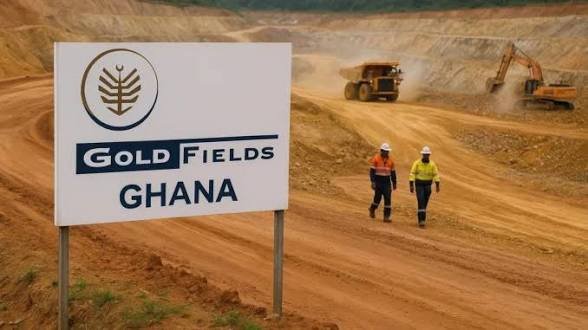
Gold Fields has raised concerns over uncertainty surrounding the renewal of its mining leases for the Tarkwa mine in Ghana, even as the South African mining company reported an 81 per cent increase in first-half profit. The company’s leases are due to expire in April 2027, and the company says an early resolution is important to protect investment and shareholder value.

Gold Fields has reported strong financial performance for the first half of 2026 but warned investors about uncertainty surrounding the renewal of its mining leases for the Tarkwa mine in Ghana.
The South African mining company reported an 81 per cent increase in half-year profit, supported by higher gold prices and increased production.
Gold Fields produced 1.267 million ounces of gold during the first half of 2026, representing a 12 per cent increase in output compared with the corresponding period.
Despite the strong financial results, the company faces uncertainty over the future of its Tarkwa operation because its current mining leases are scheduled to expire in April 2027.
Gold Fields submitted an application for renewal of the leases in November 2025 but says it has not yet received a formal response.
The uncertainty has attracted attention from investors because Tarkwa is one of Gold Fields’ major producing assets.
The mine produced approximately 192,000 ounces of gold during the first half of the year, accounting for about 15 per cent of Gold Fields’ total group production during the period.
The company therefore considers the renewal of the leases important to the continued operation of the mine and the protection of shareholder value.
Gold Fields Chief Executive Officer Mike Fraser said the company needed an early resolution to the issue.

The company has indicated that it could consider legal avenues to protect its interests if the matter is not resolved.
The situation comes as Ghana continues to benefit from high international gold prices and seeks to maximize the economic value of its mineral resources.
Gold remains one of Ghana’s most important export commodities and provides significant government revenue through taxes, royalties and other payments.
Large-scale mining operations also provide employment and support economic activity in mining communities.
Tarkwa, in the Western Region, is one of Ghana’s major gold-producing areas.
The continued operation of large mines therefore has implications not only for mining companies but also for workers, contractors, local businesses and government revenue.
Gold Fields has maintained its full-year production guidance of between 2.4 million and 2.6 million ounces despite the uncertainty surrounding the Ghanaian leases.
The company says its strong first-half performance was supported by higher gold prices and increased production.
It also announced a significant increase in its interim dividend, which rose by 132 per cent to 16.25 rand per share.
The financial results demonstrate the favourable conditions currently supporting the global gold-mining industry.
However, the uncertainty over Tarkwa highlights the importance of regulatory stability for mining investors.
Mining companies typically make long-term investments in equipment, infrastructure and processing facilities. Such investments require confidence that companies will be able to operate for sufficiently long periods to recover their costs and generate returns.
Governments, on the other hand, have the responsibility to ensure that mineral resources are managed in accordance with national laws and that mining companies comply with the conditions attached to their leases.
The disagreement therefore involves both investment considerations and Ghana’s regulatory responsibilities.
Ghanaian authorities have denied that they are deliberately delaying Gold Fields’ lease renewal.
According to the company, Ghanaian authorities have indicated that Gold Fields must first submit updated development plans.
The issue is therefore not simply a question of whether the leases will be renewed but also whether the company has satisfied the requirements associated with the renewal process.
The discussions could have important consequences for the future of the Tarkwa mine.
If the renewal is completed in time, Gold Fields can continue planning long-term operations and investments.

If uncertainty persists, the company may face difficulties making some investment decisions.
The issue also demonstrates the importance of communication between governments and mining companies.
Clear timelines and regulatory requirements can help investors plan their operations while allowing governments to enforce national laws.
For Ghana, the Tarkwa mine remains an important economic asset.
The mine contributes to gold production, employment and economic activity in the Western Region.
Local communities depend on mining-related businesses, while the national economy benefits from foreign exchange and government revenue generated by the industry.
The future of the mine will therefore be watched closely by several stakeholders.
Investors will monitor developments regarding the lease renewal, while workers and communities will be interested in the potential impact on employment and local economic activity.
Government authorities will also need to balance the country’s interest in attracting investment with the responsibility to ensure that mining companies comply with applicable regulations.
Gold Fields has maintained that an early resolution is necessary.
The company has also indicated that it will consider appropriate legal options if necessary to protect its interests.
For now, the mine continues to operate and Gold Fields has maintained its production guidance for the year.
The company’s strong financial performance provides a positive backdrop, but the lease issue remains a significant uncertainty for its Ghana operations.
As April 2027 approaches, attention is expected to intensify on negotiations between Gold Fields and Ghanaian authorities.
The outcome will have implications for the company, its employees, mining communities in the Western Region and Ghana’s wider gold industry.
By: Oppong Frimpong Richard